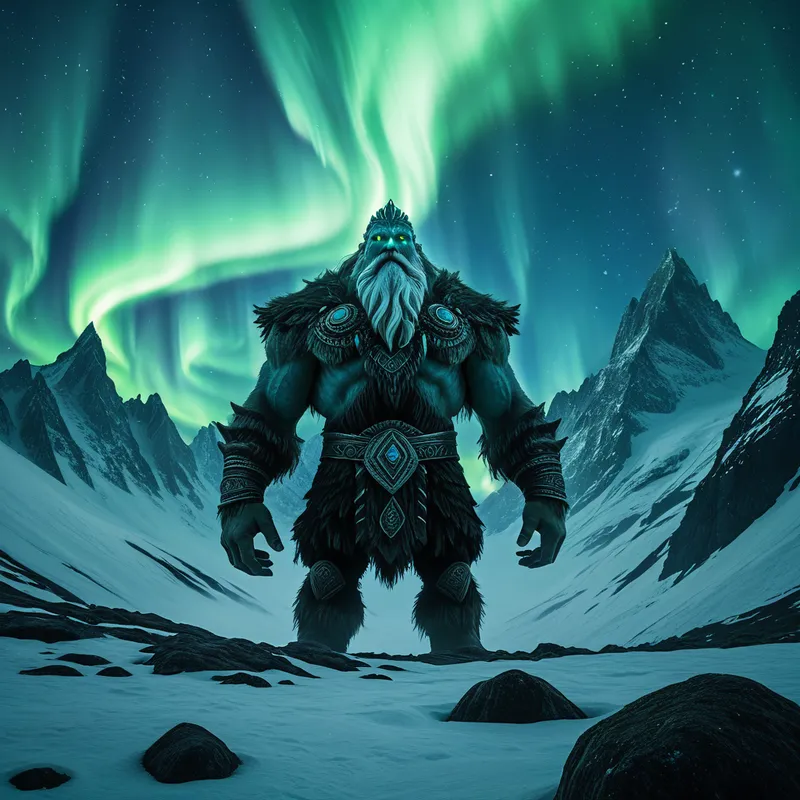
Jotunn Myth Meaning & Symbolism
The Jotunn are the ancient, chaotic giants of Norse myth, representing the raw, untamed forces of nature and the unconscious that the gods must confront and integrate.
The Tale of Jotunn
Listen, and hear the tale of the First Things, the time before time, when the world was not a world but a yawning gap. In the great nothing of Ginnungagap, fire met ice. From that meeting, from the dripping rime and the sparking ember, life stirred. Not the life of green things, but a slow, vast, dreaming life. This was Ymir, the first of the Jotunn.
Ymir slept, and from the sweat of his sleeping body, more giants were born. The frost melted, and from the drops there came a cow, Audhumla. She licked the salty ice-blocks, and with each lick, a shape emerged: hair, a head, a whole body. This was Buri. So the two lineages began in the mist: the Jotunn, chaotic and elemental, and the gods, who would become the Æsir.
But the gap was too small for such vast beings. The sons of Buri—Odin and his brothers Vili and Ve—looked upon the sprawling, snoring form of Ymir and saw not a grandfather, but a prison. With a resolve as hard as the ice from which they came, they fell upon him. The battle was not of swords, but of creation itself. From Ymir’s fallen body, they fashioned the world: his flesh became the earth, his blood the seas, his bones the mountains, his skull the sky. They took the sparks from Muspelheim and set them in that skull to be stars. They built a fortress from his eyebrows, Midgard, to keep humanity safe.
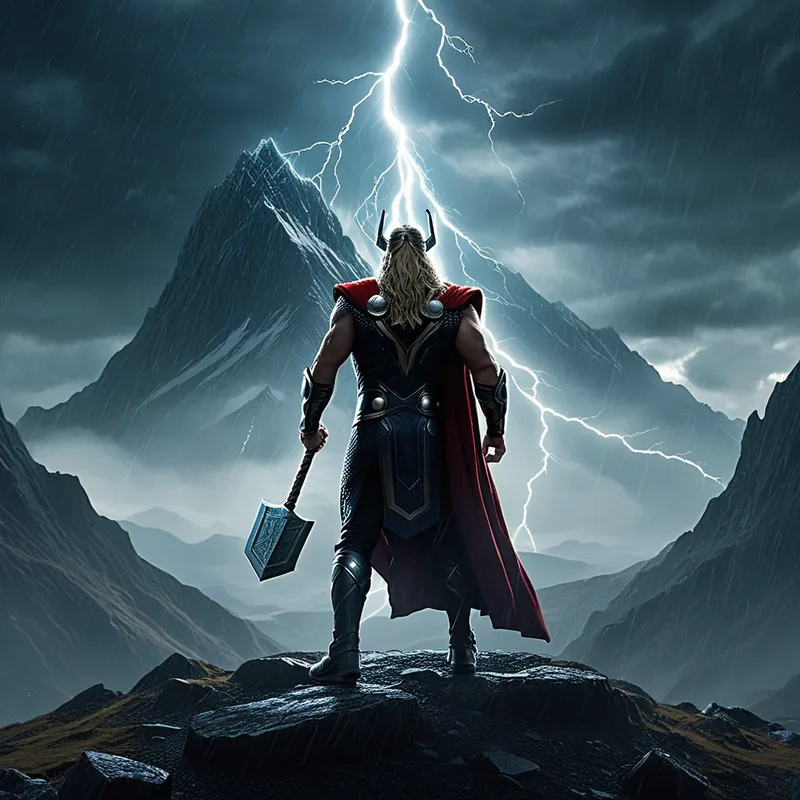
Yet the Jotunn were not gone. They were the world. They were the earthquake that shakes the roots of Yggdrasil, the winter that bites with iron teeth, the tidal wave that knows no master. They dwell in Jotunheimr, a realm of crushing peaks and eternal twilight, always watching, always hungering. The gods, in their shining hall of Asgard, are forever on guard. Thor, the thunderer, rides out in his goat-drawn chariot not for glory, but for survival. His hammer Mjolnir is the wall against the rising tide of chaos. He battles the world-serpent Jormungandr, he outwits the mountain-giant Hrungnir, he faces illusions so vast they make the mountains themselves seem to stir and speak.
For every wall the gods build—the great wall of Asgard, the laws of runes, the order of the cosmos—the Jotunn whisper of the time before walls. They are the memory of the gap, the reminder that all that is built rests upon a foundation of a slain giant, and that foundation can dream, and it can remember.
Cultural Origins & Context
These stories were not mere entertainment for the Norse peoples of the Viking Age. They were the sacred narrative framework through which a harsh, magnificent, and perilous world was understood. The myths were preserved and transmitted orally by skalds—poet-historians who served as the living memory of their people. Their recitations, often in complex metrical forms like fornyrðislag or dróttkvætt, were performances of power, memory, and identity, typically heard in the fire-lit halls of chieftains.
The societal function of the Jotunn myths was multifaceted. On one level, they explained the natural world: the terrifying, impersonal forces of blizzards, avalanches, and storms were given a face and a name—Þjazi, Hrímnir. They personified the existential threats to a community living on the edge of the known world. But more profoundly, the Jotunn represented the "Other"—the chaotic wilderness beyond the fence of the farmstead (garðr), the lawless sea beyond the fjord, and the unknown peoples beyond the horizon. The gods' constant struggle to keep the Jotunn at bay mirrored the human struggle to impose ørlög (cosmic law) and social order onto a reality that was fundamentally wild and unpredictable.
Symbolic Architecture
Psychologically, the Jotunn are the ultimate representation of the Shadow in its most primordial form. They are not personal shadow—the repressed traits of an individual—but the collective, archetypal Shadow: the chaotic, amoral, and titanic forces of the unconscious that exist prior to the formation of the conscious ego (the gods).
The Jotunn are the unformed potential from which consciousness is carved, and the entropy to which it will one day return.
They symbolize everything the conscious identity must define itself against: raw instinct, unbounded emotion, and the sheer, annihilating power of nature. The gods' creation of the world from Ymir's corpse is the archetypal act of consciousness emerging from the unconscious, structuring chaos into a livable cosmos. Yet, this act is one of necessary violence. The ego must "slay" the undifferentiated totality of the unconscious to create a space for itself, but in doing so, it makes an eternal enemy of the very ground of its own being.
The Jotunn are also symbols of creative potential. They are the source of wisdom (Odin gains knowledge from the giant Mimir), of magical artifacts (Thor's hammer was forged by a Jotunn smith), and even of the gods themselves (through intermarriage, as with Loki). They represent the fertile, if dangerous, raw material that must be engaged with, not merely suppressed.
The Dreamer's Resonance
When the pattern of the Jotunn myth appears in modern dreams, it signals a profound encounter with these foundational, archetypal layers of the psyche. Dreaming of vast, slow-moving giants, of being pursued by elemental forces (tsunamis, earthquakes, avalanches), or of standing before an immense, ancient, and indifferent presence points to a somatic and psychological process of confronting the "ground of being."
This is not about a simple life stressor. It is about the dreamer's ego-structure feeling the tremors of something far older and more powerful stirring in the depths. The somatic experience might be one of awe mixed with dread, a feeling of profound smallness, or a chilling recognition of an impersonal power. Psychologically, this often coincides with a life transition so deep it threatens the very architecture of one's identity—a severe loss, a spiritual crisis, or the eruption of a long-buried trauma. The Jotunn-dream announces that the neat walls of Midgard (the conscious personality) are being tested by forces from Jotunheimr (the unconscious).
Alchemical Translation
The individuation process modeled by the Jotunn myth is not one of conquering the giant, but of integrating it. The gods do not, and cannot, exterminate the Jotunn. Ragnarok itself is the final, catastrophic return of the repressed, where the giants and monsters break all bonds. The alchemical lesson is to avoid this apocalyptic outcome through ongoing, conscious engagement.
The goal is not to live in Asgard in fear of Jotunheimr, but to build a bridge between them.
For the modern individual, this means recognizing that the chaotic, overwhelming, or "monstrous" feelings within are not enemies to be destroyed, but vital aspects of one's totality that have been exiled. The "alchemical translation" involves the hamingja (luck, personal power) of a Thor: the courage to journey into those wild inner landscapes (Jotunheimr), to face the giants of rage, grief, or primal fear, and to wrest from them not their destruction, but their transformative power. It is to learn, like Odin, to seek wisdom from the very source of chaos. The integration of the Jotunn means moving from a psychology of rigid order versus chaos to one of dynamic tension, where the raw, creative energy of the unconscious is acknowledged, respected, and brought into a conscious relationship. The self that emerges is not a pure god, but something more complex and whole: a being who remembers it is made from the body of the giant, and in whose veins still flows a trace of that ancient, star-forging ice.
Associated Symbols
Explore related symbols from the CaleaDream lexicon: