Joshua's Trumpets Myth Meaning & Symbolism
Joshua leads Israel to circle Jericho for seven days. On the seventh, their trumpets sound and the city's walls fall, a testament to faith over force.
The Tale of Joshua’s Trumpets
Hear now, and let the silence of the desert fill your ears before the sound that shattered stone.
The land was a clenched fist, and in its palm sat Jericho, its gates shut tight against the sky and the people who moved like a shadow across the plains. These were the children of Abraham, led now by Joshua, a man whose soul was a whetstone for divine instruction. Before him, the walls rose, a teeth-gritted defiance of sun-baked clay and stone. A city holding its breath.
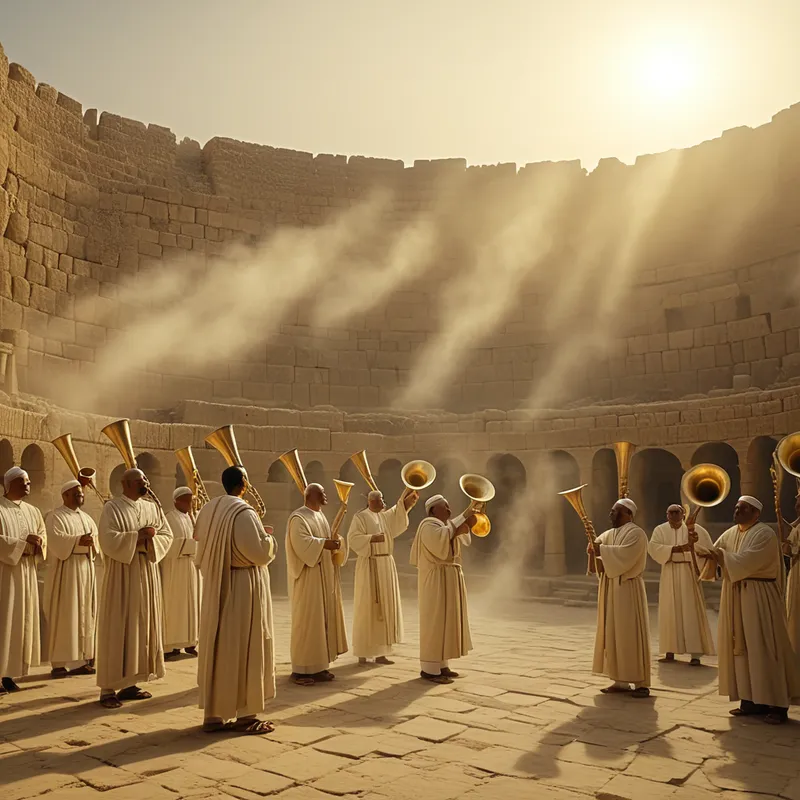
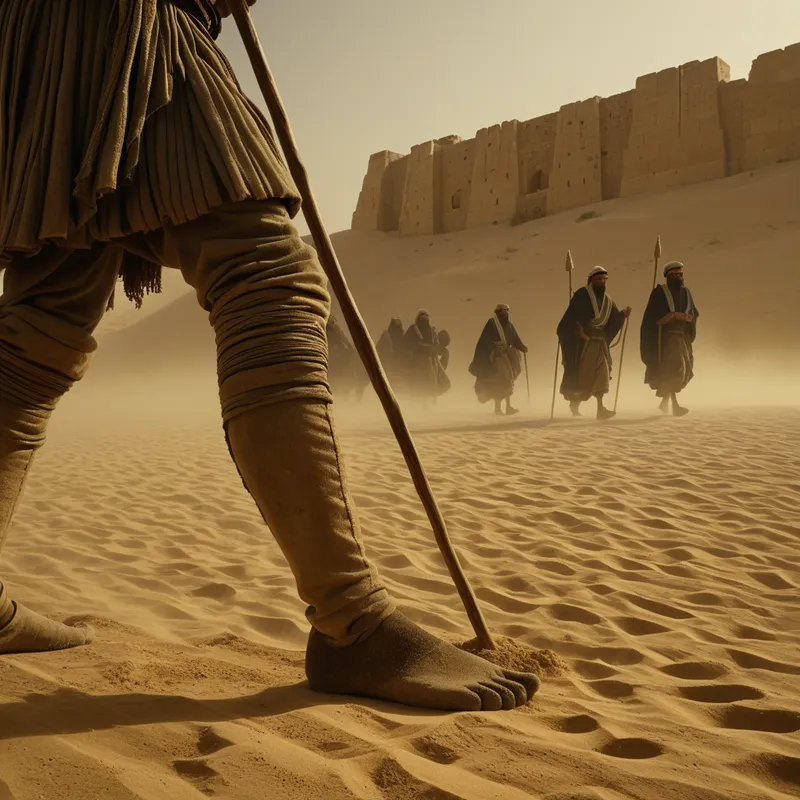
And a command came, not from Joshua’s own strategizing mind, but from a voice that spoke in the space between heartbeats. The plan was not of war, but of ritual. A walking meditation of faith. For six days, the fighting men, the seven priests bearing the Ark of the Covenant, and the vanguard of the people, would circle the city once in utter silence. Only the scuff of sandals on grit, the rustle of linen robes, the dry whisper of the wind. The priests carried before the Ark seven trumpets made from the horns of rams—shofars—but their lips remained sealed. Jericho watched from its heights, a silent, mocking audience to a silent, mysterious parade.
For six dawns, this solemn procession traced a perfect, patient circle in the dust. The tension was a taste of copper in the mouth. The silence grew heavier than the walls themselves, a weight pressing on the chest of every watcher, within and without.
Then came the seventh day. The sun rose not on a single circuit, but on seven. Around and around the city they went, the circle tightening not in space, but in time, coiling the silence like a spring. On the seventh circuit, as the shadows began to stretch long, Joshua raised his hand. A breath was drawn by seven priests.
And they blew.
The sound that erupted was not music. It was the voice of the mountain given to the ram, now given to man. A raw, ragged, triumphant blast that tore the waiting silence to shreds. At the signal, a great shout went up from all the people—a roar of released faith, a thunder from human throats that met the shofar’s cry.
And the earth answered.
The foundations of Jericho remembered their birth in chaos. The meticulously laid stones forgot their bonds. With a groan that came from the world’s core, the mighty walls trembled, cracked, and fell flat. Not breached by battering ram, but laid low by obedience. Not taken by storm, but surrendered to sound. The city that was closed was opened, not from without, but from within its own collapsing heart. The shout faded into the settling dust, and where a fortress had stood, there remained only a threshold, crossed.
Cultural Origins & Context
This narrative is anchored in the Book of Joshua, a foundational text of national identity for ancient Israel. It exists at the fraught intersection of memory, theology, and ethnogenesis. The story is not a military report but a theological manifesto, told and retold by priests and storytellers to forge a collective consciousness. Its primary function was to articulate a core tenet of the Sinai covenant: victory and land are not earned by human might or strategy, but are gifts contingent upon faithful obedience to divine instruction. The ritualistic, non-violent (in method, if not in outcome) conquest of Jericho served as the archetypal model for how the land of Canaan was to be received—as a sacred trust, not a mere prize.
The use of the shofar is profoundly significant. This was not a martial bugle but a sacred instrument used to announce new moons, festivals, and the Year of Jubilee. Its sound marked temporal and spiritual transitions. By employing it here, the story sacralizes the act of conquest, framing it as a liturgical event, a holy day of divine intervention. The tale was a powerful tool for social cohesion, teaching each generation that their collective identity and safety were rooted in a fidelity that transcended conventional power.
Symbolic Architecture
At its heart, this is a myth about the architecture of reality and the frequency that can dissolve it. The walled city of Jericho represents the complex, fortified structures of the psyche and the world that seem immovable: entrenched habits, ideological certainties, psychological defenses, and systemic oppressions. They appear permanent, impregnable.
The most formidable walls are not made of stone, but of consensus reality. They are held together by the mortar of “the way things are.”
Joshua, as the faithful executor, symbolizes the ego that aligns itself not with its own will, but with a transpersonal directive—the Self, or the voice of the deeper psyche. The six days of silent circling represent the necessary, often frustrating period of preparation, incubation, and containment. It is the work done in the shadows, the commitment to a pattern that makes no logical sense to the conventional mind. The silence is the containment of one’s own doubt, anxiety, and the urge to force a solution.
The seven shofars embody the power of focused, sacred vibration—the Word made sound. In mystical thought, sound is the primal creative force. The shout of the people is the full, embodied commitment and release of energy that must follow the focused intention. The collapse is not an attack from outside, but a resonant disintegration. The wall falls flat, creating not rubble, but a path. It signifies that when the psyche aligns with its deepest pattern (the Self), the obstructing complex does not need to be violently overthrown; its foundational illusion is revealed, and it simply ceases to be an obstacle.

The Dreamer’s Resonance
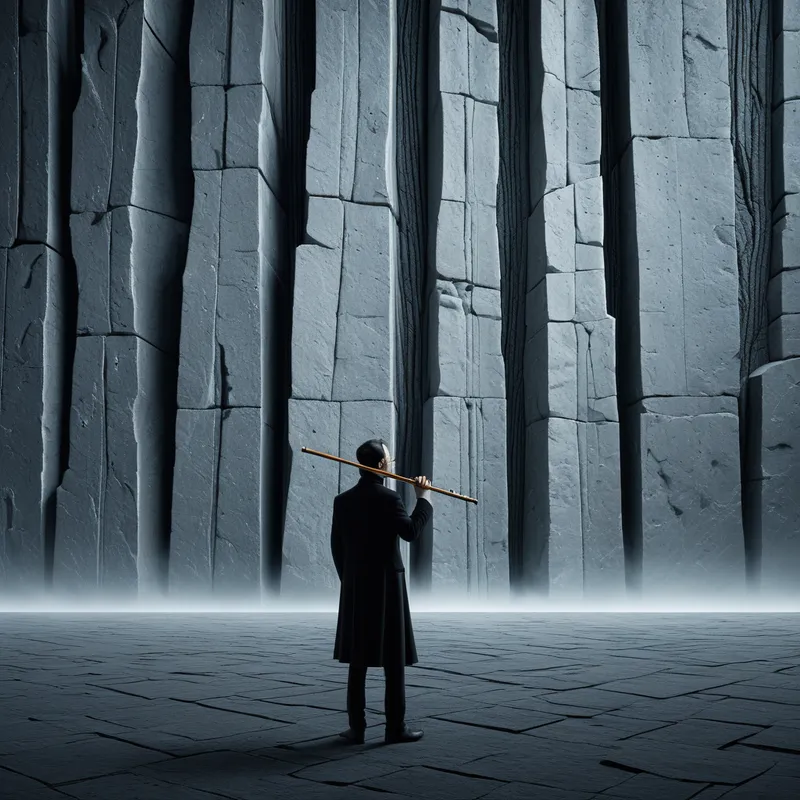
When this myth stirs in the modern dreamer, it often manifests as an encounter with an impossible barrier. You may dream of a vast wall, a locked door with no key, or an institution of immense, silent power. The feeling is one of frustration and impasse. You may also dream of holding a simple instrument—a horn, a bell, a flute—or of needing to remain silent for a prescribed time.
This dream pattern signals a psyche engaged in a process of resonant dissolution. The somatic experience is often a tightness in the chest or throat—the contained shout, the unsounded trumpet. The psychological process is the recognition that the obstacle cannot be solved through more effort within the old paradigm. The dream is instructing the dreamer to cease frontal assault and to begin a patient, ritualistic, perhaps illogical circumambulation of the problem. It calls for a gathering of one’s inner “priests”—the aspects of oneself capable of holding sacred focus—and a commitment to the timing of the unconscious. The moment of sounding the trumpet in the dream is the moment of somatic release, the permission to give voice to one’s full truth, which then catalyzes an internal structural shift.
Alchemical Translation
The alchemy of Joshua’s Trumpets is a masterclass in solve et coagula—dissolve and coagulate—for the soul. The first six days are the solve, not of the wall, but of the ego’s pretension to power. The ego (Joshua and the army) is dissolved into a ritual vessel, its personal will submitted to a supra-ordinate pattern. It walks the circle, the circumambulatio, a classic alchemical image for the process of individuation where one revolves around the Self (symbolized by the Ark).
Individuation is not about building a stronger fortress of the ego, but about learning the specific frequency that makes the fortress unnecessary.
The seventh day is the coagula, the precipitation of the new state. The focused sound and the collective shout represent the integration of conscious intention (the shout) with transpersonal, archetypal power (the shofar blast). This combined vibration is the lapis philosophorum, the philosopher’s stone, not as a physical object but as an act of consciousness that transmutes base reality.
For the modern individual, this myth models the transformation of a life impasse. The instruction is clear: identify your “Jericho”—the seemingly permanent blockage. Then, cease direct combat. Institute a daily, disciplined, perhaps silent practice of “circling” it—through journaling, meditation, active imagination, or artistic expression—not to attack it, but to observe it from all angles in a spirit of faithful curiosity. Gather your inner resources. Wait for the inner timing. When the tension is full, allow the authentic expression—the shout, the creative act, the boundary spoken—to emerge from a place of aligned integrity. The resulting collapse is not destruction, but revelation. The wall was not your limit; it was the shape of your old world. Its falling flat is the gift of the ground upon which your next step must be taken.
Associated Symbols
Explore related symbols from the CaleaDream lexicon: