Joshua at Jericho Myth Meaning & Symbolism
The Israelites, led by Joshua, bring down the walls of Jericho through ritual, faith, and a final, earth-shaking shout, claiming their destiny.
The Tale of Joshua at Jericho
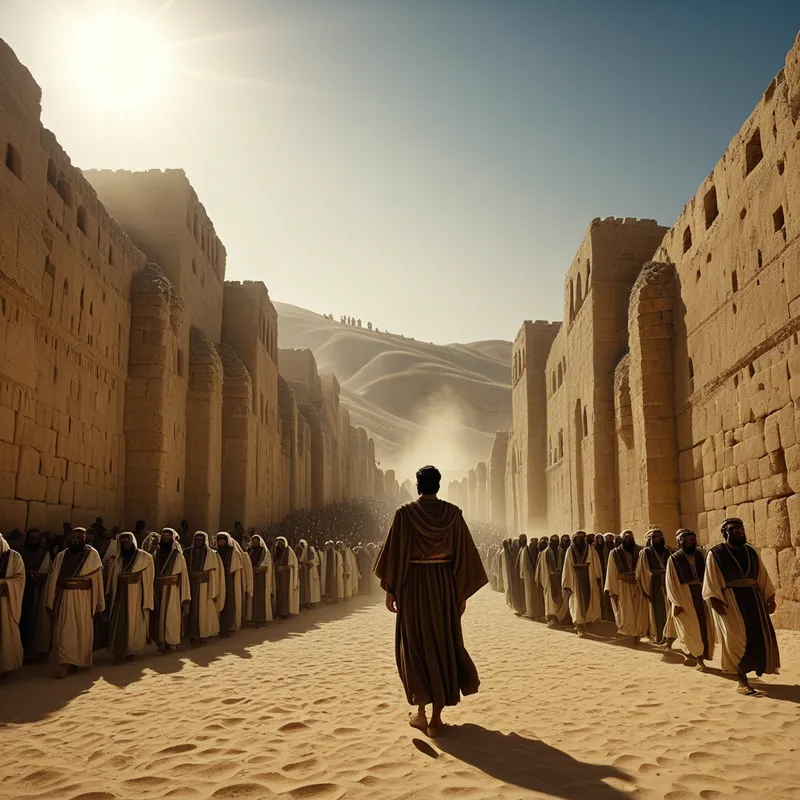
The desert sun was a hammer on bronze, and the land was a promise unfulfilled. Before the people stood Jericho, its gates shut tight, its walls a sheer and mocking defiance against the sky. It was the first fortress of the Promised Land, and it barred the way.
Joshua, son of Nun, successor to Moses, stood in the dust. He was not alone. A presence, a commander of the host of Yahweh, had appeared to him with a sword drawn. The message was not of conventional siege, but of sacred pattern. The strategy was a liturgy of conquest.
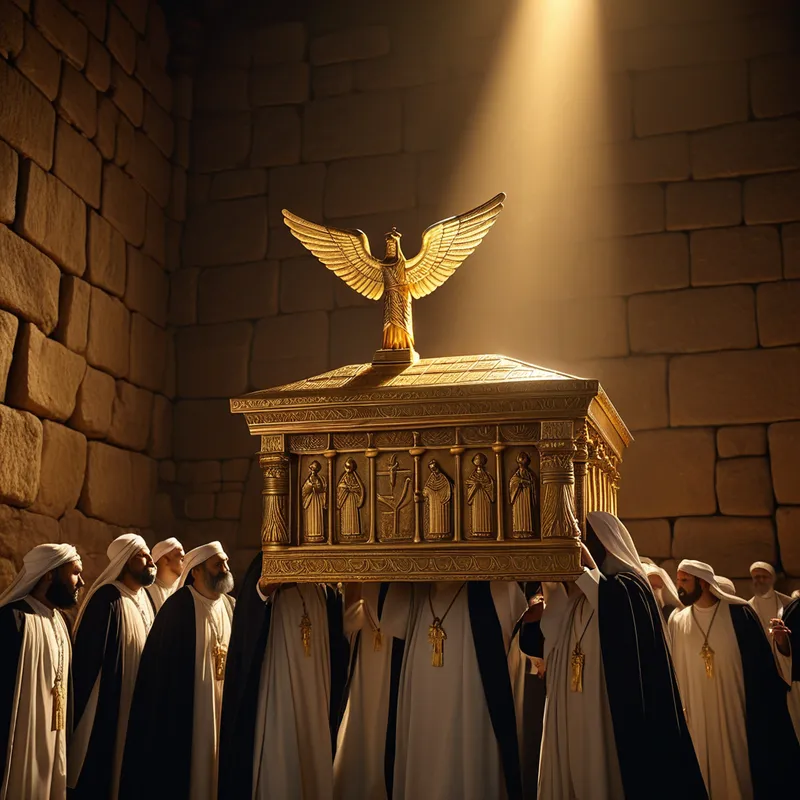
For six days, as the people of Jericho watched from their ramparts in confusion and dread, a silent procession unfolded. At its heart, borne by priests in linen, was the Ark of the Covenant. Before it marched armed men, and behind it came the rear guard. They circled the city once, a perfect, silent orbit, the only sound the shuffle of sandals on grit and the occasional blast of the rams’ horns carried by seven priests. Then they returned to camp. They did this for six days. The tension was a cord pulled taut across the valley.
On the seventh day, they rose at dawn. This day, the pattern deepened. They circled not once, but seven times. The air grew thick with the scent of dust and anticipation. On the seventh circuit, as the horns gave a long, shuddering blast, Joshua cried out to the people: “Shout! For Yahweh has given you the city!”
And they shouted. It was not a mere cry of men, but a roar that seemed to gather the faith of forty years in the wilderness, the memory of parted seas, and the weight of a divine oath. The sound struck the walls. And the earth answered.
The great stones groaned. A deep tremor rose from the foundations. The mighty walls, which had stood for generations, did not crumble from without—they fell in upon themselves, collapsing in a thunderous avalanche of dust and shattered rock, save for one house marked by a scarlet cord. The people went up, every man straight before him, and the city was taken. The fortress of the old order was laid low, not by battering ram, but by a shout born of obedience to a celestial rhythm.
Cultural Origins & Context
This narrative is anchored in the Book of Joshua, a text that sits at the pivotal juncture between the Torah (Law) and the former prophets in the Hebrew canon. It represents the culmination of the Exodus story—the transition from a wandering, tribal confederation to a people claiming a territorial homeland. Scholars debate the historical archaeology of Jericho’s destruction, but the myth’s power is cultural and theological, not strictly archaeological.
It was a story told and retold around campfires and in communal gatherings, a foundational epic for a people defining their identity. It served multiple societal functions: it was a etiology explaining the ruins that may have been visible in the landscape; a theodicy justifying the displacement of Canaanite inhabitants as divine will; and, most crucially, a paradigm of holy war (herem). The ritualistic, non-violent siege emphasized that the victory was wholly Yahweh’s gift, contingent upon the people’s strict adherence to ritual law and purity. The story cemented Joshua as the archetypal faithful leader and established a template for understanding how divine promise meets human action in the crucible of history.
Symbolic Architecture
At its core, the myth is a profound allegory for the collapse of an entrenched psychic structure through faithful, repeated action aligned with a higher order.
Jericho represents the fortified complex. It is the seemingly impregnable wall of habit, trauma, dogma, or fear that stands between the conscious ego and its “promised land”—a state of greater wholeness, potential, or self-realization. Its gates are “tightly shut”; it is a closed system, resistant to change.
The seven-day ritual is the pattern that disrupts. The number seven signifies completeness and divine order. The silent marching, the carrying of the sacred Ark, and the blast of the horns constitute a circumambulation—a ritual circling of the center. In depth psychology, this mirrors the process of consciously attending to a complex, not with brute force, but with sustained, ritualized awareness. One brings the symbol of the transcendent (the Ark) to bear upon the problem, circling it again and again.
The shout that brings down the wall is not an act of aggression, but the final, integrated expression of a process that has already been accomplished in the symbolic realm. It is the moment when unconscious realization becomes conscious truth.
The collapse “every man straight before him” signifies that when the obstructive complex falls, the path to individuation is direct and personal. The preserved house of Rahab, the outsider who showed faith, symbolizes that elements aligned with the new consciousness are integrated, not destroyed.

The Dreamer’s Resonance
When this myth stirs in the modern psyche, it often manifests in dreams of immense, insurmountable walls or barriers. The dreamer may find themselves walking around a vast structure, feeling a sense of ritual purpose without knowing why. They may hear distant, resonant horns or feel a building pressure to shout or make a sound.
Somatically, this can correlate with a feeling of constriction in the chest or throat—the wall internalized. The psychological process is one of confronting a psychic inertia that has long been taken for granted as permanent. This could be a core belief (“I am not worthy”), a relational pattern, or a creative blockage. The circling in the dream reflects the necessary, often frustrating, work of analysis, therapy, or mindful repetition—approaching the issue from all angles, gathering energy and insight.
The climactic shout in the dream is the breakthrough: a sudden sob, a spoken truth in a relationship, the decisive action that finally flows from prepared ground. It is the somatic release of energy that was held in check by the wall itself. The dream signals that the preparatory work is done, and the conscious ego is now being called to enact the collapse through a definitive, embodied declaration.

Alchemical Translation
The alchemical journey mirrored here is the solve et coagula—the dissolution of the old, rigid form so the new may be coagulated. Joshua, as the ego aligned with the Self (symbolized by the commander of Yahweh’s host), undertakes the opus.
The wilderness wandering is the nigredo, the chaotic, preparatory suffering and doubt. Jericho is the prima materia, the hardened, leaden state of the psyche that must be transformed. The ritual circling is the circulatio, the careful, patient distillation and rotation of the matter in the vessel of attention. The Ark is the lapis, the sacred, transformative agent—the living symbol of the Self’s guiding presence.
The alchemical fire is not physical flame, but the heat of concentrated, faithful attention applied in a disciplined pattern over time.
The sevenfold circuit on the seventh day represents the culmination of the cyclical process, achieving a perfect, resonant frequency. The final shout is the moment of transmutation. The rigid structure (the wall) dissolves not into nothingness, but into its component parts—the dust from which it came and from which a new city (the renewed psyche) can be built. The victory is total because the old identity as “wanderers outside the wall” is shattered along with the stones. The individual steps into a new psychic territory, having learned that the most formidable fortresses fall not by assault, but by the resonant frequency of a soul in alignment with its deepest destiny.
Associated Symbols
Explore related symbols from the CaleaDream lexicon: