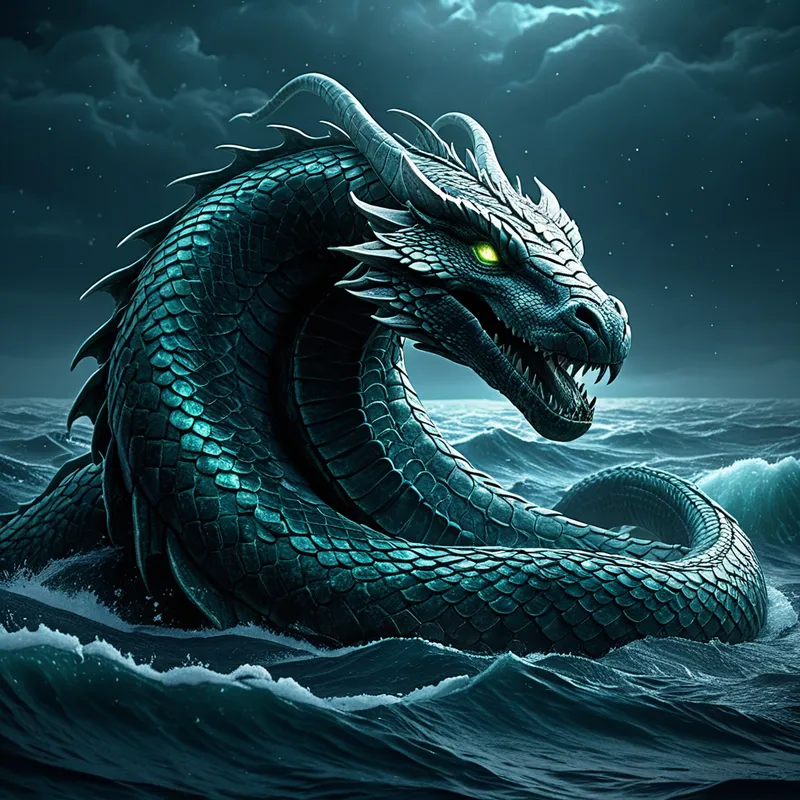
Jormungandr Myth Meaning & Symbolism
The monstrous serpent cast into the sea, destined to encircle the world and face its brother, the god Thor, at the final battle of Ragnarok.
The Tale of Jormungandr
Listen, and hear the tale of the coil that binds the world.
In the time before time, when the breath of the giant Ymir still misted the void, the All-Father Odin looked upon the nine worlds growing from the great ash, Yggdrasil. Yet from the dark, dripping caves of Jotunheim, a brood of monstrous children was born to the trickster Loki and the fierce giantess Angrboda. Three they were: a wolf whose jaws could swallow the sun, a daughter half-alive and half-decayed, and a serpent whose growth knew no limit.
This serpent, Jormungandr, was a horror of scales and cold intent. It grew with every breath, its length spilling across the land, a river of venom and muscle. The gods, in council beneath the boughs of Yggdrasil, saw the shadow it cast and knew fear. This child of chaos could not roam free. With a mighty heave, Odin himself seized the thrashing serpent and hurled it from the high walls of Asgard. Down, down it fell, through the roots of the world, into the great ocean that encircles Midgard.
The sea received the monster. And there, in the sunless deeps, Jormungandr grew. It grew until its head could touch its own tail, until its immense body formed a perfect, unbroken ring around all the lands of men. It became the Midgard Serpent, the boundary of the known world, sleeping in the abyss, its slow heartbeat a tide, its stirrings the cause of tempests.
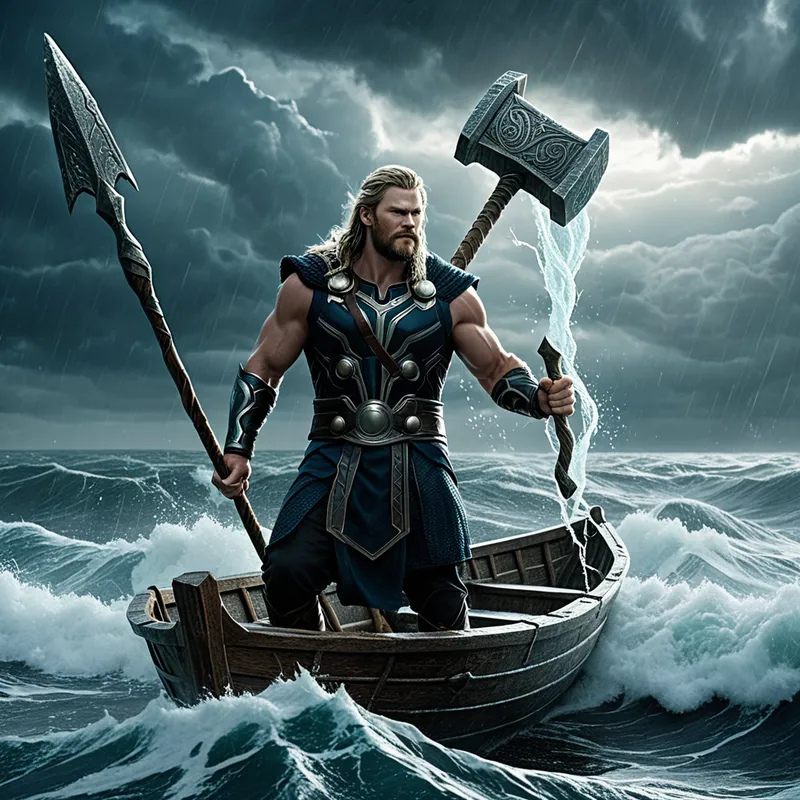
But fate had woven another thread. The serpent’s brother was Thor, the thunderer, protector of Midgard. Their enmity was written in the stars. Once, in the hall of the giant Utgard-Loki, Thor was tricked into lifting a cat that was Jormungandr in disguise, straining the cosmos. Their true meeting came on a fishing trip with the giant Hymir. Thor baited his hook with the head of a great ox and cast his line into the ocean sea. The bait was taken. With a roar that split the sky, Thor hauled the line, his feet driving through the boat's planks. From the depths arose the head of Jormungandr, eyes like cold moons, fangs dripping with venom that hissed in the salt air. Thor raised his hammer, Mjolnir, to strike the death blow. But Hymir, terrified, cut the line. The serpent sank back into the deep, leaving only a churning whirlpool and a promise of a future clash.
For the final meeting is foretold. At Ragnarok, the twilight of the gods, the seas will boil and the serpent will heave its coils onto the land. Thor and Jormungandr will meet for the last time. The thunder god will slay the world-coil, crushing its skull with Mjolnir. But as the monster dies, it will exhale a final, immense breath—a cloud of venom so potent it will engulf Thor. The protector and the contained chaos will kill each other, and from their mutual destruction, the world will be washed clean, ready to be born again from the sea.
Cultural Origins & Context
This myth was not penned in a book but breathed into life in the great halls of the Viking Age, between the 8th and 11th centuries. It was told by skalds—poet-historians—to the crackle of a longfire, the air thick with the smell of smoke and mead. The primary sources, the Poetic Edda and the later Prose Edda by Snorri Sturluson, are our windows into this oral tradition.
The myth functioned as a profound cosmological and psychological map for a people intimately acquainted with a dangerous, unpredictable world. The sea was both a highway and a grave. Jormungandr, dwelling in that very sea and encircling the land, gave a tangible, monstrous form to the existential threat of chaos that lay beyond the village boundary. The story explained natural phenomena—earthquakes were the serpent turning in its sleep, storms its anger. More deeply, it reinforced a core Norse worldview: order (orlog) is not a default state but a hard-won, temporary containment of primal chaos. The gods themselves are not omnipotent administrators but active, struggling forces in this eternal dynamic.
Symbolic Architecture
Jormungandr is the archetypal Shadow made cosmic. It represents everything that is too vast, too primal, and too dangerous to be integrated into daily consciousness. It is the repressed chaos of the unconscious, the unacknowledged rage, the latent potential for destruction that resides within and without.
The serpent does not attack the world from without; it is the world's own necessary boundary, the tension that gives form to the contained.
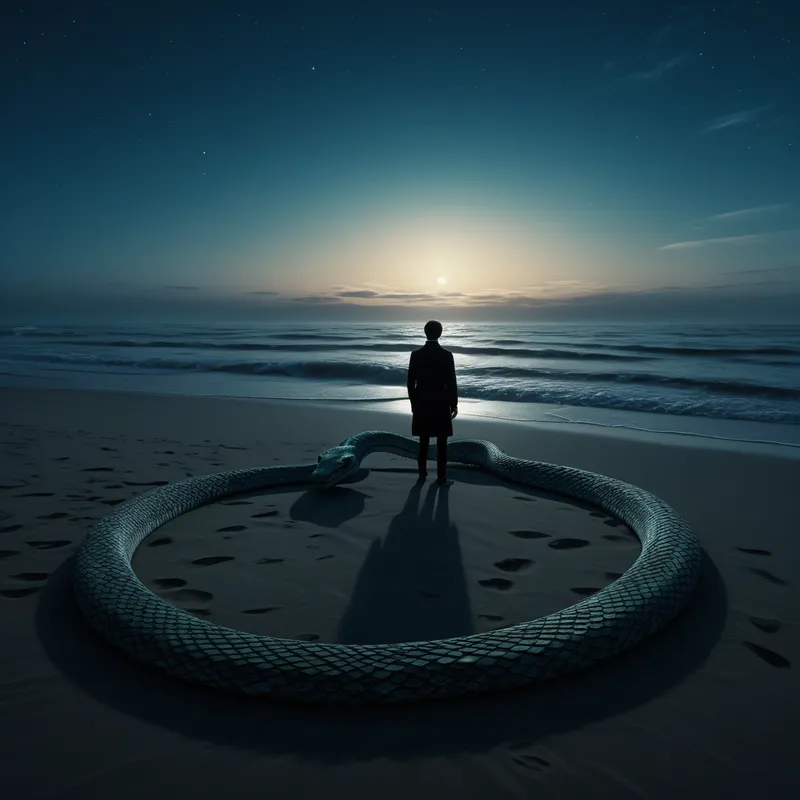
Its casting into the sea by Odin is the primordial act of psychological repression and cultural taboo-creation. We take what is monstrous within our collective psyche and exile it to the "deep," to the unconscious, where we hope it will remain dormant. Yet, like the serpent, it does not die; it grows in the dark, forming the very limits of our known self. The ouroboros—the serpent biting its own tail—is a perfect symbol of this self-contained, self-sustaining psychic complex. It is a closed loop of energy that defines the perimeter of the ego.
Thor’s battles with it symbolize the ego's necessary, heroic, but ultimately tragic struggle with the contents of the unconscious. The ego (Thor) must periodically confront the Shadow (Jormungandr) to assert order and safety. Yet the myth is brutally honest: these confrontations are never final. The line is cut; the serpent retreats. Total victory over the unconscious is an illusion. The final confrontation at Ragnarok reveals the ultimate truth: the conscious principle and the unconscious shadow are co-dependent. Their mutual annihilation is not mere destruction, but a necessary dissolution for rebirth.
The Dreamer's Resonance
When Jormungandr surfaces in modern dreams, it signals a profound encounter with a personal or collective Shadow of immense scale. This is not a dream of a small snake, but of something vast, oceanic, and encircling.
The dreamer may find themselves on a shoreline, watching a titanic shape move beneath the waves, feeling a dread that is both terrifying and awe-inspiring. They may dream of being in a boat on a suddenly stormy sea, or of a coiling pressure around their chest or home—a sense of being constricted by a problem so large it defines the boundaries of their life. The somatic experience is one of deep, visceral unease, a feeling of a foundational reality shifting. Psychologically, this dream marks the point where a repressed complex—perhaps a lifelong pattern of anger, a buried trauma, or a denied creative/destructive power—has grown so large it can no longer be ignored. It is announcing itself, demanding recognition. The dreamer is at the threshold of what psychologist James Hollis calls "the Middle Passage," where the ego's old structures are confronted by the sheer scale of the unconscious.
Alchemical Translation
The myth of Jormungandr models the alchemical stage of nigredo—the blackening, the confrontation with the primal, chaotic massa confusa. The individuation process requires not the slaying of this inner serpent, but the courageous act of fishing for it, of bringing it to the surface of awareness, as Thor did.
The goal is not victory, but the transformative encounter. One must behold the monster to understand the shape of one's own world.
The first step is Containment (The Casting Out): Recognizing what parts of ourselves we have exiled as "monstrous" and acknowledging they are still part of our psychic ecosystem. The second is Confrontation (The Fishing Trip): Having the strength (Thor) to consciously engage with this shadow material, to feel its immense weight on the line of attention, even if we are not yet ready to "land" it fully. The final, mature stage is Integration (The Ouroboros): Understanding that this serpent is not an external enemy but the very structure of your unconscious self. Its coil defines you. The psychic task shifts from battle to relationship, from slaying to navigating.
The venom that kills Thor is the toxic, purgative truth that emerges when the shadow is fully faced. It destroys the old, heroic ego-identity that was defined against the shadow. In the psyche's Ragnarok, this death is necessary. From it, a consciousness less rigid, less defensive, and more capable of holding paradox can be reborn—a consciousness that knows it is both the fisherman and the serpent, the container and the contained, forever circling the depths of its own being.
Associated Symbols
Explore related symbols from the CaleaDream lexicon: