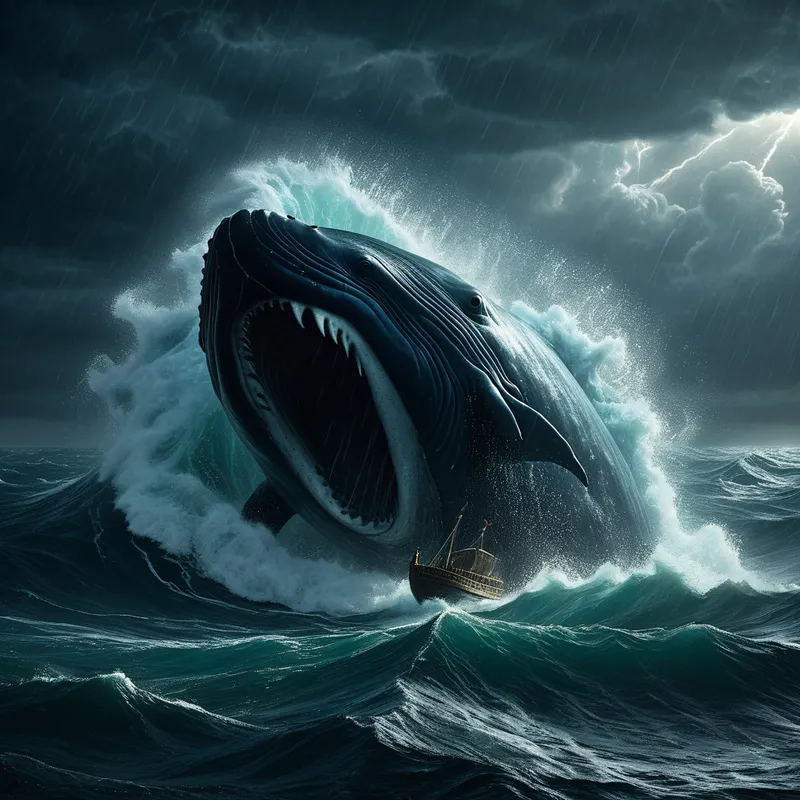
Jonah in the Whale Myth Meaning & Symbolism
A prophet flees his divine calling, is swallowed by a great fish, and emerges transformed after three days in the dark belly of the deep.
The Tale of Jonah in the Whale
Hear now a tale of flight and fathom, of a voice that would not be silenced and a man who tried to outrun the sky. The word of YHWH came to Jonah, son of Amittai, a command that landed in his soul like a stone: “Arise, go to the great city of Nineveh, and cry out against it, for its wickedness has risen before me.”
But Jonah’s heart seized. Nineveh? The jewel of the Assyrian empire, a city of blood and splendor, an enemy of his people. To walk its gates was to walk into the lion’s maw. So he arose, but not eastward to the desert road. He turned his face west, to the sea. To the port of Joppa, where the salt air stung with promise of escape. He paid his fare and descended into the hold of a ship bound for Tarshish, the far edge of the known world, fleeing from the presence of YHWH.
Then YHWH hurled a great wind upon the sea. A storm rose, a fury so mighty the ship threatened to be shattered. The seasoned sailors cried out, each to his own god, and cast the cargo into the raging deep to lighten the ship. But Jonah had gone down into the innermost parts of the vessel, lay down, and fell into a deep, troubled sleep—a sleep of denial.
The captain found him. “What do you mean, sleeper? Arise, call on your god!” The lot was cast, and it fell upon Jonah. “Tell us,” they demanded, their faces etched with terror from the storm and the uncanny truth, “on whose account has this calamity come upon us?” And Jonah confessed: “I am a Hebrew, and I fear YHWH, the God of heaven, who made the sea and the dry land.” He told them of his flight. The men’s fear grew greater still. “What shall we do to you that the sea may quiet down for us?”
“Pick me up and hurl me into the sea,” Jonah said, his voice hollow with resignation. “Then the sea will quiet for you, for I know it is because of me that this great tempest has come upon you.”
The men rowed harder, straining to bring the ship to land, but the sea grew more and more tempestuous. At last, with prayers for forgiveness on their lips, they took Jonah and threw him into the chaos. The sea ceased its raging. And YHWH appointed a great fish to swallow Jonah.
Darkness. Pressure. The smell of salt and the deep. Jonah was in the belly of the fish three days and three nights. Not in a cavern of bones, but in a living temple of dissolution, surrounded by the rhythmic pulse of a heart not his own. It was here, in the absolute interior of the deep, that the prayer finally broke from him—a psalm of distress and remembrance, reaching from the roots of the mountains, from the land whose bars closed upon him forever. He remembered YHWH.
And the word of YHWH came to the fish. It vomited Jonah out upon the dry land. The command came again, unchanged: “Arise, go to Nineveh.” And Jonah, washed in brine and humility, arose and went.

Cultural Origins & Context
The Book of Jonah is a unique work within the Hebrew prophetic canon. Unlike the direct oracles of an Isaiah or Jeremiah, it is a narrative about a prophet, a didactic story likely composed in the post-exilic period (5th-4th century BCE). It is read annually in Judaism on Yom Kippur, the afternoon service, serving as a profound meditation on repentance, divine mercy, and human responsibility that transcends national boundaries.
Its societal function was multifaceted. On one level, it was a critique of prophetic or national insularity, challenging the notion that YHWH’s concern was for Israel alone. The pagan sailors pray sincerely and are spared; the wicked city of Nineveh, Israel’s historical enemy, repents en masse and is forgiven. The story wrestles with the scandal of divine compassion, which Jonah himself finds bitterly difficult to accept. It is a myth passed down not to glorify a hero, but to humble a people, to expand their understanding of the divine economy from one of tribal covenant to one of cosmic, unsettling grace.
Symbolic Architecture
The myth’s power lies in its stark, almost alchemical, symbolic stages: the Call, the Flight, the Descent, the Confinement, and the Reluctant Return.
Jonah represents the part of the psyche that receives a call to a difficult but necessary destiny—a vocation, a confrontation, a growth—and actively resists it. His flight to Tarshish is not mere cowardice; it is a sophisticated act of self-sabotage, a choosing of the literal opposite direction. The storm is the inevitable psychic turbulence that arises when the Self is at war with itself, when conscious intention violently contradicts the trajectory of the soul.
The belly of the whale is not a punishment, but the necessary womb of the unconscious where the inflated ego is dissolved so that the authentic self can be reconstituted.
The great fish is the archetypal container of transformation. It is the involuntary descent into the depths of one’s own being. The three days and three nights signify a complete cycle of death and incubation. In this enforced solitude and sensory deprivation, stripped of all agency and external reference, Jonah’s grand resistance collapses. His prayer from the belly is the sound of the ego finally acknowledging its dependency on a reality larger than its own will. The fish is thus a paradoxical savior, the agent of the very fate Jonah fled, carrying him through the deep not to destruction, but to his own doorstep, reborn.

The Dreamer's Resonance
When this myth patterns a modern dream, it signals a profound somatic and psychological process of envelopment. The dreamer may find themselves in a dark, enclosed space—a basement, a cave, the hold of a ship, or an organic, pulsating interior. This is not a nightmare of claustrophobia, but a temenos, a sacred container of the unconscious.
The somatic feeling is one of profound pressure and suspension. Action is impossible; one can only be. This dream state corresponds to a life situation where all outward striving has failed or been stripped away: a burnout, a depression, a forced pause after a loss, or the quiet crisis that follows achieving a long-sought goal only to find it empty. The “whale” has swallowed the dreamer’s old identity. The psychological process at work is one of composting—the breakdown of outdated attitudes, stubborn resistances, and performed selves so that their essential nutrients can be reclaimed. The dream is an assurance from the deep psyche that this containment, however terrifying, is part of the healing trajectory.

Alchemical Translation
The alchemical journey of Jonah is a perfect map of the individuation process. The initial nigredo, the blackening, is Jonah’s flight into the storm and his plunge into the chaotic sea—the conscious descent into conflict and the shadow. The belly of the whale is the albedo, the whitening, not a place of light, but of washing and purification in a saline solution of tears and self-reckoning. Here, in the dark, the prima materia of the personality is dissolved.
To be vomited upon the dry land is to be born anew into the same world, but with a consciousness that has been tempered in the gut of the leviathan.
The reluctant journey to Nineveh that follows is the beginning of the citrinitas, the yellowing or dawning of a new consciousness. Jonah performs his duty, but his heart is not yet fully transformed; he sulks over the withered plant, still attached to his petty comforts and sense of justice. The final lesson, YHWH’s speech about compassion for the great city and its innocent children, points toward the elusive rubedo, the reddening. This is the integration of the heart with the will, where one’s personal calling is aligned with a transpersonal compassion. The myth does not show us a fully redeemed hero, but a man in process, arguing with God under a desert sun—a more authentic, engaged, and human figure than the sleeper in the ship’s hold. He has been carried by the deep to the very edge of his own capacity for mercy. The work of the whale is complete; the work of the heart begins.
Associated Symbols
Explore related symbols from the CaleaDream lexicon: