Jonah Myth Meaning & Symbolism
A prophet flees his divine call, is swallowed by a great fish, and emerges transformed, modeling a universal journey of descent and reluctant redemption.
The Tale of Jonah
Hear now the tale of Jonah, son of Amittai, a man who tried to outrun the voice of God.
The word of YHWH came to him, a command that struck like thunder in his soul: “Arise, go to Nineveh, that great city, and cry out against it, for their wickedness has risen up before me.” But Jonah’s heart seized with a cold dread. Nineveh was the jewel of the Assyrian empire, a metropolis of unimaginable scale and brutality, the enemy of his people. To walk its streets and proclaim its doom was to invite a death more terrible than prophecy.
So Jonah ran. Not toward the dusty east, but to the very edge of the known world. He went down to the port of Joppa, down into the hold of a ship bound for Tarshish, fleeing from the presence of YHWH. He paid his fare and descended into the dark, wooden belly, seeking sleep, seeking oblivion.
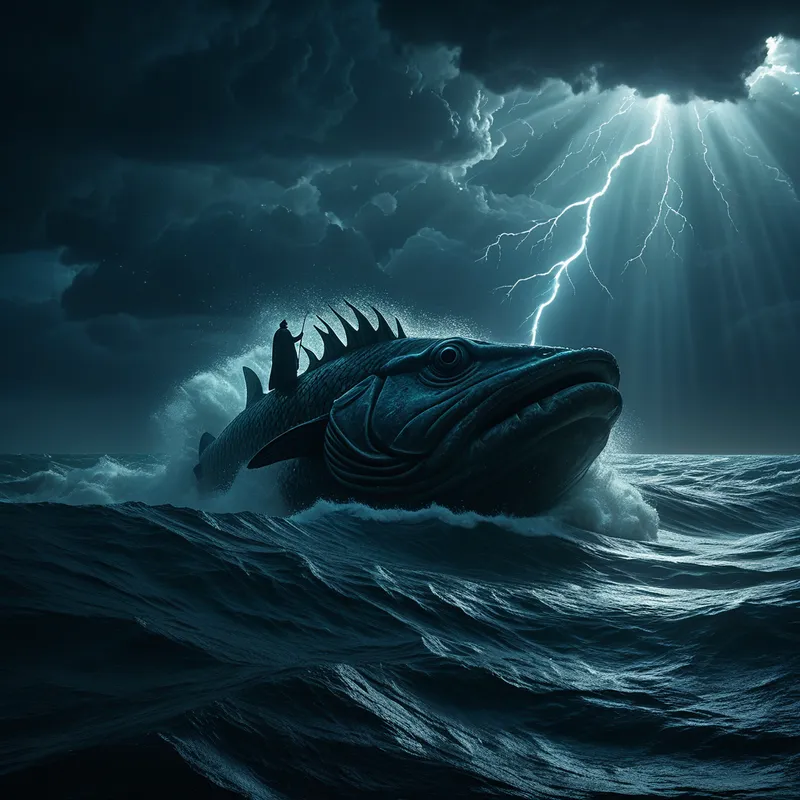
But YHWH hurled a great wind upon the sea. A mighty tempest arose, until the ship was like a nutshell in the fist of a giant, threatened to be broken. The mariners, seasoned and salt-hardened, cried each to his own god and cast the cargo into the sea to lighten the ship. But Jonah had gone down into the innermost parts, into a deep, stubborn sleep. The captain found him and roared, “What do you mean, sleeper? Arise, call on your god!”
The lot fell to Jonah. “Tell us,” they demanded, their faces etched with terror and spray. “On whose account has this calamity come upon us?” And Jonah confessed: “I am a Hebrew, and I fear YHWH, the God of heaven, who made the sea and the dry land.” He told them of his flight. The men’s fear grew exceedingly. “What shall we do to you that the sea may quiet down for us?”
“Pick me up and hurl me into the sea,” Jonah said, his voice hollow with resignation. “Then the sea will quiet down for you, for I know it is because of me that this great tempest has come upon you.”
The men rowed hard to bring the ship back to land, but they could not, for the sea grew more and more tempestuous. So they took Jonah and cast him into the raging deep. And the sea ceased from its raging. As Jonah sank into the green darkness, the water closing over his head, the crew offered sacrifices and made vows.
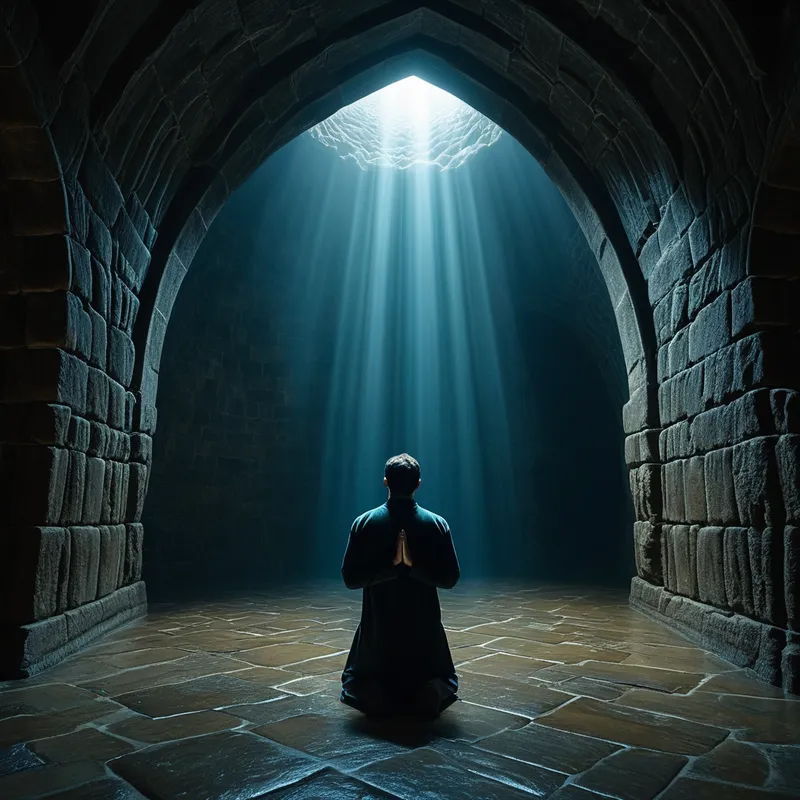
But YHWH appointed a great fish to swallow Jonah. And Jonah was in the belly of the fish three days and three nights. There, in the absolute dark, surrounded by the rhythmic pulse of a living tomb, in the gastric heat and the smell of salt and decay, Jonah prayed. From the belly of Sheol he cried out. And YHWH spoke to the fish, and it vomited Jonah out upon the dry land.
The word of YHWH came to Jonah a second time: “Arise, go to Nineveh.” And Jonah arose and went. He walked a day’s journey into the vast city and proclaimed, “Yet forty days, and Nineveh shall be overthrown!” And a miracle greater than the fish occurred: the people of Nineveh believed God. From the greatest to the least, they proclaimed a fast and put on sackcloth. The king rose from his throne, covered himself with sackcloth, and sat in ashes. He decreed that every man and beast should cry mightily to God and turn from their evil ways.
And God saw their works, that they turned from their evil way; and God relented of the disaster that he had said he would do to them.
But this displeased Jonah exceedingly, and he was angry. He prayed, “O YHWH, is this not what I said when I was yet in my country? That is why I made haste to flee to Tarshish; for I knew that you are a gracious God and merciful, slow to anger and abounding in steadfast love, and relenting from disaster.” He asked to die. He went east of the city, made a booth, and sat under its shade, to see what would become of the city.
And YHWH God appointed a plant that grew up over Jonah to shade his head. Jonah was exceedingly glad because of the plant. But at dawn the next day, God appointed a worm that attacked the plant, so that it withered. When the sun rose, God appointed a scorching east wind, and the sun beat down on Jonah’s head until he was faint. Again, he asked that he might die.
God said to Jonah, “Do you do well to be angry for the plant?” And Jonah said, “Yes, I do well to be angry, angry enough to die.”
And YHWH said, “You pity the plant, for which you did not labor, nor did you make it grow, which came into being in a night and perished in a night. And should not I pity Nineveh, that great city, in which there are more than 120,000 persons who do not know their right hand from their left, and also much cattle?”
The story ends there, with Jonah silent, sitting in the blistering heat, confronted by the vastness of a compassion wider than his own understanding.
Cultural Origins & Context
The Book of Jonah is a unique text within the Hebrew Bible, nestled among the twelve Minor Prophets. Unlike the others, which are primarily collections of oracles, Jonah is a tightly constructed narrative—a prophetic novella. Scholars date its final composition to the post-exilic period (likely 5th-4th century BCE), a time when Jewish identity was being re-forged after the Babylonian exile. The story, however, likely draws on much older traditions.
Its societal function was profoundly subversive. It was told not as a simple history of a prophet, but as a theological and satirical masterpiece aimed at a community struggling with exclusivity and nationalism. The audience, returned from exile and rebuilding their temple and walls, might have held deep-seated hatred for nations like Assyria (of which Nineveh was the ancient capital). Jonah embodies that narrow, vengeful nationalism. The story systematically dismantles it, revealing a God whose concern extends beyond Israel’s borders to even the most brutal of empires. It is a story about the perils of a contracted heart and the scandalous, unbounded grace of the divine.
Symbolic Architecture
The myth of Jonah is a perfect map of a psychological crisis and its reluctant resolution. Every movement is a descent.
The call to Nineveh is the summons of the Self, the demand to confront what we most fear and reject—our own inner “Assyria” of shadow, complexity, or a destiny we did not choose.
Jonah’s flight to Tarshish is not mere disobedience; it is a movement away from consciousness, down into the unconscious (the ship’s hold, then the sea). The storm is the psychic upheaval that ensues when life is lived in opposition to one’s deep purpose. Throwing Jonah overboard is not punishment, but the necessary, if terrifying, act of surrender—the ego allowing itself to be dissolved for the greater whole.
The great fish is the ultimate symbol of the containing, transformative womb of the unconscious. It is not hell, but a liminal space, a dark night of the soul where the old identity is broken down. The three days and nights prefigure the archetypal cycle of death and rebirth. Jonah’s prayer from the belly is the crucial inner work done in darkness, where grandiosity falls away and only raw, honest petition remains.
The vomiting onto dry land is the rebirth, the emergence of a new, humbled consciousness, now capable of performing its task—not with triumphalism, but with a hollowed-out authenticity.
The final act with the plant and the worm is the masterstroke. It reveals that Jonah’s transformation is incomplete. He is still attached to personal comfort and a petty sense of justice. God’s final question leaves the story open-ended, forcing the listener—and Jonah—to sit with the discomfort of a love that is infinitely more expansive than our own cherished grievances.

The Dreamer's Resonance
When this myth appears in modern dreams, it signals a profound somatic and psychological process of introversion under duress. The dreamer may not dream of a literal whale, but of being trapped in a basement, a subway tunnel, a bureaucratic maze, or any enclosed, organic-feeling space from which there seems no exit. This is the “belly” experience.
Somatically, it often correlates with feelings of pressure, constriction, or digestive issues—a literal “gut” reaction to a life situation the conscious mind is refusing to digest. Psychologically, the dreamer is in a state of forced incubation. They have, like Jonah, refused some call—a career change, a relationship truth, a creative venture, a necessary confrontation—and the unconscious has “swallowed” them whole to initiate a process they would not choose.
The dream is not punitive but initiatory. The feeling of being stuck, of going in circles in the dark, is the psyche’s way of holding the dreamer in the alchemical nigredo, the blackening, until the old attitudes dissolve. The emergence from this dream-space, when it comes, often feels sudden, messy, and undignified—being “vomited” onto the shore of a new, raw awareness.

Alchemical Translation
The myth of Jonah is a precise model of psychic transmutation, or individuation. It maps the journey from a rigid, ego-bound position to a more fluid, Self-oriented existence.
The prima materia, the base matter for this work, is Jonah’s refusal. This is not a flaw, but the necessary starting friction. The alchemical vessel is the great fish—the sealed container of the unconscious where the work happens. The stormy sea is the solutio, the dissolution of old structures. The three days in the belly are the mortificatio and putrefactio, the symbolic death and decomposition of the outmoded personality.
The prayer from the depths is the separatio, where the essential self is distilled from the dross of resentment and fear.
Jonah’s proclamation in Nineveh, now stripped of ego-investment, is the coagulatio—the new, more authentic expression coming to solid form in the world. But the process is not linear. The final scene with the plant represents the circulatio, the return of the unintegrated shadow in a new form (petty anger, self-pity). God’s questioning is the final stage of rubedo, the reddening or enlightenment, which is not a blissful state but a searing exposure to a greater, more complex reality.
For the modern individual, the alchemy of Jonah teaches that we are not transformed by our successes, but by our reluctant surrenders. Our destiny often calls us toward our personal Nineveh—the place, inner or outer, we most despise or fear. The journey requires being swallowed by the unknown, digested in darkness, and spat back out, humbled and enlarged, capable of a compassion that finally exceeds our own understanding. The work is done not in the light of our intentions, but in the dark belly of our avoidance.
Associated Symbols
Explore related symbols from the CaleaDream lexicon: