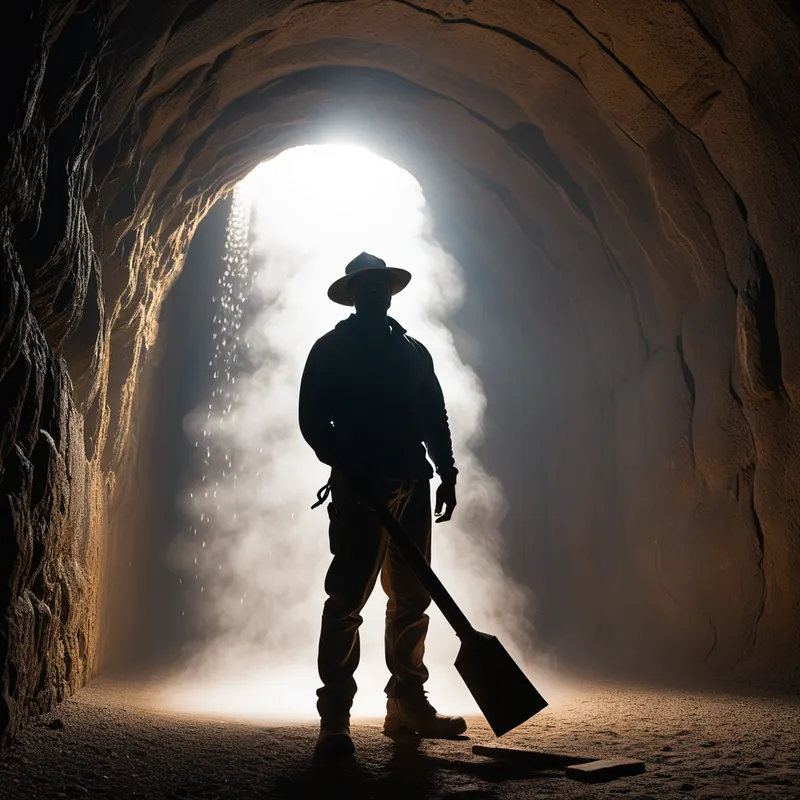
John Henry Myth Meaning & Symbolism
A steel-driving man of legendary strength races a steam drill to prove human spirit's worth, winning with his heart before it breaks.
The Tale of John Henry
Listen. There is a sound in the mountain, a rhythm older than the river. It is the sound of a man meeting the earth, a conversation of iron and stone. This is the story of that sound, and of the silence that followed.
He was born with a hammer in his hand, they say. John Henry was a man of muscle and song, a steel-driver on the C&O Railroad, driving the line through the heart of the West Virginia mountain at Big Bend Tunnel. When he swung his twenty-pound hammer, the sun paused. When he sang his work song, the rocks themselves listened. He was not just a laborer; he was a force, a testament to what breath and blood and will could achieve.
Then came the machine. A cold, hissing thing of polished brass and steam—a steam drill. The Captain brought it to the tunnel mouth, its promise hanging in the air like coal dust: progress, efficiency, the future. "This drill," the Captain said, "can out-drive any ten men." The other drivers looked at their blistered hands, then at the unblinking eye of the machine. A chill settled in the tunnel, deeper than the mountain's cold.
John Henry stepped forward. The song in his chest fell silent, replaced by a deeper, more terrible music. "A man ain't nothin' but a man," he said, his voice echoing off the stone. "But before I let that steam drill beat me down, I'll die with this hammer in my hand." The challenge was set: man against machine, flesh against furnace, soul against system. One day, sunrise to sunset, to drive the farthest into the living rock.
Dawn broke. The whistle blew. The steam drill screamed to life, a mechanical dragon gnawing at the stone. And John Henry began to swing. Clang. Clang. CLANG. His hammer was a heartbeat, a thunderclap. His shaker, the man who turned the drill, sang with him, their voices weaving a spell of endurance. The heat was infernal. The air thickened with rock powder and sweat. The machine never tired, never slowed, its piston a relentless, mindless pulse.
But John Henry’s pulse was a drum of destiny. He drove himself beyond human limits, each swing a defiance of the inevitable. As the sun bled toward the horizon, the foreman’s measurements were called. The machine had driven a mighty length. John Henry had driven more. He had beaten the machine. A great cry went up from the men—a cry of triumph, of vindication.
John Henry laid his hammer down. He walked to the mouth of the tunnel, looked at the setting sun, and placed his hand over his heart. "It’s killed me," he said, quiet as the settling dust. And he fell. The greatest steel-driver the world ever knew died there on the railbed, his victory complete, his sacrifice absolute. They buried him near the tracks, and some say when the wind blows through the mountains, you can still hear the echo of his hammer, a ghost in the rhythm of the rails.
Cultural Origins & Context
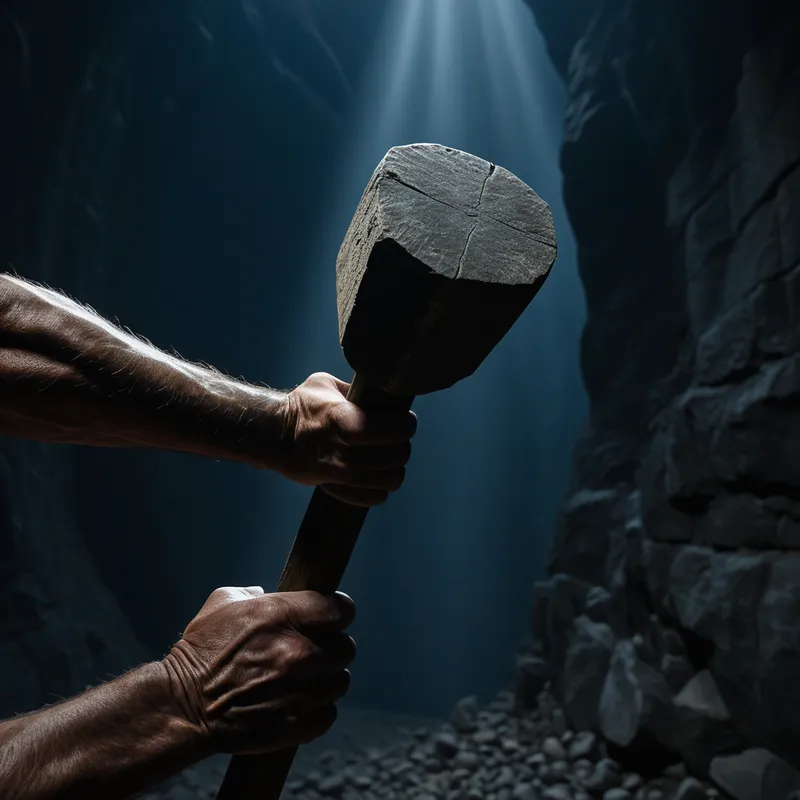
The ballad of John Henry is not a story from a single pen, but a song born from the collective breath and toil of a people. It emerged in the post-Civil War era, a foundational piece of American Folklore, specifically from the experiences of Black railroad workers. Its primary medium was the work song and the oral tradition, sung in rail camps, penitentiaries, and fields to synchronize labor and carry the weight of the day.
While no single historical John Henry has been definitively verified, the myth is anchored in the very real, brutal context of the Railroad Expansion. It gave voice to the visceral anxiety of the Industrial Age, where human skill and physical mastery were being rendered obsolete by steam and steel. For the marginalized workers—many of whom were only a generation removed from slavery—the story was more than a tall tale. It was a eulogy for a certain kind of human dignity, a monument built from melody to a way of life being drilled into oblivion. It functioned as a cultural coping mechanism, transforming collective fear and grief into a narrative of heroic, if tragic, resistance.
Symbolic Architecture
At its core, the myth of John Henry is a profound map of a fundamental human confrontation. John Henry himself symbolizes the incarnate spirit—the raw, authentic, soulful power of the individual human being in harmony with his tools and his song. He is the embodiment of Psyche in its most grounded form.
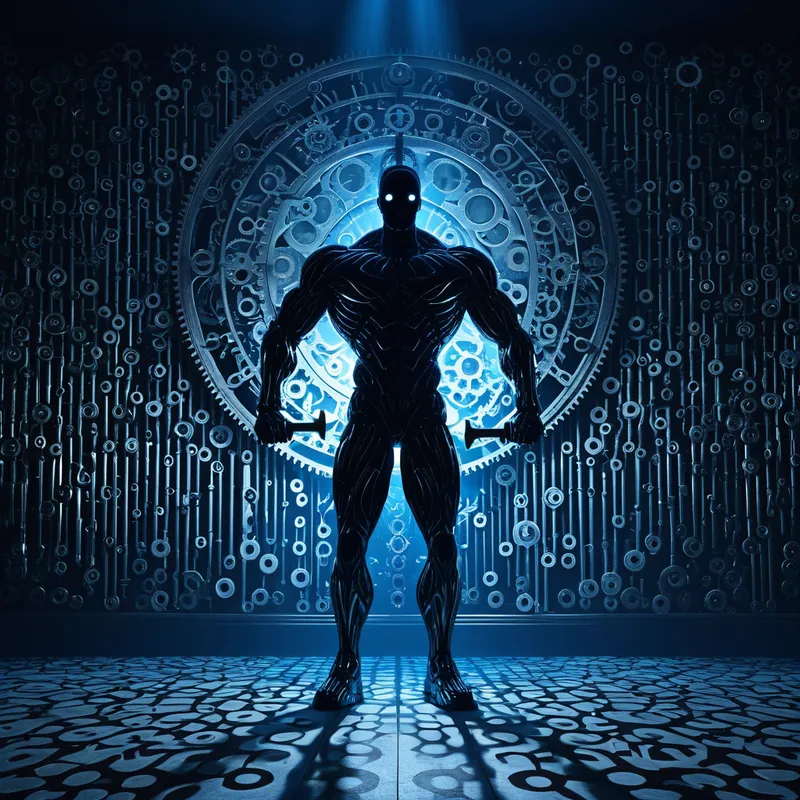
The steam drill is the symbol of the System, of Progress as an abstract, devouring force. It is not merely a tool, but an agent of a new, colder world order that values output over essence, consistency over character. The race in the tunnel is the archetypal clash between these two realms.
The victory of the spirit is always a Pyrrhic one, purchased at the cost of its very embodiment.
The hammer is his will, his agency, the extension of his soul into the world. The tunnel is the Underworld, the dark, constricted space where such ultimate trials must occur. His death immediately following his victory is the myth’s most critical symbolic truth: the old, whole, instinctual self cannot survive its ultimate confrontation with the modern, fragmenting world. It wins its dignity, but forfeits its life in the current order.

The Dreamer's Resonance
When this myth stirs in the modern Personal Unconscious, it often manifests as dreams of impossible, exhausting labor. You may dream of racing against a clock that is also a machine, of trying to prove your worth through sheer, unsustainable effort. The somatic feeling is one of cardiac strain—a tightness in the chest, a breathlessness—mirroring John Henry’s literal heartbreak.
Psychologically, this dream pattern signals a profound crisis of value. The dreamer is in a state where their essential, authentic self—their unique skills, their passionate "song"—feels threatened by an impersonal force. This could be workplace automation, bureaucratic demands, social media metrics, or any system that reduces qualitative human experience to quantitative data. The dream is the psyche’s dramatization of the soul being driven to its breaking point to prove it still matters. It asks the terrifying question: "What part of me must die to prove I am alive?"
Alchemical Translation
The individuation process modeled by John Henry is not one of integration, but of sacred sacrifice and conscious dissolution. The alchemical vessel is the dark tunnel of the psyche, where the base material of the ego—our identified strength and capability—is subjected to extreme pressure.
The first stage is Nigredo, the blackening. This is the arrival of the steam drill, the shattering of the old identity. The hero’s initial reaction is not adaptation, but a doubling down on his primal nature. He chooses to meet the new threat with the old tool, his hammer. The race itself is the Rubedo, the reddening or intensification, where he drives his own nature to its absolute, brilliant, and fatal limit.
The alchemy of John Henry is the transmutation of the ego into a legend; the person perishes so that the archetype may be born.
His victory is the ultimate act of Individuation in this context: he defines himself utterly on his own terms, even if those terms are obsolete to the outer world. He consciously sacrifices his physical life for the eternal life of meaning. For the modern individual, the "alchemical translation" is the recognition of what inner value is worth dying for, even if it’s metaphorically. It is about performing one’s essential "song" with such purity and commitment that, even if the context destroys you, the echo of your truth becomes a permanent part of the landscape of the soul. The task is not to beat the machine at its own game, but to swing your hammer with such authentic force that you create a sound that outlasts both you and the machine. The psychic transmutation is from a worker in the system to a timeless note in the human chorus.
Associated Symbols
Explore related symbols from the CaleaDream lexicon: