Jinwu Myth Meaning & Symbolism
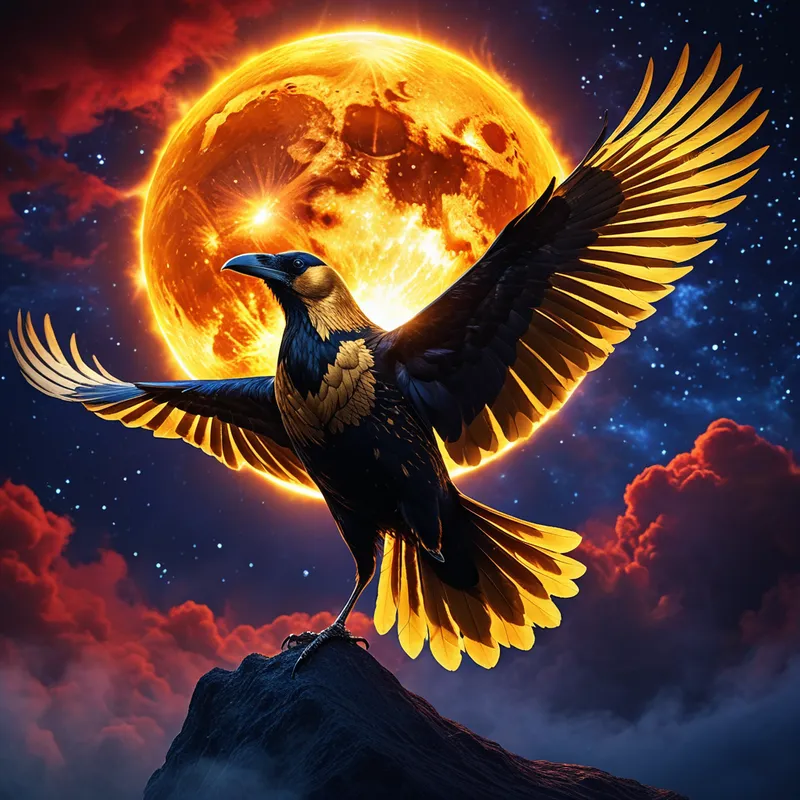
The myth of Jinwu, the golden sun crow, who carries the solar chariot across the sky, embodying cosmic duty, celestial fire, and the burden of light.
The Tale of Jinwu
In the time before time, when the sky was a raw and formless vault, the great celestial sovereign Di Jun looked upon the darkness between the stars. From the primal chaos of the Hundun, he summoned forth a being of pure, condensed solar essence. It was not born, but kindled. Its form was that of a crow, but its feathers were not black—they were the color of hammered gold at the heart of a forge, and its eyes held the piercing, unwavering gaze of a star.
This was Jinwu. And it was not alone. From that same divine spark, two others emerged, their forms identical, their spirits bound to the same cosmic purpose. Di Jun bestowed upon them a sacred duty: to bear the solar chariot across the dome of heaven. Yet, the sun was a weight beyond measure, a cauldron of unbridled creative fire that would consume any ordinary bearer. To withstand this, Di Jun granted each crow a third leg—a pillar of stability, a triangulation of divine will against the chaos of pure energy.
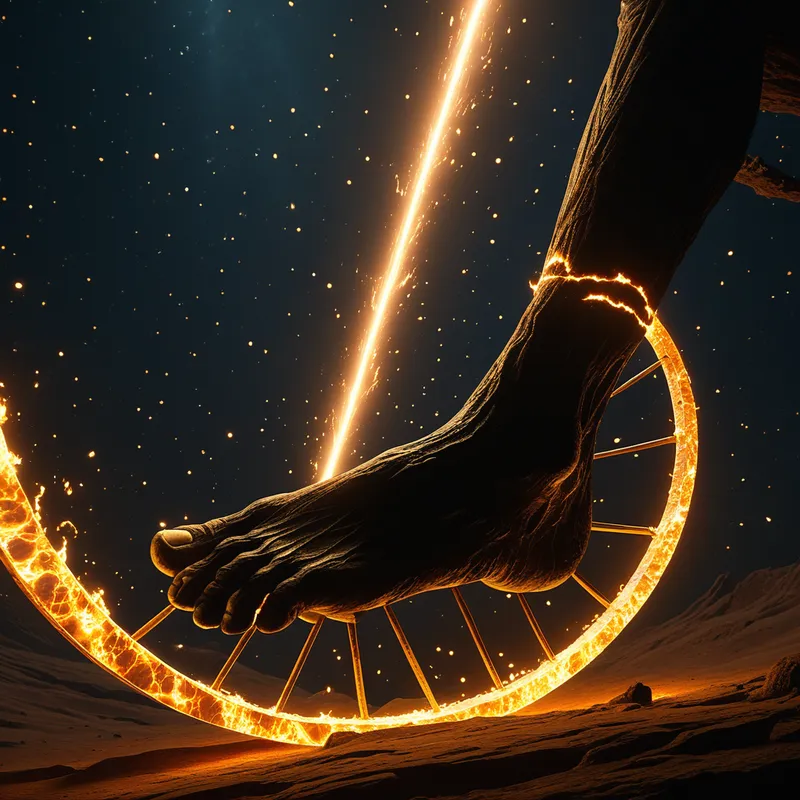
Each dawn, from the Fusang tree in the far east, one Jinwu would rise. It would sink its three talons into the harness of light, and with a cry that split the silence of the void, it would begin its journey. The heat was a physical weight, a roaring wind of flame that beat against its golden wings. It was not a flight of joy, but of profound, solemn labor. The crow did not own the light; it served it. Its path was the unerring arc from east to west, a blazing scar across the azure sky, bringing vision, warmth, and the relentless rhythm of time to the world below.
At the journey’s end, at the Yuan valley, the weary Jinwu would relinquish the sun, which would travel through the underworld to be born anew. For a time, the crow would rest in a celestial nest, its feathers cooling from incandescent white to a soft, glowing gold, before the cycle demanded its strength once more. This was the eternal compact: a being of fire, bound to a path of fire, so that the world below might know the balance of day and night, of activity and rest, of the visible and the hidden.
Cultural Origins & Context
The myth of the Jinwu finds its roots in the earliest strata of Chinese cosmology, notably in texts like the Classic of Mountains and Seas (Shan Hai Jing) and the Chu Ci (<abbr title="" Songs of Chu", an anthology of ancient Chinese poetry">Songs of Chu). It is an animist and astrological narrative, predating the more systematized philosophical schools. The sun was not an abstract ball of gas, but a numinous entity with agency and presence, requiring a divine chauffeur.
This myth functioned as a foundational explanation for the most fundamental observable phenomenon: the daily journey of the sun. It answered the child’s question, "How does the sun move?" with a story that imbued the cosmos with relationship and duty. The Jinwu was the personification of that celestial mechanics, a bridge between the incomprehensible power of the heavenly bodies and the relatable image of a laboring, avian spirit. It was told by shamans, astronomers, and storytellers, serving to connect agrarian life—utterly dependent on the sun’s regularity—to a sacred, animate universe. The crow, often an omen in other contexts, was here elevated to a solar symbol, demonstrating the capacity for cultural symbols to hold paradoxical, layered meanings.
Symbolic Architecture
At its core, the Jinwu is an emblem of consciousness itself—the light-bearing principle that journeys through the psyche, illuminating the landscape of the soul. Its three legs are its most potent symbol, representing a trinity of forces necessary to bear the burden of awareness.
The three legs are not merely for balance; they are the triangulation of Will, Endurance, and Purpose that allows the individual to carry the fire of consciousness without being consumed by it.
The first leg is Duty (Li)—the sacred obligation, the contract with the cosmos and the self. The second is Sacrifice (Xisheng)—the daily expenditure of energy, the acceptance of the consuming heat of existence. The third is Cyclical Return (Fu)—the knowledge that after the exertion, there is the restorative dark, the journey through the underworld of the unconscious to be replenished. The Jinwu does not create the sun; it serves it. This reflects the psychological truth that the ego does not generate consciousness but is its vehicle, tasked with carrying it through the day of our lives.
Furthermore, the myth presents a cosmology of benevolent order. The sun’s path is not arbitrary; it is guided. The potential chaos of raw solar power is tempered by a devoted servant. This translates to the internal experience: our raw instincts, passions, and creative fires (the sun) need a structuring, guiding principle (the Jinwu) to become useful, life-giving forces rather than agents of chaos and burnout.
The Dreamer's Resonance
When the pattern of the Jinwu stirs in the modern unconscious, it often manifests in dreams of immense, solemn responsibility. One might dream of carrying a brilliant but dangerously heavy light source—a lantern, a child of light, a burning sphere—across a vast, predetermined landscape. There is a profound somatic sense of weight, of heat on the back, of a path that must be walked despite exhaustion.
This dream motif signals that the dreamer is grappling with the burden of consciousness in a specific area of life. It may appear during periods of intense career pressure, the demanding care of a family, or the lonely work of a creative or spiritual undertaking. The feeling is not of victimhood, but of a chosen, sacred burden. The psyche is asking: What is the sun you have agreed to carry? Are your three legs—your will, your resilience, your connection to renewal—stable enough for the journey? The dream may also highlight a fear of failing in this duty, of dropping the sun and plunging the world (one’s internal or external world) into chaos.

Alchemical Translation
The journey of the Jinwu is a perfect map for the alchemical process of psychic integration, or individuation. The prima materia, the raw stuff of the soul, is the chaotic, potent energy of the Self (the sun). The ego’s task is not to become the Self, but to become the faithful Jinwu to it.
The alchemical stage of Nigredo (blackening) is the recognition of the burden—the heat, the weight, the sheer scale of the responsibility of being an integrated consciousness. The Albedo (whitening) is the disciplined, daily journey across the sky—the application of will and structure to that raw energy, transforming it into the illuminating light of awareness that orders one’s life. The Citrinitas (yellowing) is the golden glow of the crow itself, the ego forged and tempered by its service, becoming something resilient and radiant.
The ultimate goal is not to stop the journey, but to achieve the Rubedo—the reddening—where the service itself becomes the fulfillment. The crow does not resent the sun; it is fulfilled by its arc. The ego, in full alignment with its purpose, finds that carrying the light is the meaning.
The myth teaches that transformation comes not from avoiding our central, burning duty—our "sun"—but from building the tripartite strength (the three legs) to carry it with grace. Our renewal comes from honoring the necessary descent into the Yuan valley of rest and introspection after the labor of the day. In this eternal cycle of service, journey, and restoration, the individual soul mirrors the cosmos, finding its ordered, purposeful place within the great celestial machinery of becoming.
Associated Symbols
Explore related symbols from the CaleaDream lexicon: