Jingdezhen porcelain Myth Meaning & Symbolism
A myth where a potter's devotion and a celestial sacrifice fuse with earth and fire, birthing the luminous, soul-infused porcelain of Jingdezhen.
The Tale of Jingdezhen Porcelain
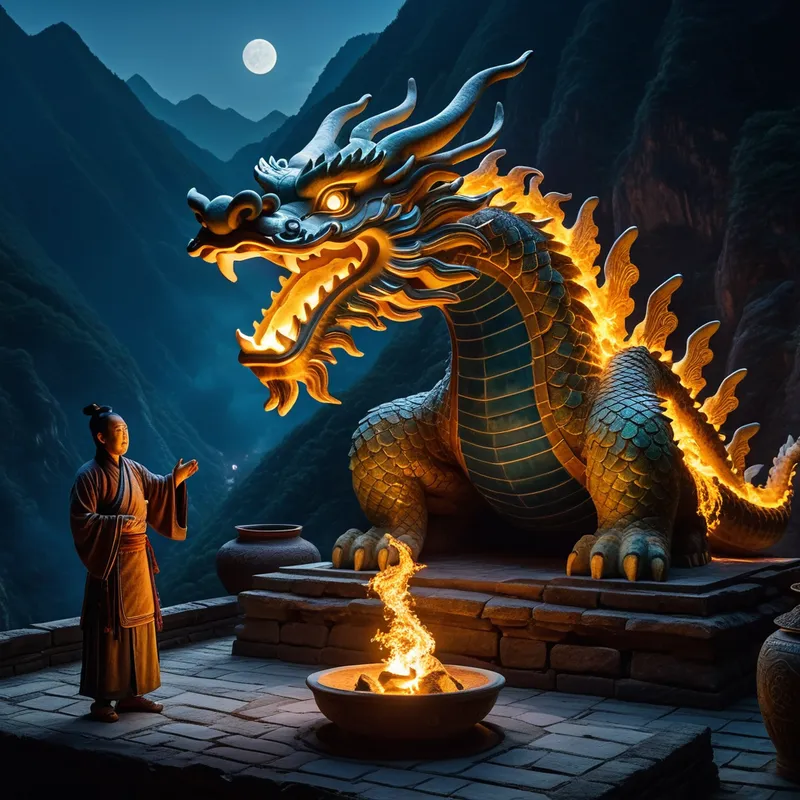
Listen, and hear the story not of a city, but of a soul born from fire and earth. In the time when mountains were young and rivers sang older songs, there was a valley cradled by emerald hills, a place where [the earth](/myths/the-earth “Myth from Hindu culture.”/) wept a strange, white tear. The people there knew this substance—kaolin—as the bones of the sleeping dragon. They shaped it, they baked it, but their wares were coarse, fragile, dull. They yearned for a vessel that could hold the moonlight, a bowl that could sing when struck.
Among them was a potter named Tao, whose hands were gentle but whose spirit burned. He dreamed of a substance pure as winter’s first snow, strong as mountain stone, and luminous as a captured star. For years, his kiln birthed only failure—cracks, warps, dull lumps of wasted earth. The village elders shook their heads; the fire, they said, was never hot enough, the clay never willing.
One desperate night, under a sky pregnant with unshed rain, Tao built his final kiln. He gathered the purest kaolin, mixed with the spirit of [the river](/myths/the-river “Myth from Buddhist culture.”/) quartz, and formed a single, perfect vase. As he placed it in the kiln’s heart, he did not pray to the usual gods of hearth and harvest. He whispered to the mountain itself, to the ancient dragon whose bones he stole, and to the capricious spirit of the fire.
He stoked the flames until they roared like a trapped beast, hotter than any forge before. The kiln glowed, a furious sun in the dark valley. Yet, as dawn approached, Tao knew it was not enough. The transformation he sought hovered just beyond the flame’s reach. In a moment of ultimate devotion, a sacrifice not of blood but of essence, he did not step back. He opened the kiln’s maw and thrust his own hands, the tools of his life’s work, into the inferno.
At that moment, [the sky](/myths/the-sky “Myth from Persian culture.”/) split. A streak of celestial blue—the color of the deepest heaven—fell from the stars, drawn by the purity of his sacrifice and the intensity of his fire. It mingled with the ash, the clay, and [the potter](/myths/the-potter “Myth from Abrahamic culture.”/)’s offering. The mountain rumbled, not in anger, but in release.
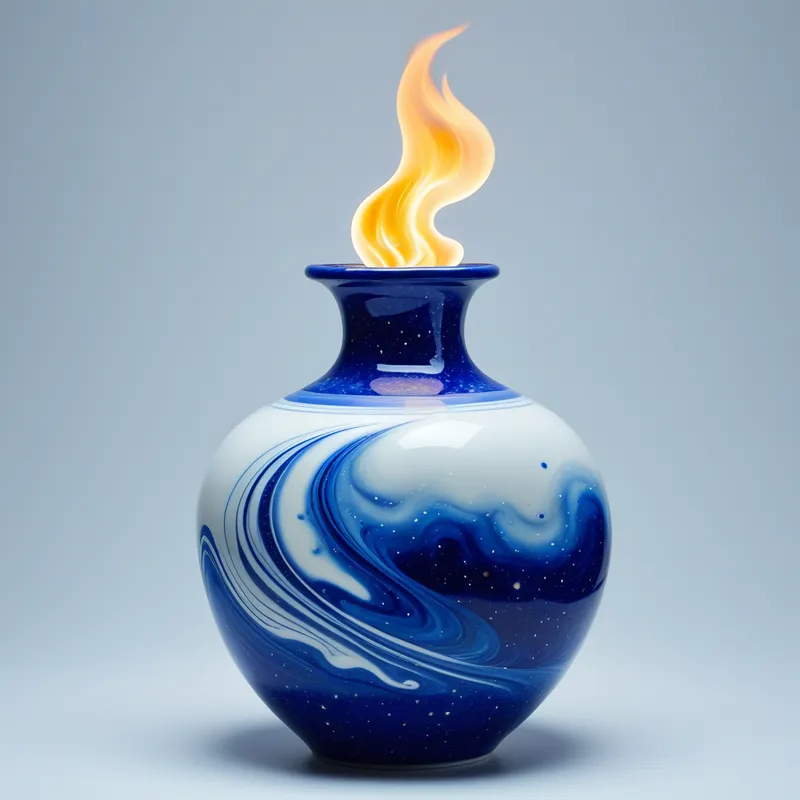
When the fire died and the ashes cooled, Tao, his hands scarred but his eyes clear, reached into the kiln. What he withdrew was not a vase of earth. It was a vessel of captured light. It was thin as an eggshell, resonant as a bell, white as jade yet translucent, and adorned with flowing patterns of that celestial blue, now known as qinghua. He had not just fired clay; he had married earth to heaven in a crucible of human will. He named the place Jingdezhen, and from that day, its kilns breathed soul into [the world](/myths/the-world “Myth from Tarot culture.”/).
Cultural Origins & Context
The story of Jingdezhen’s genesis is a foundational etiological myth, born from the very furnaces of the city that became synonymous with [porcelain](/myths/porcelain “Myth from Chinese culture.”/) for over a millennium. Unlike myths of distant gods, this is a legend of human artisanship elevated to the divine. It emerged organically from the guilds and kiln masters of the Song Dynasty, a time when Jingdezhen’s technical mastery was producing porcelain so exquisite it was termed “white gold” and treasured across continents.
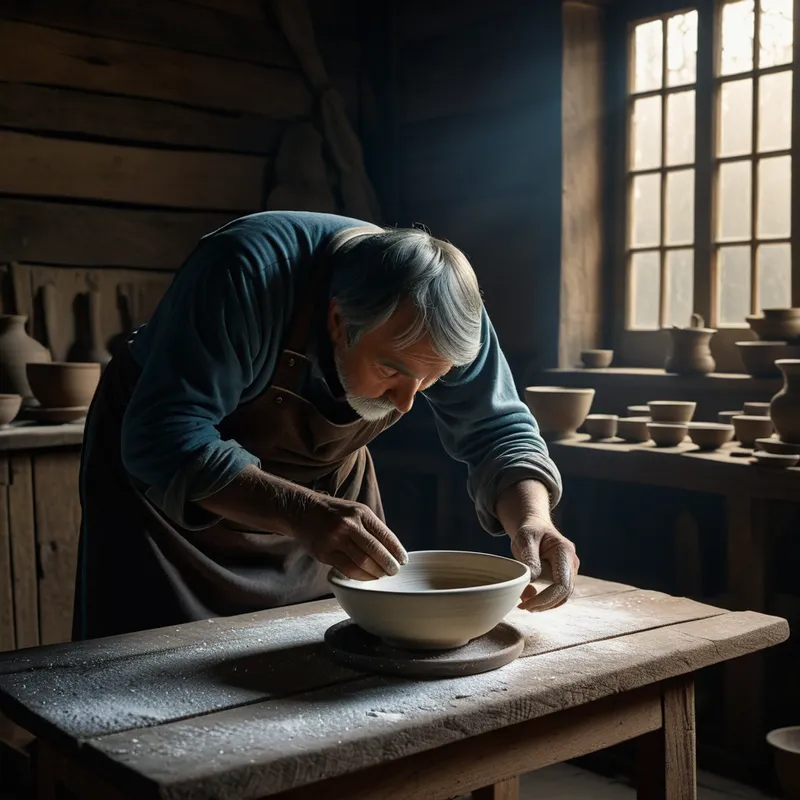
The tale was passed down not in imperial courts, but in workshops thick with clay dust. Master potters told it to apprentices as they wedged the kaolin, a sacred initiation into the craft’s spiritual burden. Its societal function was multifaceted: it explained the preternatural quality of Jingdezhen ware, it codified the extreme dedication required of the artisan (the “potter’s sacrifice”), and it sanctified the industrial process. The kiln was not just an oven; it was an alchemical womb, and firing day was a ritual where the mundane met the miraculous. The myth served as a charter, justifying the city’s global prestige and instilling in every craftsman the belief that their work was a cosmological act.
Symbolic Architecture
At its core, the myth is a profound map of creation, where three realms—[Earth](/symbols/earth “Symbol: The symbol of Earth often represents grounding, stability, and the physical realm, embodying a connection to nature and the innate support it provides.”/), Humanity, and [Heaven](/symbols/heaven “Symbol: A symbolic journey toward ultimate fulfillment, spiritual transcendence, or connection with the divine, often representing life’s highest aspirations.”/)—are fused in a fourth element: transformative Fire.
The white kaolin represents primal potential, the [prima materia](/myths/prima-materia “Myth from Alchemical culture.”/) of the [soul](/symbols/soul “Symbol: The soul represents the essence of a person, encompassing their spirit, identity, and connection to the universe.”/)—pure, formless, and waiting. The potter, Tao, is the archetypal homo faber, the [human](/symbols/human “Symbol: The symbol of a human represents individuality, complexity of emotions, and social relationships.”/) ego with a [vision](/symbols/vision “Symbol: Vision reflects perception, insight, and clarity — often signifying the ability to foresee or understand deeper truths.”/) of perfection. His struggle is the [human](/symbols/human “Symbol: The symbol of a human represents individuality, complexity of emotions, and social relationships.”/) [condition](/symbols/condition “Symbol: Condition reflects the state of being, often focusing on physical, emotional, or situational aspects of life.”/): possessing the [material](/symbols/material “Symbol: Material signifies the tangible aspects of life, often representing physical resources, desires, and the physical world’s influence on our existence.”/) and the skill, yet lacking the final, transcendent power.
The kiln is the crucible of the Self, where identity is subjected to unbearable heat to discover if it will shatter or become diamond.
The potter’s act of sacrificing his hands—his means of agency and [identity](/symbols/identity “Symbol: Identity represents the sense of self, encompassing personal beliefs, cultural background, and social roles.”/)—is the pivotal [moment](/symbols/moment “Symbol: The symbol of a ‘moment’ embodies the significance of transient experiences that encapsulate emotional depth or pivotal transformations in life.”/). It symbolizes the surrender of conscious control, [the ego](/myths/the-ego “Myth from Jungian culture.”/)’s offering to a process greater than itself. This allows for the descent of the celestial blue (qinghua), the transcendent principle, the numinous “[spirit](/symbols/spirit “Symbol: Spirit symbolizes the essence of life, vitality, and the spiritual journey of the individual.”/)” that completes the work. The resulting [porcelain](/symbols/porcelain “Symbol: A delicate, refined ceramic material symbolizing fragility, purity, and transformation through fire. Often represents beauty that requires careful handling.”/) is thus a triune being: [body](/symbols/body “Symbol: The body in dreams often symbolizes the dreamer’s self-identity, personal health, and the relationship they have with their physical existence.”/) ([clay](/symbols/clay “Symbol: Clay symbolizes malleability, creativity, and the potential for transformation, representing the foundational aspect of life and the ability to shape one’s destiny.”/)), soul (human sacrifice/devotion), and [spirit](/symbols/spirit “Symbol: Spirit symbolizes the essence of life, vitality, and the spiritual journey of the individual.”/) (celestial infusion). It is no longer a mere object; it is a [symbol](/symbols/symbol “Symbol: A symbol can represent an idea, concept, or belief, serving as a powerful tool for communication and understanding.”/) of achieved wholeness.
The Dreamer’s Resonance
When this myth stirs in the modern unconscious, it often manifests in dreams of intense, creative pressure and fragile beauty. To dream of shaping perfect, white clay signifies a confrontation with one’s raw, unformed potential. The somatic feeling is often one of anxious, meticulous focus—the dreamer’s hands working with urgent care.
Dreams of a kiln, especially one that is overheating, cracking, or glowing ominously, point to a psychological process underway: the “firing” of the personality. This is a period of intense stress, life transition, or emotional trial where the old structures of [the self](/myths/the-self “Myth from Jungian culture.”/) are being tested. The fear is of “cracking”—of psychological breakdown or failure.
Most poignantly, to dream of reaching into a fire or sacrificing a part of oneself to complete a beautiful object reflects a profound crossroads in individuation. The dreamer is grappling with the necessity of surrendering a cherished skill, a long-held identity, or a mode of control to allow a deeper, more authentic self to emerge from the trial. The finished, luminous vessel in the dream represents the nascent, integrated Self, perceived as both incredibly precious and terrifyingly fragile.
Alchemical Translation
The myth of Jingdezhen porcelain is a perfect allegory for the Jungian process of individuation—the psychic alchemy of becoming whole. We all begin as kaolin: a mass of innate potentials, complexes, and inherited patterns. The conscious ego, the potter, takes this material and attempts to shape a life according to its design. But the ego’s designs are always provisional.
The kiln-fire is the inevitable encounter with the heat of life: suffering, conflict, passion, and the demands of reality. We are all thrust into this fire. The common instinct is to retreat, to fire at a low, safe temperature, which produces a stable but coarse, opaque life—functional, but lacking luminosity and resonance.
Individuation demands the sacrificium intellectus—the sacrifice of the intellect’s total control. One must offer one’s prized competencies and self-conceptions to the flames of the unconscious.
This is the potter offering his hands. Psychologically, it is the willingness to let go of who you think you are, to admit helplessness, and to allow a transpersonal force (the Self, symbolized by the celestial blue) to enter the process. This is not passive; it is a conscious, painful act of faith made at the moment of greatest tension.
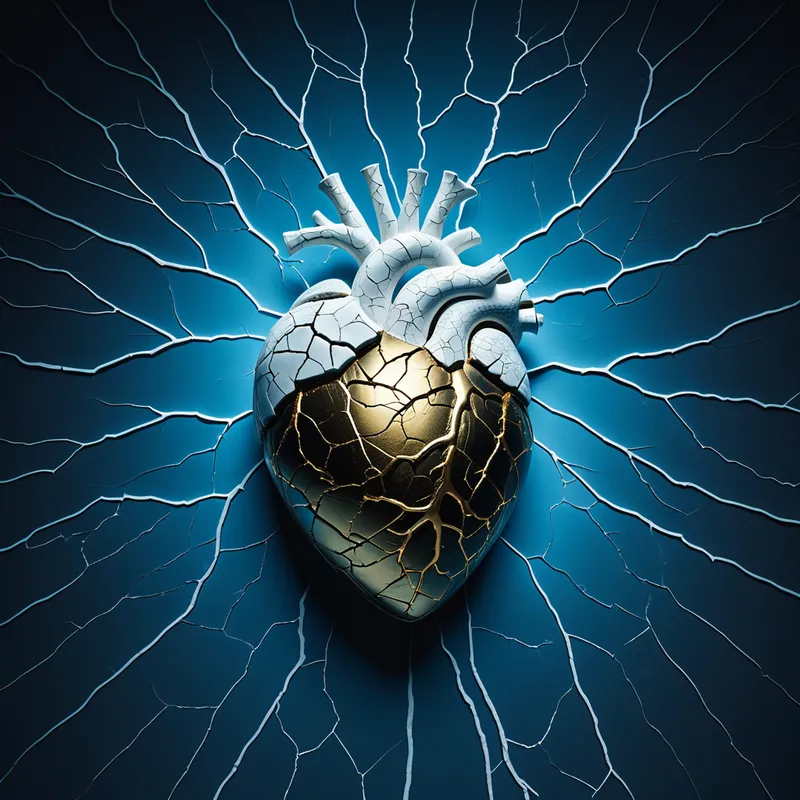
The result is not the destruction of the ego, but its transmutation. The porcelain vessel is the new, integrated personality. It retains the form given by the ego (the potter’s skill) but is now imbued with a transcendent quality. It is stronger yet more translucent, capable of “ringing true.” It holds the blue patterns of the infinite within the white field of consciousness. To become Jingdezhen porcelain is to understand that one’s true value is born not from avoiding the fire, but from consenting to be utterly reconstituted by it, emerging as a vessel that can finally hold the light.
Associated Symbols
Explore related symbols from the CaleaDream lexicon: