Jesus' Empty Tomb Myth Meaning & Symbolism
A myth of a sealed tomb found empty, signaling a radical rupture in cosmic order and the triumph of life over death.
The Tale of Jesus’ Empty Tomb
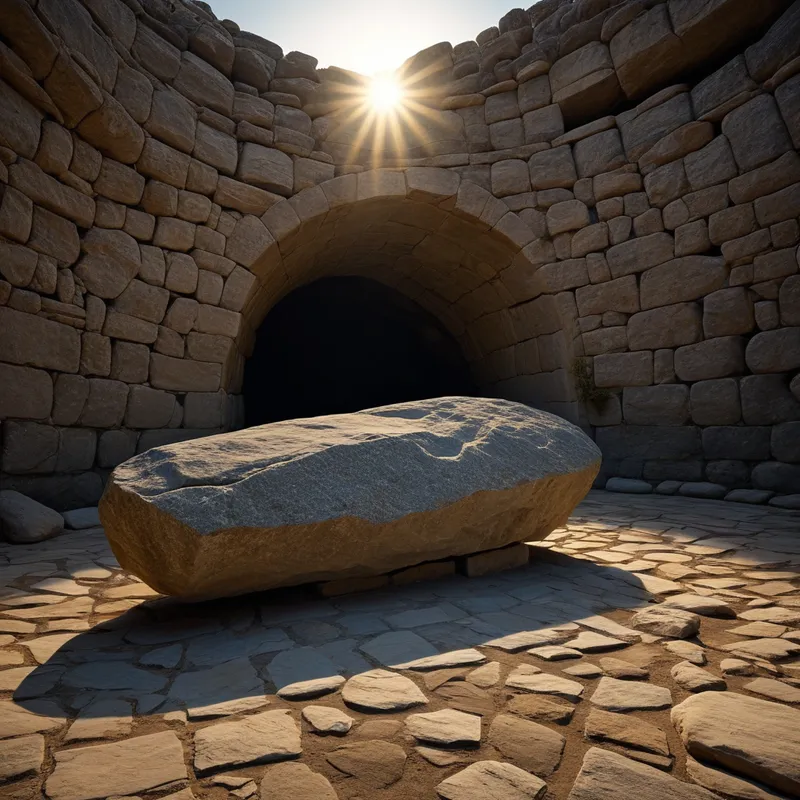
[The world](/myths/the-world “Myth from Tarot culture.”/) held its breath. For three days, [the sky](/myths/the-sky “Myth from Persian culture.”/) had wept ash-grey tears since the unthinkable had happened. The one they called the Messiah had been broken on the Roman wood, his light seemingly extinguished by the cold machinery of empire and fear. His body, hastily anointed, was laid in a tomb hewn from stone—a borrowed crypt sealed with a disc of rock so massive it spoke a final, physical “no.” The stone was the full stop at the end of the sentence of a life.
Then, on the first day of the week, while darkness still clung to [the earth](/myths/the-earth “Myth from Hindu culture.”/) like a shroud, [Mary Magdalene](/myths/mary-magdalene “Myth from Christian culture.”/) came. She came with spices and a heart of lead, carrying only the duty of the final, loving gesture. But the world had shifted in the night. The stone, that definitive seal, was rolled aside. The mouth of the tomb was open, a dark yawn against the pale rock.
She ran. Her breath came in ragged gasps as she fetched John and the rock-solid [Peter](/myths/peter “Myth from Biblical culture.”/). The men raced, a frantic dash through the olive groves. John, younger, arrived first. He stooped, peering into the gloom. He saw the linen burial cloths lying there, collapsed like the shed skin of a serpent. But he did not enter.
Peter arrived, all impulse and storm. He went straight in, into the scent of myrrh and aloes and absence. He saw the linens, and separate from them, the cloth that had been around Yeshua’s head, neatly folded, set apart. This was not the work of thieves or vandals. Thieves do not fold. Vandals do not leave order. This was a deliberate vacancy.
Then John entered. The text says simply, “He saw and believed.” What did he believe? Not a theory, not a doctrine, but the evidence of the empty space. The body was gone, but the trappings of death remained, orderly and abandoned. The tomb was not a scene of loss, but of a finished transaction. The women who came later would hear the impossible question from luminous strangers: “Why do you look for the living among the dead?”
The conflict was not with soldiers or a stone. It was with reality itself. The rising action was the dawning, terrifying, glorious realization that the rules had been rewritten. Death, the oldest tyrant, the final enemy, had been met at its very core—the sealed grave—and found wanting. The resolution was not a body, but a presence; not a corpse reanimated, but a life transcended, appearing in gardens, on roads, behind locked doors. [The empty tomb](/myths/the-empty-tomb “Myth from Christian culture.”/) was the silent, physical proof of a rupture in the cosmic order, the first note of a new song sung into [the void](/myths/the-void “Myth from Buddhist culture.”/).

Cultural Origins & Context
This narrative forms the explosive core of the earliest Christian proclamation, or kerygma. Historically, it emerges from a first-century Judean context under Roman occupation, a culture steeped in apocalyptic expectation and diverse beliefs about resurrection, typically seen as a collective, end-time event.
The story’s transmission is pivotal. In the cultural milieu of the time, women’s testimony was considered unreliable in legal settings. That the primary witnesses to the empty tomb in all four canonical Gospels are women—Mary Magdalene foremost among them—is a striking detail. It argues for the primitive authenticity of the report; no later inventor crafting a persuasive story would lead with witnesses deemed culturally incompetent. The tale was passed down not as a philosophical idea but as a witnessed event, a scandalous fact that demanded explanation. Its societal function was foundational: it served as the empirical anchor for the claim that Yeshua was not merely a martyred teacher but the victorious Christ whose resurrection inaugurated a new age, a new creation, offering hope and identity to a marginalized community facing persecution.
Symbolic Architecture
Psychologically, the empty tomb is not about the negation of [death](/symbols/death “Symbol: Symbolizes transformation, endings, and new beginnings; often associated with fear of the unknown.”/), but the transformation of its [vessel](/symbols/vessel “Symbol: A container or structure that holds, transports, or protects something essential, representing the self, emotions, or life journey.”/). The tomb represents the ultimate container of the finite self, [the ego](/myths/the-ego “Myth from Jungian culture.”/)-[structure](/symbols/structure “Symbol: Structure in dreams often symbolizes stability, organization, and the framework of one’s life, reflecting how one perceives their environment and personal life.”/) built of personal [history](/symbols/history “Symbol: History in dreams often represents the dreamer’s past experiences, lessons learned, or unresolved issues that continue to influence their present.”/), [trauma](/symbols/trauma “Symbol: A deeply distressing or disturbing experience that overwhelms the psyche, often manifesting in dreams as unresolved emotional wounds or psychological injury.”/), and limitation—all that is destined to die.
The stone rolled away is the psyche’s own consent to be opened, revealing that the most solid-sealing truth we know—our own end—is permeable.
The abandoned linens are powerful symbols. They are the cast-off [identity](/symbols/identity “Symbol: Identity represents the sense of self, encompassing personal beliefs, cultural background, and social roles.”/), the former “garment” of [the self](/myths/the-self “Myth from Jungian culture.”/) that is no longer needed. The neatly folded face [cloth](/symbols/cloth “Symbol: Cloth often symbolizes protection, comfort, and transformation, serving as a barrier and a medium for expression in dreams.”/) suggests not a frantic escape, but a deliberate, completed [operation](/symbols/operation “Symbol: An operation signifies a process of change or transformation that often requires deliberate effort and planning.”/). It signifies the leaving behind of the mortal [persona](/symbols/persona “Symbol: The social mask or outward identity one presents to the world, often concealing the true self.”/) with care, not in disgust. The [emptiness](/symbols/emptiness “Symbol: Emptiness signifies a profound sense of void or lack in one’s life, often related to existential fears, loss, or spiritual quest.”/), therefore, is not a void of [absence](/symbols/absence “Symbol: The state of something missing, void, or not present. Often signifies loss, potential, or existential questioning.”/) but a plenum of potential. It symbolizes the shocking [truth](/symbols/truth “Symbol: Truth represents authenticity, honesty, and the quest for knowledge beyond mere appearances.”/) that the center of our greatest fear—the tomb of our old [life](/symbols/life “Symbol: The symbol of ‘Life’ represents a journey of growth, interconnectedness, and existential meaning, encompassing both the joys and challenges that define human experience.”/), our fixed [identity](/symbols/identity “Symbol: Identity represents the sense of self, encompassing personal beliefs, cultural background, and social roles.”/), our deepest defeat—can become the very [site](/symbols/site “Symbol: The concept of a ‘site’ in dreams often represents a specific location associated with personal memories, emotional experiences, or stages in one’s life.”/) of liberation and new genesis. The [hero](/symbols/hero “Symbol: A hero embodies strength, courage, and the ability to overcome significant challenges.”/)’s [journey](/symbols/journey “Symbol: A journey in dreams typically signifies adventure, growth, or a significant life transition.”/) culminates not in returning with a boon, but in disappearing from the [prison](/symbols/prison “Symbol: Prison in dreams typically represents feelings of restriction, confinement, or a lack of freedom in one’s life or mind.”/) altogether, demonstrating that the prison itself was an illusion.
The Dreamer’s Resonance
When this mythic pattern stirs in the modern dreamer, it signals a profound somatic and psychological process: the death-and-rebirth archetype is activating. To dream of finding a familiar, sealed space—a room, a vault, a coffin—strangely open and empty can be deeply unsettling.
The somatic feeling is often one of dizzying disorientation, a groundlessness. This mirrors Mary’s initial panic. The dream-ego confronts the evidence that a part of the self it believed to be solid, defined, and permanent—perhaps a long-held grievance, a defining trauma, a rigid role (the caregiver, the victim, the achiever)—has vanished. The container remains, but the content has transmuted. This dream is not about literal death, but about the dissolution of a psychic complex that once felt like the core of one’s identity. The process is one of deep, often involuntary, [nigredo](/myths/nigredo “Myth from Alchemical culture.”/) and ablutio—the blackening and the washing away. The dreamer is in the tomb, experiencing the necessary emptiness that precedes authentic renewal.
Alchemical Translation
The alchemical process mirrored here is the ultimate transmutation: turning lead (the dead, entombed self) into gold (the liberated spirit). The myth models the individuation journey’s most critical phase.
First, the nigredo: the crucifixion and entombment. The conscious ego suffers its ultimate defeat, its plans and understanding shattered. All seems lost in the blackness of the sealed sepulcher.
Then, the hidden, mysterious operation: the albedo. This occurs unseen, in the dark. It is the unconscious [psyche](/myths/psyche “Myth from Greek culture.”/)’s work of dissolution and recombination. In the myth, this is the silent [Sabbath](/myths/sabbath “Myth from Judeo-Christian culture.”/), the day of rest when God works. For the individual, it is the period of depression, incubation, or unknowing, where the old structures are quietly broken down.
The empty tomb is the evidence of the albedo—not the new dawn itself, but the first white light reflecting off the opened vessel, proving the work is done.
Finally, the stone is rolled away not by human effort, but by a force from beyond the ego. The individual does not “achieve” this resurrection; they witness its evidence and are called to believe in the reality of a process greater than themselves. The alchemical gold is the [lapis philosophorum](/myths/lapis-philosophorum “Myth from Alchemical culture.”/), the Philosopher’s Stone—the integrated Self that has passed through and transcended the illusion of its own annihilation. The modern individual’s [triumph](/myths/triumph “Myth from Roman culture.”/) is to stand before the empty tomb of their old identity, to behold the abandoned wrappings of a former life, and to dare to believe the impossible: that this emptiness is not the end, but the one truly necessary condition for a life that is genuinely, fearlessly new.
Associated Symbols
Explore related symbols from the CaleaDream lexicon: