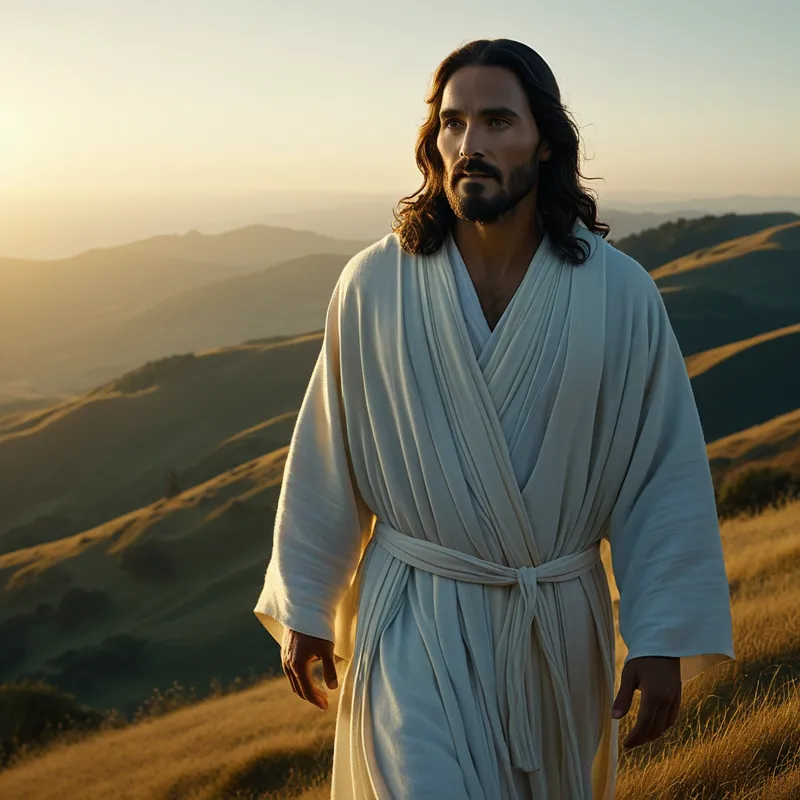
Jesus Myth Meaning & Symbolism
A myth of divine incarnation, sacrificial death, and triumphant resurrection, offering a map for the soul's journey through suffering into wholeness.
The Tale of Jesus
In the fullness of time, under the watchful eye of a single, brilliant star, the Logos was woven into flesh within a humble maiden. He was born not in a palace of stone, but in the earthy sanctuary of a stable, his first breaths mingling with the scent of hay and animal warmth. They called him Yeshua.
He grew in wisdom, and in the ripeness of his years, a voice cried out in the wilderness—a prophet named John—preparing a way. In the cool, flowing waters of the Jordan, the heavens were torn open, and a declaration thundered: “This is my beloved Son.” Thus anointed, he walked the dust-choked roads of Judea. His words were not like the scholars’; they were seeds that fell on the heart’s soil, speaking of a kingdom not of land and legion, but of spirit. He touched the untouchable, spoke peace to the storm, and offered living water to the parched soul. He gathered followers—fishermen, tax collectors, the weary and hopeful—and showed them a mirror, a reflection of their own divine potential.
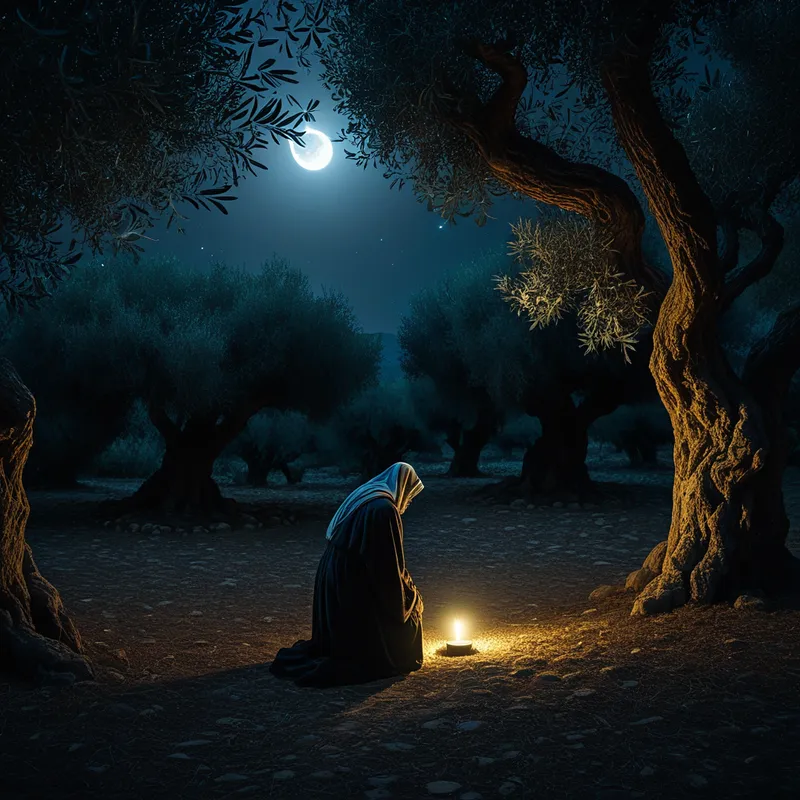
But light casts long shadows. His radical love, his claim of intimacy with the Abba, threatened the careful orders of temple and empire. In a hushed upper room, he broke bread and poured wine, speaking of a covenant in his body and blood. Then, in a garden heavy with the scent of olives and dread, he sweat tears of blood, pleading for another way, yet surrendering to a will greater than his own.
Betrayed by a kiss, he was paraded before cynical rulers. A crown not of gold, but of cruel thorns was pressed upon his brow. He was scourged, his back a map of suffering, and forced to carry the instrument of his death—a rough-hewn cross—through a gauntlet of grief and scorn. On a hill called Golgotha, under a sky that turned to mourning, they nailed him to the wood. Between two thieves, he hung, a portrait of ultimate abandonment. “Father, forgive them,” he whispered, and finally, “It is finished.” The earth trembled. The temple veil, separating the holy from the human, tore from top to bottom. He was laid in a tomb, sealed with a stone, and the world held its breath in a silent Saturday.
Then, at dawn on the first day of the week, the stone was rolled away. The tomb was empty, save for folded linens. To a weeping woman named Mary Magdalene, he appeared, not as a ghost, but as a gardener, calling her name. He walked with the despairing on a road, broke bread with them, and showed his wounded hands and side. Death, the ancient enemy, was found to have no final claim. The sacrificed one was alive, the firstborn of a new creation.
Cultural Origins & Context
This story emerged from the fertile, turbulent soil of Second Temple Judaism, a culture yearning for liberation under Roman occupation. It was a story told not first by scholars in scrolls, but by witnesses in marketplaces and homes—fishermen, tentmakers, and former zealots. They were part of a messianic movement that interpreted the life and shocking death of their rabbi, Jesus of Nazareth, through the lens of ancient Hebrew scripture, particularly the suffering servant passages of Isaiah.
The primary vehicle was oral tradition—stories, parables, and accounts of miracles memorized and shared within tight-knit communities. These were later codified into the Gospels, which are not neutral biographies but theological narratives, each painted with the unique colors of its author’s community and purpose. The myth’s societal function was multifaceted: it provided a new identity (a people “in Christ”), explained catastrophic suffering (the crucifixion), offered ultimate hope (resurrection), and created a powerful ethical framework based on radical love and forgiveness, setting itself apart from both Roman imperial cult and traditional Jewish law.
Symbolic Architecture
At its core, the Jesus myth is a profound symbolic drama of the psyche’s journey toward wholeness, or individuation. The figure of Jesus represents the Self—the divine nucleus of the personality that calls one to a destiny beyond the ego’s comfort.
The incarnation is the descent of the Self into the messy, limited reality of conscious life. The ego must host something infinitely greater than itself.
The Last Supper symbolizes the necessity of assimilating (eating and drinking) one’s own destined suffering and transformation. The agony in Gethsemane is the ego’s brutal confrontation with the will of the Self, a moment of terrifying, solitary choice between personal desire and transpersonal purpose.
The crucifixion is the ultimate image of the ego’s necessary sacrifice. It is the death of the old identity, the persona, and all its attachments. It represents being stretched between opposites (heaven and earth, human and divine, crime and grace) and held in the unbearable tension where transformation occurs.
The resurrection is not a reversal of death, but its transmutation. It is the emergence of a new, integrated consciousness from the ashes of the old—a body that bears the wounds but is no longer bound by them.
The Dreamer's Resonance
When this mythic pattern stirs in the modern dreamer, it often signals a profound dark night of the soul. Dreaming of being betrayed, unfairly accused, or carrying a heavy burden may reflect the psyche’s preparation for an ego-death—the end of a life chapter, a career, a relationship, or a long-held self-image.
Somatic sensations in such dreams—a pressure on the chest, a feeling of being bound or pierced—can mirror the psychological weight of this process. A dream of being in a garden in deep anguish points to the prelude to sacrifice, the internal debate before a fateful, life-altering decision. Conversely, dreams of empty tombs, rolled-away stones, or encountering a familiar yet transformed figure in a garden speak to the nascent stage of renewal, the first intimations of a new Self struggling to be born from the dissolution. The dream ego is not literally Jesus, but is participating in the archetypal drama of suffering, surrender, and rebirth that he embodies.

Alchemical Translation
The myth provides a complete map for the alchemical opus. The life and teachings represent the nigredo—the blackening. Here, the base material of the personality (the lead) is confronted with its shadow through radical humility, forgiveness of enemies, and love for the outcast. This is the painful dissolution of egoic certainties.
The crucifixion is the pivotal mortificatio—the killing and fixing. The conscious personality must be “nailed” to the cross of its contradictions and sacrificed to a higher unity. This is not self-annihilation, but the surrender of the ego’s central control to the guidance of the Self.
The three days in the tomb are the silent, essential albedo—the whitening. It is a state of passive incubation, where the psychic material rests in the unconscious, purified and awaiting new form.
The resurrection is the rubedo—the reddening, the production of the lapis. This is the birth of the integrated individual who has assimilated their suffering and shadow. The “glorified body” that can pass through walls yet eat fish is the symbol of a consciousness that is both grounded in reality (corporeal) and liberated from its former limitations (transcendent). For the modern individual, the alchemical translation is this: one must consciously consent to be broken open by life’s inevitable sufferings, not to be destroyed, but to have the hard shell of the ego cracked so that the greater, golden Self within can finally emerge and walk the earth anew.
Associated Symbols
Explore related symbols from the CaleaDream lexicon: