Jericho's Walls Myth Meaning & Symbolism
A story of a city's impenetrable walls, a people's faith, and a divine command to march and shout until the impossible stone crumbles into dust.
The Tale of Jericho's Walls
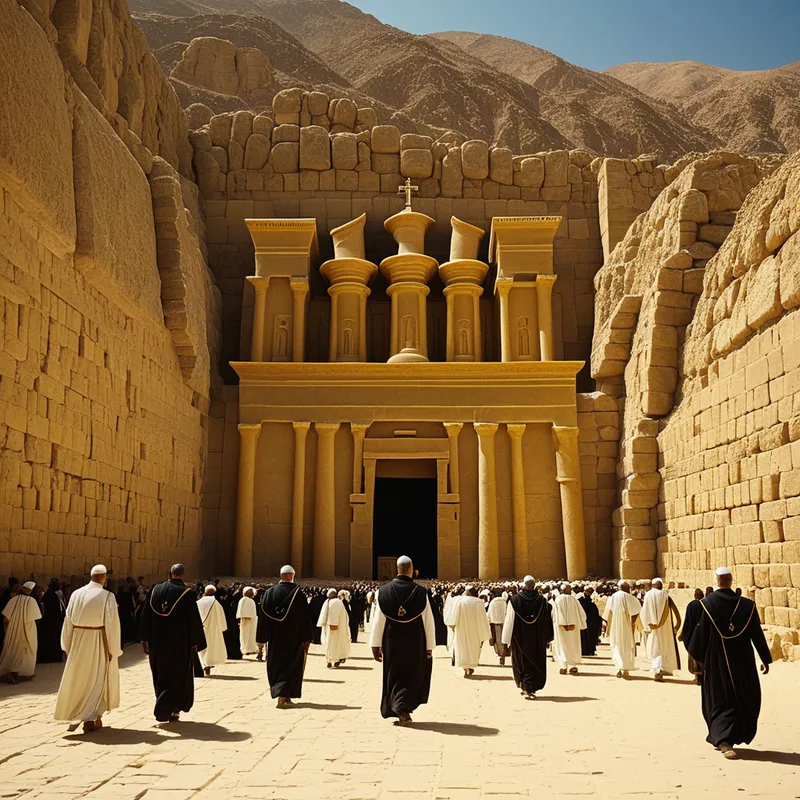
Hear now a tale of stone and spirit, of a barrier that defied the sun and a sound that brought it down. Beyond the Jordan’s flow, in a land of promise and peril, stood Jericho. Its walls were not merely built; they were a statement carved from the earth’s bones, a circle of defiance so high it scraped the belly of the sky, so thick it mocked the siege-craft of kings. It was a city shut up tight, a clenched fist of stone.
And to this fortress came a people who carried their god in a box of gold and acacia wood. They were led by Joshua, a man with the weight of a promise on his shoulders. The command that came to him was not of battering rams or scaling ladders. It was a strategy of sacred absurdity. For six days, the warriors, the priests bearing the Ark of the Covenant, and seven priests with shofars made of ram’s horn, walked in utter silence. Once each day, they completed a full circuit around the immense wall. The only sound was the shuffle of sandals on dust and the distant, taunting cries of the guards above.
Inside the walls, fear curdled into confusion, then into a brittle mockery. What were these fools doing? This was not war; it was a funeral procession for their own hopes.
On the seventh day, they rose with the dawn. This day, they did not walk once, but seven times. The air grew taut, charged with a terrible patience. On the seventh circuit, as the sun climbed, Joshua raised his hand. The priests lifted the shofars to their lips. And Joshua spoke the word that had been held in the people’s hearts for seven days: “Shout!”
And they shouted. A roar tore from the throats of every man, woman, and child—a cry of forty years of wandering, of faith held against all evidence, of a promise remembered. The priests blew a long, shuddering blast on the ram’s horns, a sound that was not music but a tectonic groan.
Then, the world unmade itself.
The great stones did not topple outward. They did not shatter from a blow. From their deepest foundations, a tremor awoke. The mighty wall shuddered, then collapsed inward upon itself, every stone falling flat, as if bowing to the dust from which it came. The roar of the shout was swallowed by the deeper roar of collapsing masonry, a cloud of powdered limestone rising like a ghost of the barrier it once was. Where there had been an impossibility, there was now only a ramp of broken stone, leading into the heart of the city. The silence that followed was more profound than the silence that had preceded it—a silence of awe, of a world rearranged by a sound.

Cultural Origins & Context
This narrative is anchored in the Torah and the historical books of the Hebrew Bible, specifically the Book of Joshua. It functions as a foundational etiological myth, explaining not just a military conquest, but the theological and moral justification for the Israelite settlement in Canaan. It was a story told and retold around fires, in temple readings, and during Passover, serving as a potent reminder of divine election and covenant.
The tale operates on multiple cultural levels. Historically, it marks the transition from a nomadic, tribal existence to a settled, national one. Societally, it reinforced absolute reliance on YHWH over human military strategy—a radical concept in the ancient Near East. The ritualistic, seven-day pattern mirrors creation itself, framing the event not as a battle but as a re-creation of the land according to divine order. The story was a collective anchor, affirming that their identity was not forged in conventional power, but in obedience to a sacred, often inscrutable, pattern.
Symbolic Architecture
The walls of Jericho are the ultimate symbol of the impregnable defense. They represent not just a physical barrier, but a psychological one: the rigid ego-structure, the entrenched complex, the seemingly unassailable fortress of old beliefs, trauma, or identity that separates the conscious self from its promised land—the fuller, more authentic state of being.
The most formidable walls are not made of stone, but of the stories we tell ourselves about what is possible.
Joshua embodies the directed will of the ego, now aligned with a higher directive (the Self). The Ark of the Covenant represents the numinous, guiding center of the psyche—the sacred law or inner truth one carries. The silent marching is the disciplined, often frustrating period of preparation and containment, where energy is gathered and focused without premature expression. The shofar blast is the voice of spirit, the archetypal call that shatters literalism. It is not an argument, but a resonant frequency that disrupts old structures.
The collapse inward is critical. The wall does not fall on the attackers; it disintegrates from within. This signifies that the true work of breaking down a complex is internal. The external act (the shout) merely triggers the internal failure of the complex’s own foundation, which was always more fragile than it appeared.
The Dreamer's Resonance
When this myth stirs in the modern unconscious, it often manifests in dreams of confronting immense, smooth barriers or endlessly circling a problem. You may dream of a vast wall in a landscape, a sealed vault door, or being trapped in a circular room with no exit. The feeling is one of frustration and impossibility.
Somatically, this can correlate with a sense of constriction in the chest or throat—the shout that cannot be uttered. Psychologically, the dreamer is likely at the precipice of a major breakthrough but is caught in the "silent marching" phase. They are gathering the psychic energy needed, perhaps through therapy, journaling, or simply enduring a difficult period, but the conscious ego (Joshua) has yet to receive or act on the command to "shout." The dream is a snapshot of the tension before the release, highlighting the paradoxical need for disciplined patience followed by a single, total, and cathartic expression of one's truth.

Alchemical Translation
The alchemy of Jericho is a masterclass in solve et coagula—the dissolution and reconstitution of the psyche. The old, calcified city-ego (Jericho) must be dissolved so that the liberated spirit can inhabit a new, more conscious structure.
The process begins with the nigredo, the blackening: the recognition of the wall, the feeling of being shut out from one's own life. The silent marching is the albedo, the whitening—a purification through strict adherence to an inner law, a burning off of impulsive reactions. It is the moonlit work of reflection.
The shout is the rubedo, the reddening—not an explosion of anger, but the full-bodied, embodied expression of the Self. It is the heart's truth given voice.
The final stage is the citrinitas, the yellowing or enlightenment: the dust settles, revealing that the barrier was an illusion maintained by consensus. The path is open. The treasure of the city—the hidden aspects of the self that were locked away behind defenses (represented by the spoils dedicated to the sacred)—can now be integrated. The individual does not become the wall; they become the open land. The psychic energy once spent on maintaining the fortress is freed, transmuted into the vitality needed to build a conscious life on the newfound ground of the soul. The myth thus maps the journey from a psyche dominated by a monolithic complex to one that is permeable, alive, and oriented around its own sacred center.
Associated Symbols
Explore related symbols from the CaleaDream lexicon: