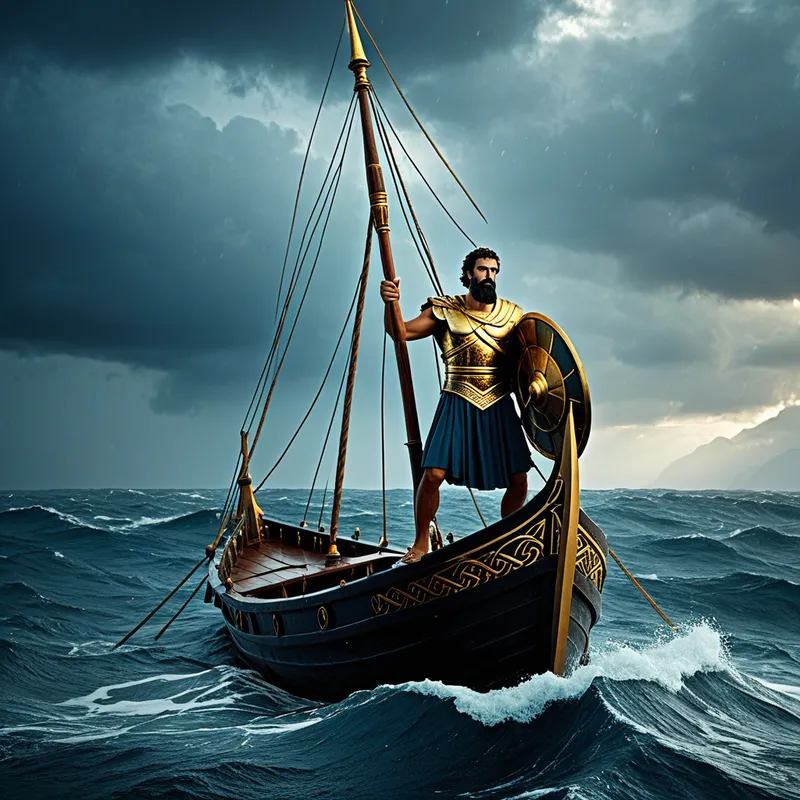
Jason Myth Meaning & Symbolism
A usurped prince's quest for a magical fleece becomes a crucible of destiny, testing loyalty, love, and the soul's true worth.
The Tale of Jason
Hear now the tale of a kingdom stolen, and the price of its return. It begins not with a hero, but with a frightened infant smuggled from a palace soaked in blood. His name was Jason, rightful heir to Iolcus, but his uncle, the usurper Pelias, had murdered all before him. The boy was secreted away to the wild slopes of Mount Pelion, to be raised by the centaur Chiron. There, far from the intrigues of men, he learned the arts of war, healing, and the secret language of the stars.
Years flowed like a river. When Jason, now a man with one sandal—a portent long feared by Pelias—returned to claim his birthright, the usurper smiled a serpent’s smile. “A kingly task for a kingly soul,” Pelias declared. “Fetch me the Golden Fleece, which hangs in the far-off grove of Ares, in the land of Colchis, guarded by a dragon that never sleeps. Bring it, and your throne is yours.”
Thus was the seed of the great voyage planted. Jason summoned heroes: the mighty Heracles, the divine musician Orpheus, the swift sons of the North Wind. The goddess Athena herself breathed into the timber of the Argo, the first true ship, giving it a voice. As the fifty oars dipped into the wine-dark sea, the very waves seemed to whisper of wonders and terrors to come.
Their path was a tapestry of trials. On the isle of Lemnos, they were nearly ensnared by forgotten love. They battled the Gegeines, outwitted the harpies, and navigated the Clashing Rocks that sought to crush them. They heard the Sirens’ lethal song, saved only by Orpheus’s sweeter melody. Each island, each storm, was a tempering fire for the crew’s unity and Jason’s resolve.
At last, they reached Colchis, a land of sorcery and iron. Its king, Aeëtes, set impossible labors: yoke fire-breathing bronze bulls, sow a field with dragon’s teeth, and fight the armed men who would spring from the earth. Here, Jason’s strength would have failed, had not the king’s own daughter, the witch-princess Medea, been pierced by Eros’s arrow. Smitten, she betrayed her father and her homeland. With her potent herbs, she anointed Jason, making him invulnerable to flame and bronze. With her cunning, she showed him how to cast a stone among the sown men, turning them against each other.
The final guardian remained: the unsleeping dragon coiled around the oak that bore the Fleece. Medea again worked her art, singing a spell of such profound sleep that the great beast’s eyelids, like ancient stone doors, slid shut. Jason reached into the sacred gloom, his fingers closing on the radiant, heavy pelt. Its light was not warm, but cold and ancient, the light of a stolen divinity.
Their escape was a blur of oars, magic, and murder. To delay her pursuing father, Medea did the unthinkable—she slew her own brother, Apsyrtus, scattering his dismembered limbs in the sea. The Argo fled through rivers that led to the very edge of the world, guided by the celestial voice of the ship itself, finally finding the path home.
But the return was ashes. Pelias, clinging to his stolen throne, refused the bargain. And Medea, her love curdling into a dark and potent thing, tricked his own daughters into murdering him, promising renewal but delivering only death. Iolcus, stained by this new crime, cast out the hero and the witch. Their final years in Corinth were a slow unraveling. When Jason sought to cast Medea aside for a royal bride, her vengeance was absolute and horrific: a poisoned gown that consumed the new bride in fire, and the slaughter of the two sons she had borne Jason. The story ends not with a hero crowned, but with a broken man sitting in the shadow of the Argo’s hull, now rotting on the shore, as a chariot drawn by dragons carries his ruined queen into the sky. The Fleece was won, but the soul was lost.

Cultural Origins & Context
The saga of Jason is one of the oldest and most complex in the Greek corpus, a foundational “road movie” of the ancient world. Its most complete surviving version comes from the Hellenistic poet Apollonius of Rhodes in his Argonautica, but the story’s roots dig far deeper, into the oral traditions of the Mycenaean age. It was a tale told by bards not merely for entertainment, but as a cultural map.
The voyage of the Argo represented the Greeks’ expanding geographical and imaginative horizons. Colchis, at the eastern edge of the Black Sea, was a real place, a source of gold and strange customs. The myth served to explain and domesticate this foreign frontier, turning it into a landscape of wonder achievable by Greek cunning and divine favor. The gathering of heroes from all across Hellas—Boeotia, Argolis, Thessaly—functioned as a mythic prototype of pan-Hellenic unity, a crew of individual stars forming a constellation of shared destiny. The story asked its original audience: What does it mean to venture beyond the known world? What must one sacrifice, and what does one truly bring back?
Symbolic Architecture
Beneath the epic adventure lies a profound psychological blueprint. Jason is not a demi-god like Heracles, but a human hero, perhaps the first of his kind—a man whose primary weapon is not strength, but persuasion (peitho), coalition-building, and, crucially, the acceptance of aid from the feminine.
The Golden Fleece itself is the ultimate symbol of the telos, the distant, radiant goal of the psyche. It is wholeness, kingship, legitimacy, and the divine right to one’s own life. But it is guarded in the grove of Ares, representing the brutal, combative, and possessive instincts that must be integrated or outwitted to claim one’s sovereignty.
The quest is never for the object itself, but for the self that is capable of holding it.
Medea is the myth’s terrifying heart. She represents the rejected, instinctual, and magical dimension of the soul—the “barbarian” wisdom and ruthless potency that civilized consciousness (Jason) needs to achieve its goal but is horrified to own. Her betrayal of her father (the old order/patriarchal complex) for the hero is a necessary psychic revolution. Yet, Jason’s ultimate betrayal of her is the fatal flaw. He uses the deep, transformative magic of the soul to gain his prize, then attempts to discard it for a “respectable” life (the Princess of Corinth). The psyche does not allow such a divorce without catastrophic consequences.
The rotting Argo on the shore is the final, devastating symbol: the vessel of one’s great journey, the unified Self that carried you through epic trials, abandoned and left to decay when the goal is misunderstood as an external prize rather than an internal transformation.

The Dreamer's Resonance
When the pattern of Jason’s myth stirs in the modern dreamer, it signals a profound crossroads in the process of individuation. To dream of a distant, glowing object just out of reach speaks to a deep yearning for purpose or completion. Dreams of assembling a team or a ship suggest the ego is mustering inner resources—the “heroic” qualities of discipline, the “artistic” insight of Orpheus, the “enduring” strength of Heracles—for a coming life-task.
Dreams of a powerful, alluring, yet frightening helper (a Medea figure) often emerge when the dreamer is on the cusp of a major change that requires tapping into long-repressed instincts, creativity, or shadow aspects. This helper may be furious or sorrowful, reflecting the dreamer’s own guilt for neglecting these deep parts of the self.
Most telling are dreams of betrayal, especially being betrayed after a great effort, or of being the betrayer of a deep, instinctual promise. These are somatic alarms. The body and psyche are reporting a fracture between the life one is living and the soul’s authentic contract. The feeling upon waking is often one of profound grief, emptiness, or unresolved rage—the emotional signature of the Fleece won but the soul forsaken.

Alchemical Translation
The alchemical journey mirrored in the myth is not the winning of gold, but the nigredo, the blackening, that follows. Jason’s saga is a cautionary map of the individuation process where the conjunctio, the sacred marriage with the anima (Medea), is achieved but not sustained.
The true work begins after the Fleece is seized. The hero’s return is the most dangerous phase. Can he integrate the “Colchian” wisdom, the ruthless magic of Medea, into the kingdom of his conscious life? Jason fails. He attempts to return to a “normal” state, to deny the transformative, disruptive power that got him there. In psychological terms, he rejects the shadow and anima that were essential to his success. The result is not individuation, but disintegration—the murder of the future (his children) and the calcification of the soul.
The ultimate trial is not facing the dragon, but living with the dragon’s tamer you have become.
For the modern individual, the alchemical translation is stark: the quest (the career goal, the creative project, the search for meaning) will necessarily call upon parts of you that are unfamiliar, wild, and uncomfortable. You may need the “Medea” within—your fierce intuition, your non-negotiable boundaries, your creative fury. To achieve the goal and then disown those powers is to court a psychic catastrophe. The true golden fleece is not the external achievement, but the forged unity of the self that the quest demands. The victory is in the vessel built for the voyage, not the trophy placed inside it. To end up sitting beneath the rotting hull of your own potential is the myth’s eternal warning, and its most profound teaching.
Associated Symbols
Explore related symbols from the CaleaDream lexicon: