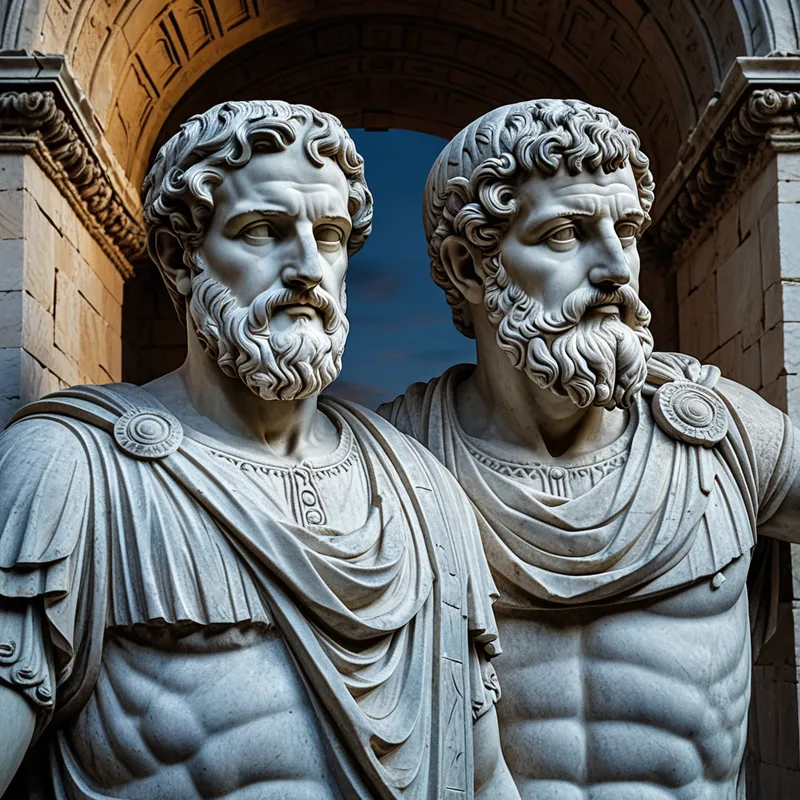
Janus Myth Meaning & Symbolism
The Roman god of gates, beginnings, and transitions, Janus sees past and future, embodying the sacred threshold where opposites meet and time turns.
The Tale of Janus
Before the first light cracks the shell of night, there is a presence. Before the word is spoken, before the step is taken, there is a space between. In that space, where one breath ends and another begins, he watches. He is the keeper of the hinge, the god of the in-between. His name is Janus.
Picture not a man, but a principle made stone and spirit. He stands at the boundary of the wild woods and the ordered city, at the river’s ford where the path divides. He has two faces, but one soul. One face, bearded and lined with the wisdom of what has been, gazes steadfastly into the deepening west, where the sun dies in glory. His eyes hold the memory of every harvest gathered, every treaty sealed, every farewell whispered at a doorway. The other face, serene and looking to the east, watches the pale line of dawn. His eyes are clear with the potential of every seed unsown, every journey not yet begun, every word waiting to be spoken.
In the time of King Numa, the people knew war and peace as strangers to each other. The gates of the temple of Mars stood open, and conflict roamed the land like a hungry wolf. Numa, seeking harmony, went to the sacred grove and prayed at the simplest of shrines—a plain archway. From the silence, a voice, both young and old, spoke: “A state is defined not only by its battles, but by its thresholds.”
Guided by this wisdom, Numa dedicated a new gateway to Janus Geminus, the double-faced one, at the northern edge of the Roman Forum. He decreed a sacred law: when the city was at peace, the great oak doors of Janus’s shrine would be shut, binding conflict outside. When the trumpets called for war, the doors would be flung open, allowing the spirit of Mars to pass through, but under the watchful gaze of beginnings and endings. For centuries, the hinges of those doors groaned only rarely, their closure a golden, silent testament to peace, witnessed by the god who saw both its coming and its going.
And when the Kalends of March bled into the Kalends of January, and the year itself was given a new beginning, it was to Janus the first sacrifice was made. The Pontifex Maximus would offer spelt and salt cake, and the Consuls would inaugurate their year under his sight. For to begin anything—a year, a war, a marriage, a business—without honoring the god of the threshold was to build a house without a door. You would be forever trapped inside, or forever shut out.
Cultural Origins & Context
Janus is a uniquely Roman divinity, with no clear equivalent in Greek mythology. His origins are primal, likely predating the more structured Olympian pantheon. He is a numen, a spirit of place and function, who evolved into a major god. His worship was embedded in the daily, monthly, and annual rhythms of Roman life.
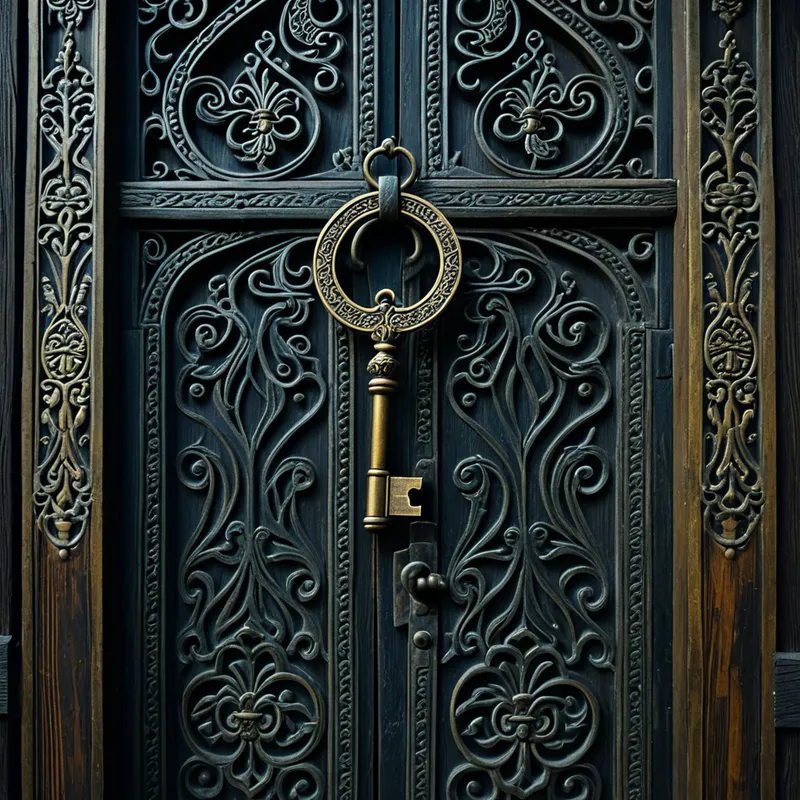
His primary priests were the Rex Sacrorum and the ordinary people themselves, for every head of a household acted as a priest of Janus at their own doorway. The myth was not a single narrative epic but a living practice passed down through ritual. His temple, a simple ceremonial gateway, was his story. Its doors, open or closed, were a direct, physical communication to the people about the state of their world. The myth of Janus was told in the act of crossing a threshold, in the first prayer of the new year, and in the profound civic symbol of the closed gates of war.
Symbolic Architecture
Janus is the archetypal symbol of the liminal. He is not the past or the future, but the conscious awareness of the transition between them. His two faces represent the fundamental duality of existence: inside and outside, old and new, backward-looking reflection and forward-looking intention.
To stand at a threshold is to hold two worlds in mind at once. Janus does not choose one; he is the capacity to contain both.
Psychologically, Janus represents the ego’s necessary function of orientation in time and space. He is the psychic faculty that allows us to learn from the past (one face) while planning for the future (the other). He is the “watchman” of the psyche, stationed at the gateway between the conscious and unconscious. Before we can integrate content from the unconscious (a new idea, a repressed memory, a creative impulse), it must pass this inner Janus, who assesses it in the context of what we already know and who we aim to become.
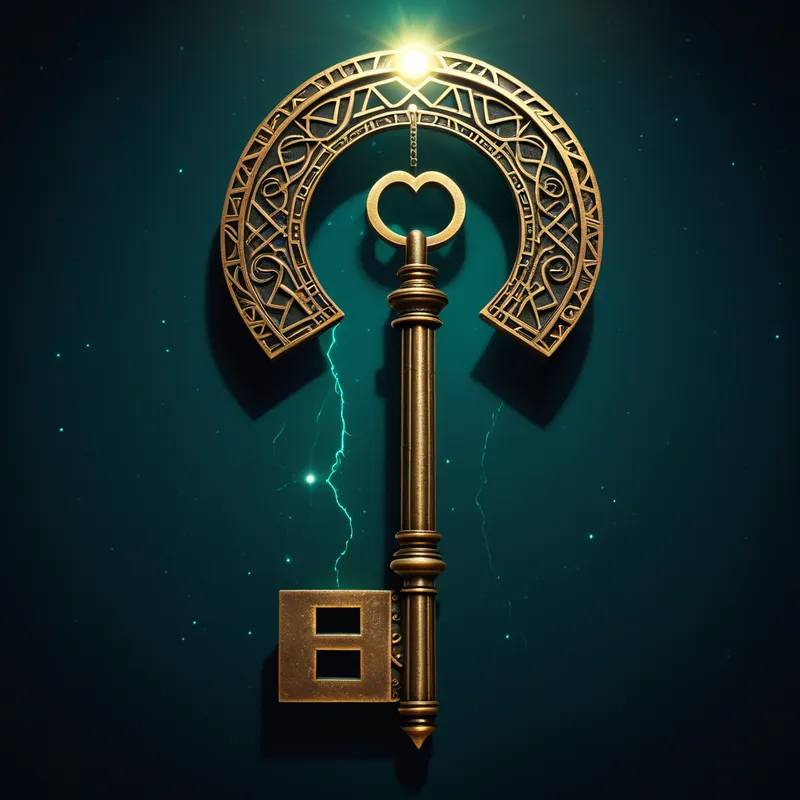
His symbol, the key, is equally potent. It speaks not of locking away, but of conscious opening and closing. It is the power of choice at the moment of passage.
The Dreamer's Resonance
When the archetype of Janus stirs in the modern dreamscape, it often manifests in imagery of literal or symbolic thresholds. Dreaming of standing in a doorway, hesitating to enter or exit; encountering a mirror that shows a different version of oneself; or finding a strange, old key—these are visitations from this gatekeeper god.
The somatic experience is one of suspension. The dreamer may feel physically stuck, or filled with anticipatory tension. Psychologically, this signals a critical point of transition that the conscious mind may be resisting or failing to acknowledge. The dream presents the threshold itself. The anxiety or awe felt is the pressure of the liminal space. Janus in a dream asks: What are you leaving behind? What are you stepping toward? Are you aware that you are doing both? It is a call to conscious reflection before action, to acknowledge the ending inherent in every beginning.
Alchemical Translation
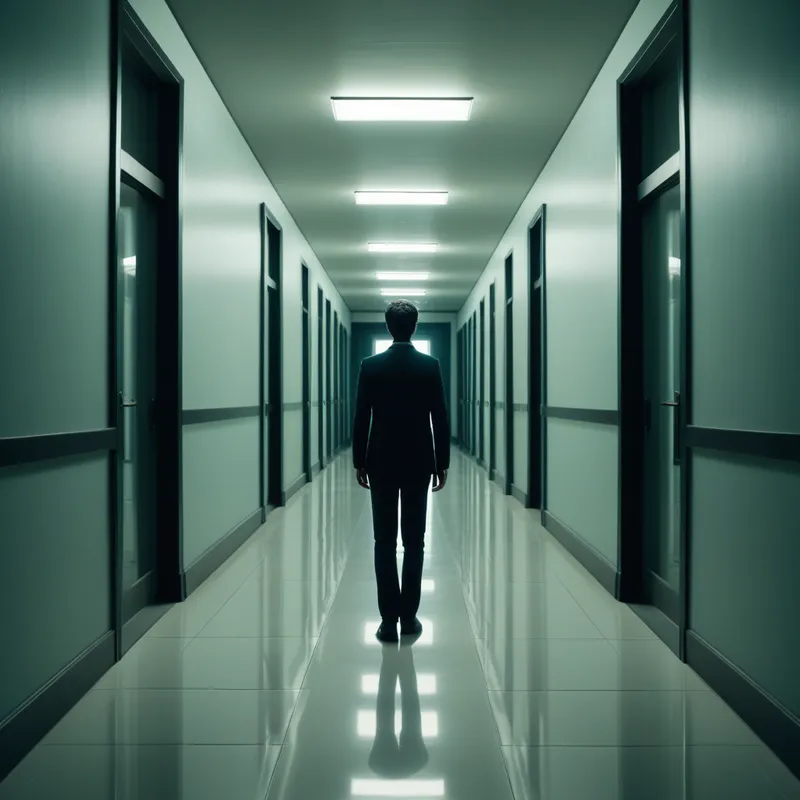
The individuation process is a series of passages through psychic thresholds. Each requires a “Janus moment”—a conscious holding of the tension of opposites before a new synthesis can emerge. The old attitude (the past-facing face) must be honored and understood before it can be released. The new potential (the future-facing face) must be clearly envisioned before it can be embodied.
The alchemical work is not to destroy one face in favor of the other, but to find the still point of the hinge on which both turn. This is the birth of the transcendent function.
The modern seeker engages in this alchemy by practicing deliberate reflection. Journaling is a Janus act: looking back on the day to understand it, then looking forward to set intention. Therapy is a journey through the Janus gate, revisiting the past to unlock a freer future. Even the simple, mindful pause before sending an email or starting a project invokes this god. By consciously naming what we are concluding and what we are initiating, we transmute blind reaction into sacred passage. We become, in our small human way, the keepers of our own gates, facing the duality of our lives with the integrated wisdom of the god who sees it all.
Associated Symbols
Explore related symbols from the CaleaDream lexicon:
- Door
- Window
- Parking
- Doorway
- Start
- General
- Foyer
- Though
- Difference
- Doorbell
- Angle
- Receptionist
- Official
- Turned
- Door Mat
- Door Knob
- Half-Opened Window
- Rotating Pizza
- Formal Suit
- Opening Door
- Swinging Doors
- Searching Keys
- Harmonious Dissonance
- Harmonious Discord
- Bus Station
- Onyx Tiles
- Zircon Crystal
- Ametrine Prism
- Platinum Key
- Mystical Key
- Security Guard's Badge
- Bouncer's ID
- Fashion Runway
- Holiday Wreath
- Holiday Card
- Revolutionary War Flag
- Enchanting Prologue
- Mythical Bookend
- Keyring of Secrets
- Brilliant Prism
- Console Table
- Salt and Pepper Set
- Window Shade
- Transitional Space
- Arched Doorway
- Elaborate Gate
- Portico Sanctuary
- Sleek Lobby
- Eroded Archway
- Traffic Light
- City Hall
- Pedestrian Walkway
- Ornate Gateway
- Open Door
- Duality Mask
- Cognitive Dissonance
- Wondrous Dichotomy
- Temple Gate
- Angel Number 1010
- Angel Number 1212
- Many-faced God
- Screen Flicker
- Schrödinger's Cat
- Quantum Spin
- The Border
- Political Office
- Parallel
- Gateway
- Pivot
- Valve
- Division
- Lintel
- Vestibule
- Aperture
- Sill
- Portico
- Juxtaposition
- Dichotomy
- Margin
- Oscillating
- Libration
- K-complex
- Penumbra