
Jannah Myth Meaning & Symbolism
The story of humanity's exile from a celestial garden and the soul's eternal longing to return to its source of divine peace and presence.
The Tale of Jannah
In the beginning, before time was counted, there was a silence so profound it was a presence. From within this silence, a command echoed: Be. And from the essence of light and divine breath, the first soul was fashioned. This was Adam, kneaded from the dark clay of the earth and animated by the spirit of Allah Himself.
His home was not of this world. It was Jannah, a garden woven from light and shadow, where rivers did not flow with mere water, but with milk clearer than moonlight, honey purer than intention, and wine that brought no heedlessness. Trees heavy with fruit whispered in a breeze that carried the scent of musk and amber. There was no weariness, no hunger, no separation. Adam walked in converse with the Divine, a resident in a palace of peace, his every need anticipated, his existence a perfect hymn of gratitude.
But in this symphony of unity, a single note of discord was permitted. Iblis, once a devoted jinn, harbored a seed of arrogance in his heart of fire. He saw the clay-born Adam as inferior and, when commanded to bow, he refused. Cast out from grace, his devotion curdled into a venomous oath: to mislead Adam and his progeny from the straight path.
Thus, the stage was set. Iblis, the whisperer, approached not with force, but with a deadly truth wrapped in a lie. He spoke to Adam and Hawwa of the one tree they were forbidden to approach. "Your Lord only forbade you this tree," he hissed, his voice like rustling leaves, "lest you become angels or become immortals." He painted prohibition not as protection, but as deprivation. The seed of doubt was sown. The desire to transcend their station, to grasp a knowledge reserved, took root.
They ate from the tree.
In that instant, the fabric of Jannah shifted. The light did not dim, but their own perception of it did. They saw their own nakedness—not just of body, but of spirit—and scrambled for the leaves of the garden to cover it. The divine call came: "Did I not forbid you that tree and tell you that Satan is a clear enemy to you?"
The exile was not a punishment of wrath, but a consequence of choice. The garden, a realm of pure presence, could not contain the newly awakened consciousness of shame and separation. With profound mercy, the words were spoken: "Descend, all of you. You are enemies to one another. On earth you will have a place of settlement and provision for a time."
The gates did not slam shut; they faded from view. Adam and Hawwa descended from the realm of unity into the world of duality, of struggle and toil, of seasons and death. But as they turned their backs on the garden, a promise was etched into their very souls: guidance would come. A path would be laid. For those who remember, who listen, and who strive, the return is not a memory, but a destiny. The longing for Jannah became the compass of the human heart.

Cultural Origins & Context
The narrative of Jannah is not a isolated folktale but the foundational human story within the Islamic worldview, meticulously preserved in the Quran and expanded upon in the Hadith. It was passed down not by bards, but by prophets, culminating in the final revelation to the Prophet Muhammad in 7th century Arabia. Its primary tellers were scholars, mystics, and parents, who used it to explain the fundamental human condition: our origin, our fall, and our ultimate purpose.
Societally, the myth functions as the bedrock of Islamic anthropology and ethics. It establishes humanity's noble origin (fashioned by God's own hands and infused with His spirit) and our inherent dignity. Simultaneously, it explains the presence of struggle, temptation, and suffering on earth not as a primordial flaw, but as a field of testing and growth. The story frames earthly life as a journey (sabil) or a tillage (harth), where one's actions sow the seeds for one's return to the eternal garden. It is a narrative that instills both hope—through the promise of mercy and return—and profound moral responsibility.
Symbolic Architecture
Psychologically, Jannah represents the pre-conscious state of wholeness, the primal unity of the infant with the mother, or the undifferentiated Self before the dawn of the ego. It is the state of being where need and fulfillment are instantaneous, where there is no gap between desire and satisfaction. This is not mere hedonism; it is the experience of complete alignment with one's source and essence.
The exile from Jannah is the birth of consciousness itself. To know good, one must know its absence. To know self, one must know other.
Adam symbolizes the nascent human ego, consciousness awakening to its own existence. The forbidden tree represents the threshold of self-awareness, the necessary—and inevitably painful—acquisition of knowledge that separates the individual from the collective unconscious. Eating its fruit is the irreversible step into duality, into the knowledge of opposites: good and evil, self and other, naked and clothed. Iblis is not an external monster but the personification of the rebellious, arrogant principle within the psyche that rejects humility and unity, that whispers of a false autonomy and grandeur. The descent to earth is the journey of incarnation, of the spirit taking on the dense, challenging, and fruitful work of life in the material world.
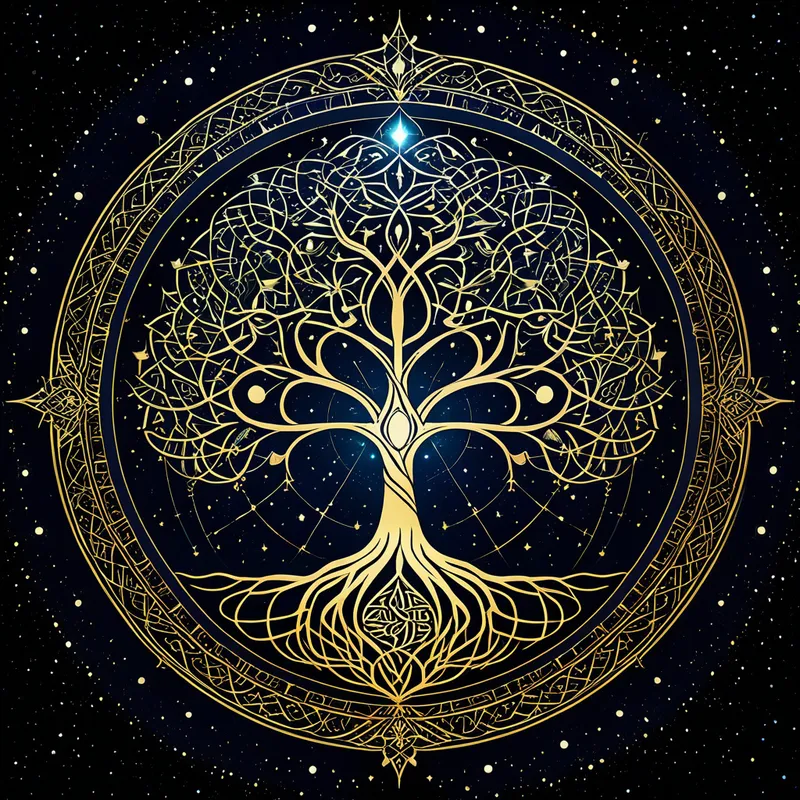
The Dreamer's Resonance
When this myth stirs in the modern dreamer, it often manifests not as a literal garden, but as a profound somatic and emotional tone. It is the dream of a lost, idyllic home bathed in golden light that you can never quite find on a map. It is the feeling of being an outsider, an orphan, in a world that feels harsh and alienating. You may dream of locked gates, of forgotten passwords, of searching for a source of water in a desert.
Psychologically, this is the process of confronting the orphan archetype within. It is the deep, often grief-filled recognition of separation—from a state of innocence, from a relationship, from a part of oneself that feels whole and secure. The body may respond with a heavy longing in the chest, a tightness in the throat, or a profound fatigue. This is not pathology; it is the soul remembering its origin story. The dream is asking: Where have you felt exiled? From what garden of peace, authenticity, or connection have you fallen?

Alchemical Translation
The alchemical work modeled by the Jannah myth is the opus of return—not a regression to infantilism, but a conscious reintegration at a higher level. The earthly life of toil is the nigredo, the blackening, the necessary dissolution and struggle that purifies the soul. The guidance sent through prophets and revelation symbolizes the inner compass of conscience, intuition, and wisdom that begins to glow in the darkness.
The goal is not to erase the experience of the Fall, but to transmute it. The clay of struggle becomes the vessel for a more conscious grace.
The soul's longing for Jannah becomes the lapis philosophorum, the philosopher's stone that drives the entire process of individuation. Every act of patience in hardship, every resistance to the inner Iblis of arrogance or despair, every moment of sincere remembrance (dhikr) of one's divine origin, is a step on the path back. The return is not to a physical location, but to a state of being: a psychic garden where the opposites are reconciled. The ego, having fully experienced its separation, willingly submits to the Self. The rivers of milk, honey, and wine then symbolize the integrated psyche: nourishment (milk), sweetness of spirit (honey), and the ecstasy of union (wine), all flowing freely from a source within. The myth teaches that our deepest wound—our sense of exile—contains the very map and the motivation for our most profound healing and homecoming.
Associated Symbols
Explore related symbols from the CaleaDream lexicon: