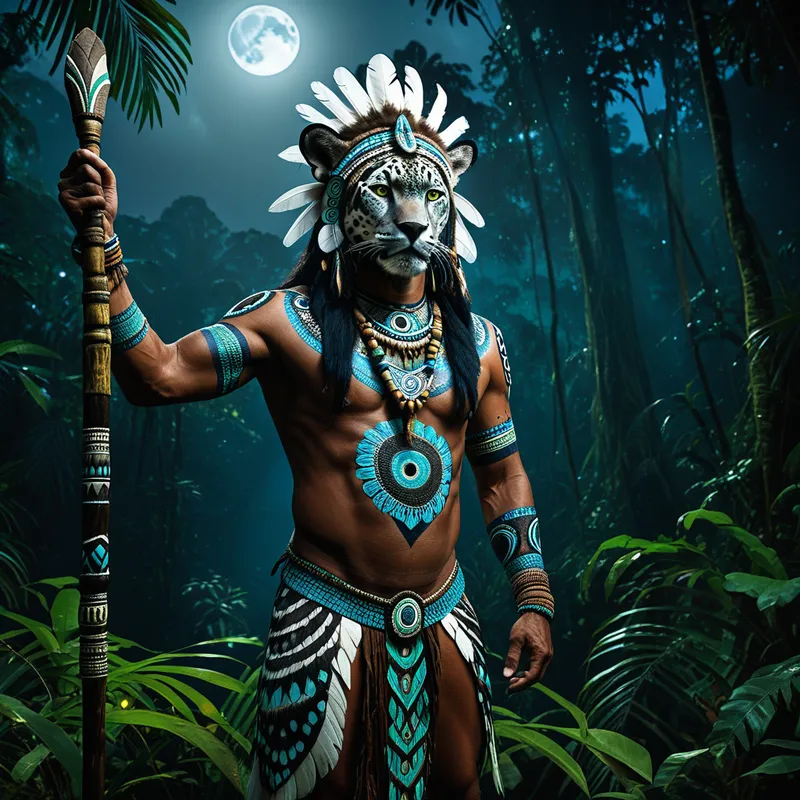
Jaguar Shaman Myth Meaning & Symbolism
A myth of a human who journeys into the spirit world to master the Jaguar's power, becoming a bridge between the physical and unseen realms.
The Tale of Jaguar Shaman
Listen. The jungle does not sleep. It breathes, a vast, green lung exhaling mist and mystery. Beneath the ceaseless chorus of frogs and insects lies a deeper silence, a presence. This is the story of how one man learned to listen to that silence and speak with the voice of the shadow.
In a time when the rivers were the only roads, there lived a man named Yawa. He was not the strongest hunter, nor the most gifted speaker. But in his dreams, he walked paths of dappled light and saw eyes watching from the kuruk. A sickness of the spirit had settled upon his people—a dullness, a forgetting of the songs that kept the world in balance. The game grew scarce, the children listless.
Driven by a quiet desperation, Yawa sought the oldest of the people, a woman whose skin was like tree bark, who remembered when humans and animals shared one language. She gave him no answers, only a gourd of bitter, dark liquid—the vine of the soul, ayahuasca. "To see the true world," she whispered, "you must first let this one dissolve."
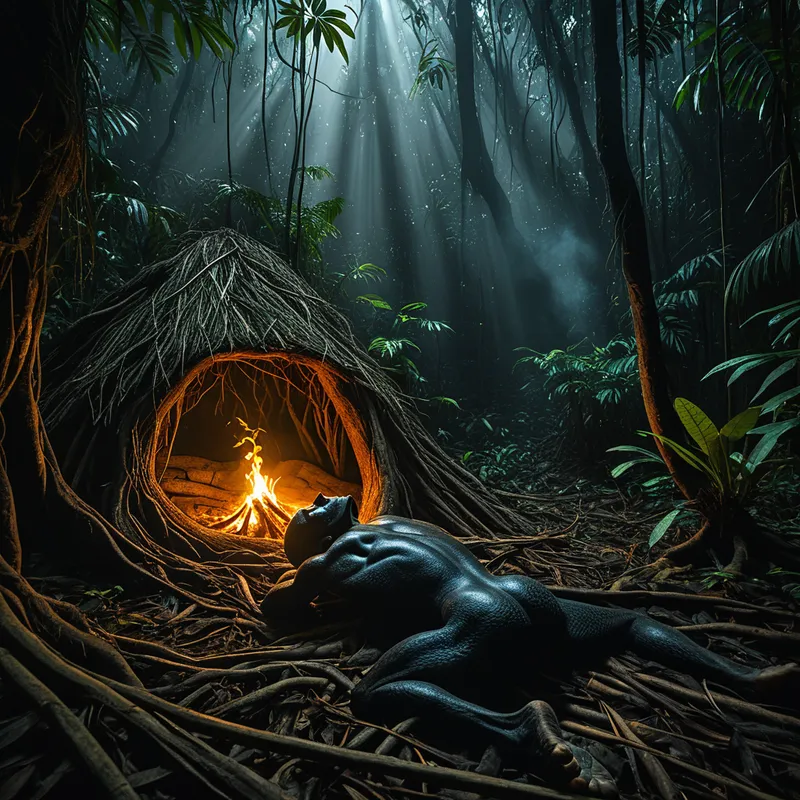
Under a moon swallowed by clouds, deep in a place where the trees formed a cathedral of roots, Yawa drank. The world melted. The earth became a great serpent, the stars dripped like sap. And from the absolute blackness between the trees, It emerged. Not a beast of flesh and blood, but the essence of predation, the shadow given form: Jaguar. Its roar was not sound but a vibration that shook Yawa’s bones to dust. It did not pounce. It absorbed him.
In that belly of pure power, Yawa died. His human fears, his small name, were stripped away. He experienced the Jaguar’s hunger, its effortless grace, its absolute solitude. He saw the forest not as a resource, but as a living body of which he was one pulsing organ. The Jaguar spirit spoke in images: the delicate balance of life and death, the sacred contract of the hunt, the terrible beauty of necessary violence.
The ordeal lasted an eternity of a single night. As dawn bled through the canopy, Yawa returned—or rather, something else returned in his shape. His eyes, once soft, now held a flickering, ancient gold. He knew the medicinal songs of plants he had never seen. He could feel the heartbeat of the forest in his own chest. He had not conquered the Jaguar. He had made a pact. He became the bridge, the Jaguar Shaman. He returned to his people not with a trophy, but with a restored connection, healing their spiritual sickness by realigning them with the fierce, sacred heart of the world itself.
Cultural Origins & Context
This narrative pattern is not a single, codified myth but a living shamanic paradigm found across various Indigenous nations of the Amazon Basin, including the Shipibo-Conibo, the Shuar, and others. It is less a story told around a fire for entertainment and more a map of a profound experiential reality: the initiatory crisis of the apprentice shaman.
The myth is transmitted through direct, often harrowing, apprenticeship. An elder shaman guides the initiate through the use of sacred plant teachers, like ayahuasca or mapacho, to deliberately encounter the Jaguar spirit. This is a dangerous process, described as being "devoured" or "dismembered" by the spirit. Success is not guaranteed; failure could mean madness or death. Societally, the successful Jaguar Shaman becomes a vital functionary—a healer (curandero), a mediator between the community and the spirit world, a diviner, and a psychological anchor. His power, derived from the jungle's apex predator, is used to protect the community from spiritual predation and imbalance.
Symbolic Architecture
At its core, the myth is a masterclass in the psychology of integrating the Shadow. The Jaguar represents the ultimate Shadow archetype: untamed instinct, raw power, predatory awareness, and the terrifying, amoral life force of nature itself. The jungle is the psyche in its primordial, undifferentiated state.
The initiation is not a battle to be won, but a marriage to be solemnized. One does not slay the inner beast; one learns to wear its skin and see through its eyes.
The "sickness" of the people symbolizes a state of psychic dislocation, where conscious life has become severed from its instinctual, vital roots. Yawa’s journey is a voluntary descent into this disowned power. His "death" is the dissolution of the fragile ego-structure that cannot contain such potency. The return represents the birth of a new, more complex consciousness that can hold both human compassion and primal force, creating what Jung called a coniunctio oppositorum.
The Dreamer's Resonance
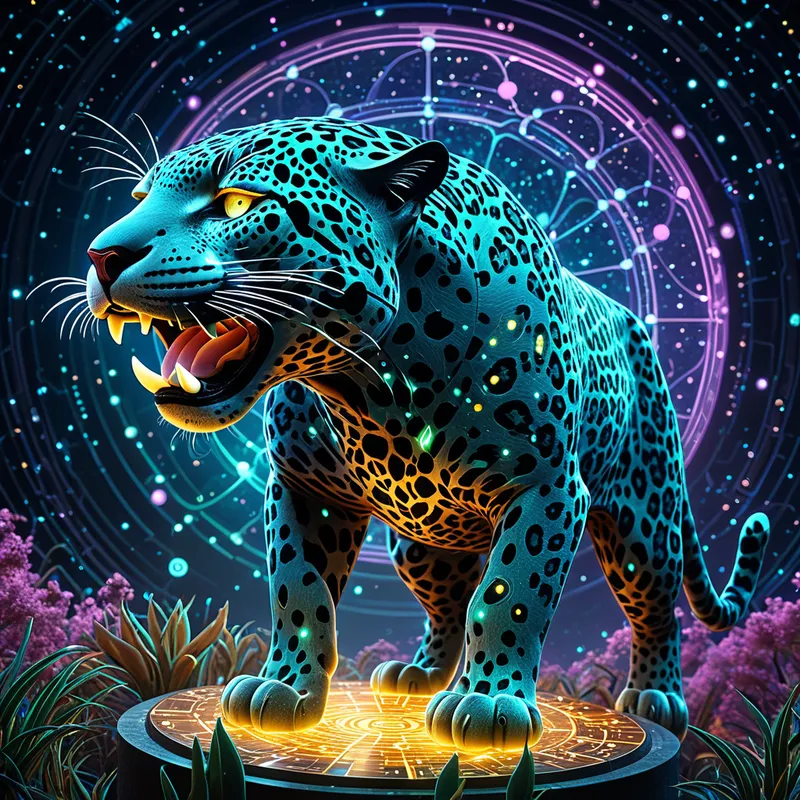
When this myth activates in the modern dreamer, it often signals a profound call from the deep unconscious. Dreaming of a jaguar—especially one that is stalking, confronting, or merging with the dreamer—points to a somatic and psychological process of confronting repressed power.
The body may feel it first: a restlessness, a sense of being "too tame," or conversely, anxiety about one's own aggressive or assertive impulses. Psychologically, the dreamer may be at a life threshold requiring a fierce, instinctual leap—leaving a stifling job, setting a vital boundary, or embracing a creative force that feels dangerously potent. The dream-jaguar is not a threat to be eliminated, but a guide to a forgotten autonomy. The terror in the dream is the ego's resistance to its own necessary expansion. To be "devoured" in the dream is to be in the alchemical stage of nigredo, where old identities break down so a more authentic self can be born.

Alchemical Translation
For the modern individual, the Jaguar Shaman's path models the complete process of psychic transmutation, or individuation. The "village" is our conventional persona, the adapted self that functions in society. The "spiritual sickness" is the depression, anxiety, or meaninglessness that arises when this persona becomes a cage.
The brew of ayahuasca is analogous to the courageous act of turning inward, of engaging with the potent, often frightening contents of our own unconscious without the filters of rationalization.
The deliberate journey into the "jungle" is the commitment to deep self-inquiry, therapy, or any practice that brings us face-to-face with our Shadow. Confronting the Jaguar is the moment of truth where we acknowledge our own capacity for rage, wildness, desire, and primal will—not to act them out blindly, but to reclaim their energy. The dissolution is the painful but necessary death of who we thought we were. The return as a healer symbolizes the ultimate goal: the integrated self. The power retrieved from the encounter is no longer used for predation but for protection, creativity, and healing—both of the self and, by extension, one's circle. The individual becomes a vessel for a greater force, transforming personal ordeal into transpersonal resource. One becomes, in a psychological sense, a shaman for one's own life, able to navigate between the visible world of daily reality and the invisible world of instinct, symbol, and soul.
Associated Symbols
Explore related symbols from the CaleaDream lexicon: