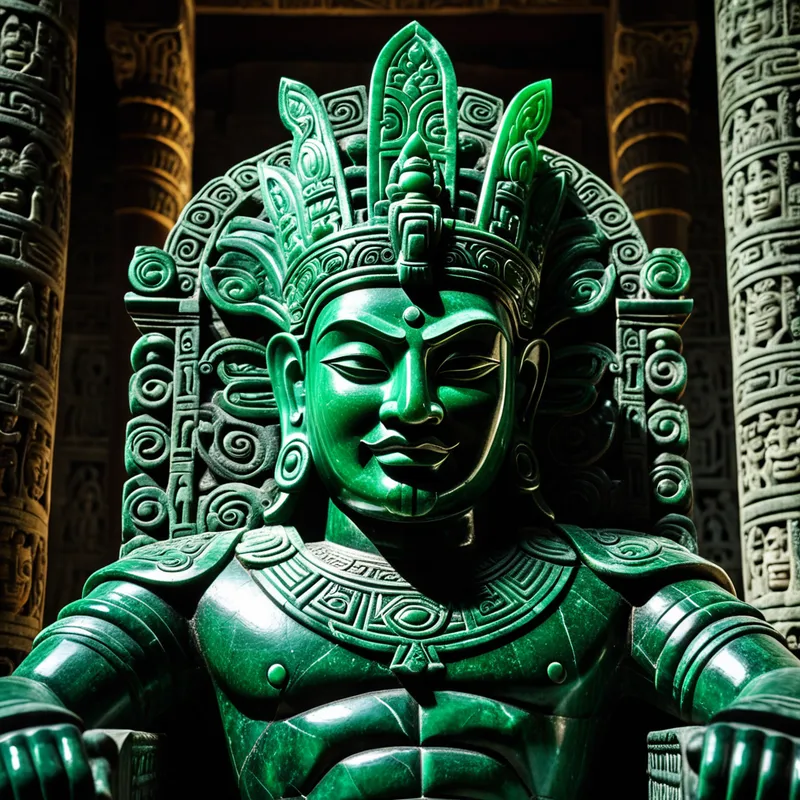
Jadeite Masks Myth Meaning & Symbolism
A myth of a king who carves his soul into jadeite masks, seeking wholeness through sacrifice, only to find his true face in the void between them.
The Tale of Jadeite Masks
Listen. The story is not carved in stone, but in the green heart of the earth. It is a story of a king who had everything, and therefore, nothing at all.
In the time when the ceiba tree’s roots drank from the waters of Xibalba and its branches brushed the belly of the starry sky, there ruled a lord named Balam K'in. His city was mighty, his storehouses full of maize and cacao, his warriors fierce. Yet, in the silent hours when the howler monkeys slept, a hollow wind whistled through the palace corridors. It was the sound of the king’s own spirit, echoing in a vast, empty chamber. He wore the face of a ruler, but behind his eyes was a question no conquest could answer: Who am I, when I am not performing for my people?
He consulted the Ah Kin, who read the patterns in the casting of red beans. “Great One,” they whispered, their voices like dry leaves, “your face is known to the world, but not to yourself. You must meet your own gaze, outside of flesh and blood.”
Driven by this cryptic decree, Balam K'in commanded his most gifted artisans. “Bring me the stone that holds the memory of rain and forest,” he ordered. “Bring me jadeite.” From the deep riverbeds, they hauled the rough, unassuming stone. For thirteen cycles of the moon, the artisans worked. Not with hammer and chisel alone, but with prayers, with sand and water, with cords of woven henequen dipped in abrasive dust. They were not carving a mask; they were coaxing a face out of a mountain’s dream.
The first mask was finished. It was the Face of the State: stern, geometrically perfect, with eyes of inlaid obsidian that saw everything and felt nothing. Balam K'in placed it over his own. The people prostrated themselves. Order was magnified. Yet, the stone was cold, and the hollow wind now had a home—it lived between his living skin and the mask’s unyielding interior.
“This is not enough,” the king said, his voice muffled by jade. “Carve another. Show me the face I wear for the gods.”
The second mask was the Face of the Supplicant: eyes upturned in ecstatic piety, mouth slightly open in a silent hymn. Adorned with symbols of the Wacah Chan and the Chaac, it was a masterpiece of devotion. Wearing it during the solstice ceremonies, Balam K'in felt a surge of connection, a fleeting transcendence. But when the ritual smoke cleared, he was alone again, a man playing a part in a divine drama written before his birth.
A terrible stillness settled upon him. He possessed the face of power and the face of piety, yet he was more fractured than ever. In a final, desperate act, he ordered a third mask. “This one,” he commanded, his voice trembling, “will be for me alone. Carve the face I see in the still water at night. Carve my shadow.”
The artisans were afraid, for to carve a man’s shadow is to risk capturing his soul. But they obeyed. This mask was different. It was not polished to a high gloss but left with the texture of unhewn rock in places. Its expression was ambiguous—not sad, not joyful, but profoundly present. It held a knowledge that was unsettling.
On a night when the moon was a sliver, a mere scratch on the black hide of the sky, Balam K'in took the three masks to the sacred cenote. He laid them on a stone altar: the State to his right, the Supplicant to his left, and the Shadow before him. He prayed not to the gods, but to the silence. Then, one by one, he shattered them. The jadeite, harder than steel, fractured with a sound like the sky breaking. Shards of green light flew into the dark water below.
Exhausted, empty of all command and ceremony, he looked into the pool. The moon’s faint reflection showed not his familiar face, nor any mask. It showed a man, simply a man, whose eyes held the quiet, enduring green of the jungle itself. The hollow wind was gone. In its place was the deep, resonant silence of a whole being. He had not found a new face; he had dissolved the need to wear one.
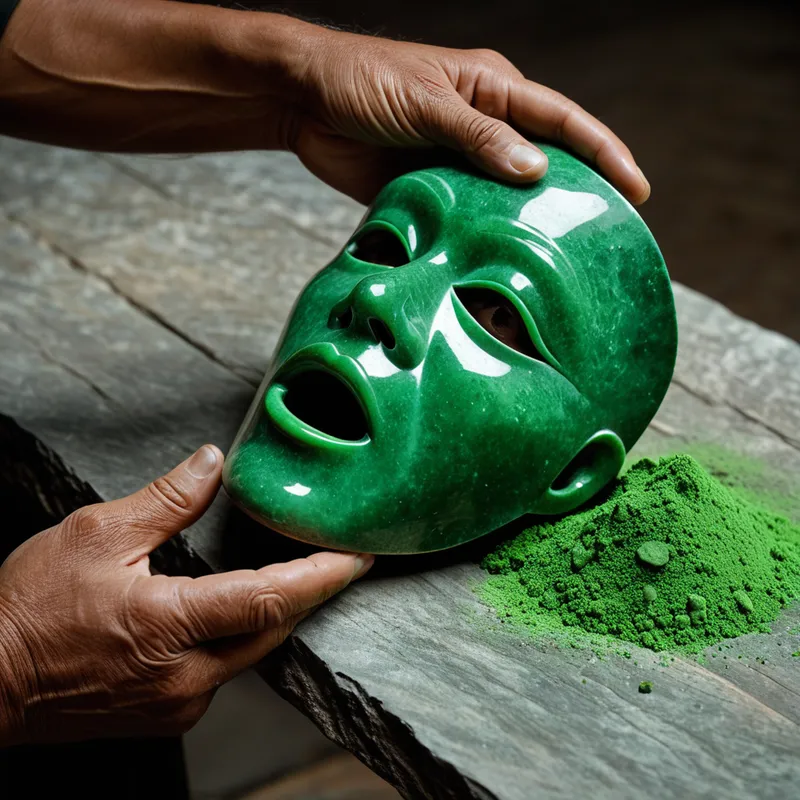
Cultural Origins & Context
The myth of the Jadeite Masks, while not a singular, codified narrative from one specific text, is a profound synthesis of core Mesoamerican—particularly Maya—philosophical and spiritual concepts. It is the kind of teaching story that would have been passed among the almehenob, perhaps during initiations or in the training of scribes and priests. Its function was not historical record-keeping but ontological instruction.
Jadeite (ya’ax ch’ich’ or “first/precious stone”) was more valuable than gold, considered the stone of life, eternity, and soul. To carve it was a sacred, slow act of revelation, mirroring the gods’ creation of humans from maize dough. The mask in Mesoamerican ritual was not a disguise but a conduit—a means for a dancer or priest to become the deity or ancestor represented. This myth inverts that communal, external function. It internalizes the ritual. The king’s journey is a solitary teyolia quest, reflecting the deep Mesoamerican preoccupation with destiny, self-knowledge, and the burdens of cosmic responsibility carried by rulers, who were seen as the pivot between the human and divine realms.
Symbolic Architecture
The myth architecturally deconstructs the psyche through its central artifact. The three masks represent not lies, but necessary personas—the authentic, yet partial, faces we wear to navigate different realms of existence.
The Face of the State symbolizes the Persona in its most rigid form. It is the archetype of order, law, and external responsibility. It is necessary for social function but becomes pathological when it fuses with identity, creating a ruler who is only a function, a hollow statue.
The Face of the Supplicant represents the spiritual persona, the ego’s relationship with the transpersonal—the gods, the ideal, the divine parent. It seeks transcendence and meaning but can easily become a performance of piety, a way to avoid the more terrifying, intimate encounter with the self.
The Face of the Shadow is the critical turning point. This is the mask of the disowned self, the repressed fears, instincts, and raw potential that the conscious ego refuses to acknowledge.
The ultimate sacrifice is not of blood or treasure, but of the illusion that any one of these carved faces is the true self. Wholeness is found in the conscious relationship between them, not in the perfection of any single one.
The shattering at the cenote—a portal to the underworld—is not destruction, but deintegration. It is the dissolution of rigid identification. The king does not emerge with a fourth, “true” mask. He emerges capable of holding the multiplicity within, his identity now fluid and contextual, rooted in the “green heart of the earth”—the enduring, living Self beyond ego.
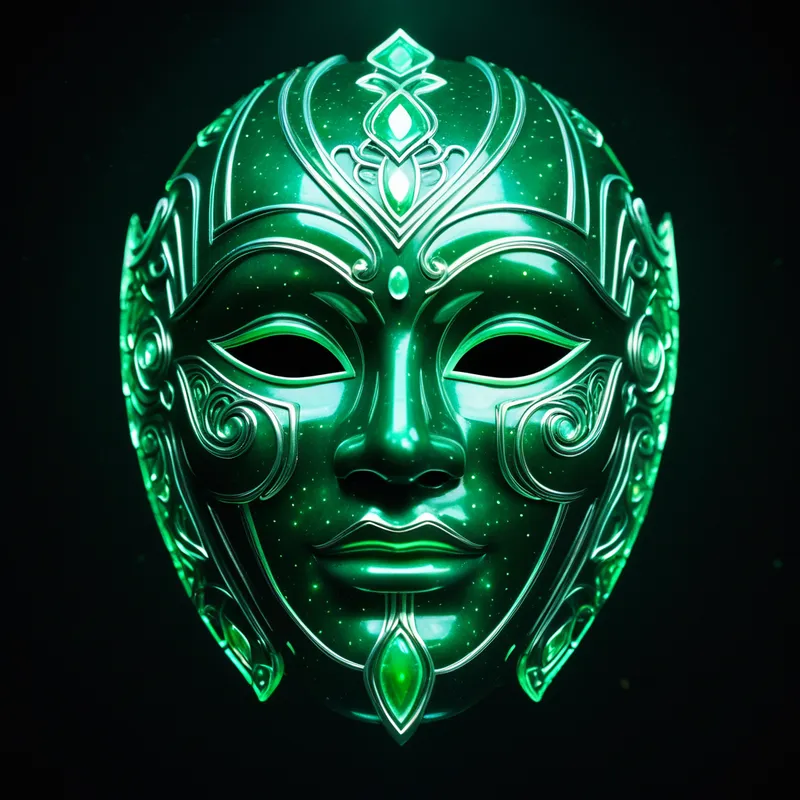
The Dreamer's Resonance
When this myth pattern stirs in the modern dreamer, it often manifests as dreams of fractured mirrors, of losing one’s face, or of wearing masks that are painfully heavy or that have fused to the skin. The somatic experience is one of constriction around the jaw and forehead, a literal feeling of being “masked.”
Psychologically, this signals a critical moment in the differentiation between the Self and the persona. The ego has become over-identified with a role—be it the Professional, the Caregiver, the Intellectual, or the Seeker. The psyche, in its drive toward wholeness, begins to undermine this over-identification. The dream masks are not villains; they are parts of the dreamer’s own psychic architecture crying out for recognition and integration. The feeling of the mask cracking or the desperate attempt to remove it in a dream marks the beginning of the ego’s surrender. It is the painful, necessary process of the “hollow wind” making itself heard, forcing a confrontation with what has been neglected in the service of a curated identity.

Alchemical Translation
The alchemical process mirrored here is solutio (dissolution) followed not by coagulatio (re-solidification into a “better” form) but by a permanent state of conscious fluidity—the creation of the Mercurial body.
For the modern individual, the “jadeite” is the core, essential, but unrefined material of our being—our innate potential and character. The “carving” is the lifelong process of education, socialization, and personal development. We expertly craft our professional mask, our social mask, our spiritual mask. The myth’s warning is that we risk worshiping these artifacts as endpoints.
Individuation is not the creation of a perfect, final mask called the “Authentic Self.” It is the development of the skill to wear the appropriate mask consciously, lightly, and to take it off, knowing it is but one facet of the gem.
The king’s journey models the path: First, recognize the mask (Awareness). Then, experience its insufficiency (Suffering). Next, dare to carve the shadow mask—to engage in honest shadow-work, bringing the rejected parts into the light of consciousness (Confrontation). Finally, perform the sacred shattering at the cenote of the unconscious. This is the act of releasing ego-attachment to any single identity, allowing the constructed selves to dissolve back into the psychic ecosystem from which they came.
The triumph is not a new, static identity, but the capacity for presence. Like the king seeing his reflection unadorned, the individual who undergoes this alchemy no longer asks “Who am I?” as a demand for a fixed label. They carry the question as a living practice, their identity a verdant, breathing process as resilient and multifaceted as the jadeite from which it was, temporarily, formed.
Associated Symbols
Explore related symbols from the CaleaDream lexicon: