
Jacob's grandsons Myth Meaning & Symbolism
A story of prophetic dreams, fraternal envy, and a father's grief, where a coat becomes a symbol of fate and the seeds of a nation are sown.
The Tale of Jacob's grandsons
Listen, and hear the tale woven in the dust and dreams of the fathers. In the land of Canaan, where the sun baked the hills and the wells were deep with memory, lived the patriarch Jacob. His heart held a special chamber for Joseph, the son of his old age. For this boy, he fashioned a garment—a coat of many colors, a tapestry of dyed threads that spoke not of a shepherd’s toil, but of a father’s unbounded favor. It shimmered on Joseph’s shoulders like a fragment of sunset captured in cloth, a banner that stirred a bitter wind among his ten older brothers.
And Joseph dreamed. In the still of the night, visions took root. He saw them in the field, binding sheaves, when suddenly his sheaf stood upright and their sheaves circled and bowed low to his. He told them. The air grew thick with the scent of envy, hot as forge-fire. He dreamed again: this time, the sun and moon and eleven stars were bowing down to him. Even his father rebuked him, yet the old man guarded the saying in his heart, a strange seed planted in silence.
The brothers had gone to shepherd the flocks near Shechem, a land stained with old violence. Jacob sent Joseph from the vale of Hebron, saying, “See if it is well with your brothers.” Joseph set out, the fateful coat upon him, a beacon moving across the wilderness. They saw him from afar—the dreamer approaching—and the old poison rose. “Come, let us slay him,” they said. “We shall see what becomes of his dreams.”
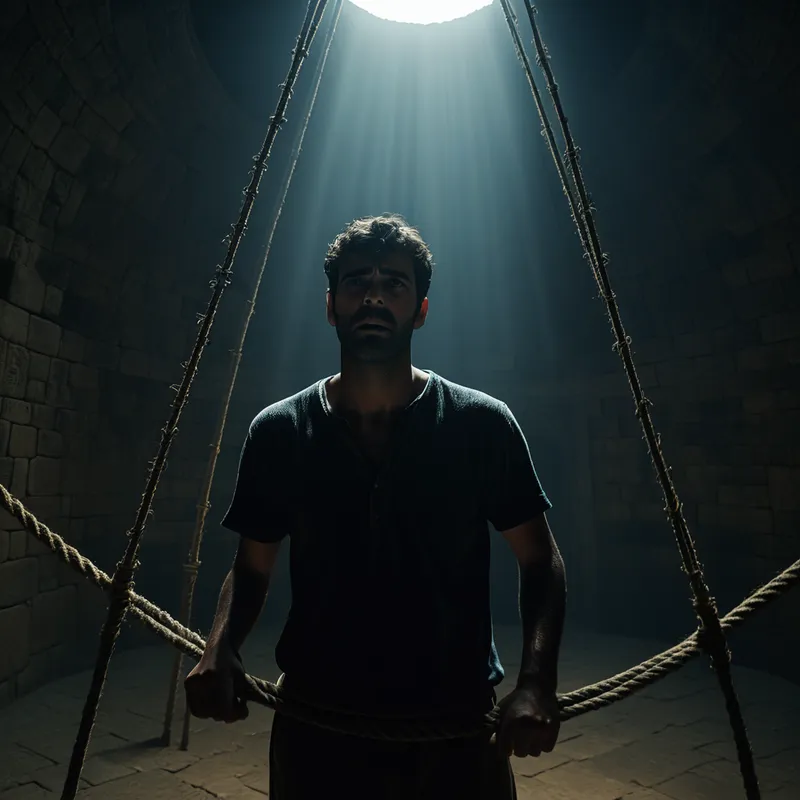
But Reuben, seeking to deliver him, persuaded them to cast him into a pit, a dry cistern whose walls echoed with emptiness. They stripped him of his coat, that symbol of all their grievance, and cast him down into the dark. As they sat to eat, their bread tasted of ash. Then, a caravan of Ishmaelites appeared, their camels laden with spices for Egypt. A colder calculus took hold. Judah spoke: “What profit is it if we slay our brother? Let us sell him.” For twenty pieces of silver, Joseph was drawn up from the pit and vanished into the train of merchants, descending to the land of the Nile.
Then, the deed demanded a story. They took the coat, slaughtered a kid, and dipped the garment in its blood. They brought it to their father. “This we have found,” they said. Jacob knew it. The fabric he had lovingly crafted was now a shroud of gore. He rent his clothes, put on sackcloth, and mourned, refusing all comfort. “I will go down to Sheol to my son, mourning.” His grief was a well deeper than the one at Dothan.
But Joseph lived. In Egypt, in the house of Potiphar, then in the darkness of a dungeon, the dreamer endured. The gift that made him a target became his salvation—the ability to interpret visions lifted him to the right hand of Pharaoh himself. Years later, when famine gripped the world and the brothers came bowing to Egypt for grain, they stood before the veiled vizier, not knowing they fulfilled the very dreams they sought to destroy. The coat of blood gave way to a robe of fine linen, and the boy they cast out became their savior, weaving their violent betrayal into the tapestry of a nation’s survival.
Cultural Origins & Context
This narrative is the foundational epic of the Children of Israel. It originates from the Book of Genesis, chapters 37-50, a core text of the Biblical tradition. It functioned as an etiological story, explaining how the clan of Jacob—dwellers of Canaan—came to be in Egypt, setting the stage for the subsequent Exodus. It was not mere history, but identity-forming memory, recited and preserved across generations by priestly custodians and tribal elders.
Its societal function was multifaceted. For a people often in exile or diaspora, it reinforced the themes of divine providence and familial cohesion despite profound betrayal. It justified the preeminence of the tribes of Ephraim and Manasseh and established the moral and leadership credentials of the tribe of Judah, from whom kings would later arise. The story served as a powerful lesson on the dangers of parental favoritism, the catastrophic potential of fraternal envy, and the mysterious, redemptive arc of a destiny that cannot be murdered.
Symbolic Architecture
At its heart, this is a myth of the individuation of a collective. Joseph represents the nascent, destined Self—the unique individual carrying a fragment of the future that the family system cannot yet tolerate.
The coat is the visible symbol of the invisible election. It is the burden and the gift of difference, marking the bearer for both glory and sacrifice.
The brothers embody the shadow of the family—the collective resentment, the unchosen, the labor that feels unseen. Their attempt to kill the dream is the ego’s violent rejection of a disruptive, transformative call from the unconscious. The pit is the liminal space, the womb of the earth where the old identity (the coat) is stripped away, initiating a descent that is necessary for any true ascent.
The figure of Judah undergoes his own transformation, moving from proposing the sale to later offering himself as a pledge for his brother Benjamin. He models the capacity for moral growth and responsible leadership, integrating the shadow of his past action. The entire arc—from the bloodied coat to the reconciliation in Egypt—symbolizes the alchemical process where the prima materia of family trauma and betrayal is eventually transmuted into the gold of a cohesive, surviving nation.

The Dreamer's Resonance
When this myth stirs in the modern psyche, it often surfaces in dreams of profound isolation amidst one’s own family, of being unfairly favored or unfairly targeted. One may dream of receiving a magnificent gift that incites jealousy, or of falling into a deep, dark hole while familiar faces watch from above. These are somatic echoes of the core conflict: the terror and loneliness of carrying a potential that your immediate environment seeks to negate.
The psychological process is one of differentiation. The dreamer is grappling with the cost of their own authenticity. The “brothers” in the dream may represent internalized familial expectations, societal pressures, or aspects of the self that are hostile to one’s unique calling. The dream pit is not merely a prison; it is the necessary container where the old, externally-given identity (the coat) dies, so the authentic self, forged in exile and ordeal, can eventually emerge. To dream of Joseph is to feel the weight and promise of a destiny that demands a painful separation before any homecoming is possible.

Alchemical Translation
The myth of Joseph and his brothers is a master blueprint for psychic transmutation. It maps the journey from naive inflation (the dreamer boasting his dreams) through the nigredo—the blackening, represented by the pit, the slavery, and the prison. This is the stage of despair, where all light seems extinguished.
The betrayal by one’s own kin is the ultimate dissolution of the persona, forcing the soul to find its foundation not in tribal belonging, but in its intrinsic connection to the symbolic life.
Joseph’s service in Potiphar’s house and his imprisonment are the albedo and citrinitas—the whitening and yellowing—where skills are honed in obscurity and inner authority is built. His ability to interpret dreams becomes the tool of his rubedo, the reddening or glorious culmination, where he is elevated to a position of supreme executive function. He now holds the keys to the granaries, the sustenance of life itself.
The final, crucial stage of the alchemy is not his personal glory, but the reconciliation. When the brothers bow, he does not simply exact revenge; he reveals himself. This is the integration of the shadow. The once-rejected Self now embraces and provides for the very forces that sought to destroy it, not from weakness, but from a transformed consciousness that sees the larger pattern. The individual’s ordeal becomes the salvation of the whole family. The psychic transmutation is complete when the personal destiny becomes the vessel for collective redemption, turning the base metal of fraternal hatred into the gold of a reconciled and enduring legacy.
Associated Symbols
Explore related symbols from the CaleaDream lexicon: