
Jacob and Esau Myth Meaning & Symbolism
A tale of twin brothers, a stolen birthright, and a lifelong struggle for identity, culminating in a transformative embrace that reconciles divided selves.
The Tale of Jacob and Esau
Hear now the story of two nations, born of a single womb, their destinies entwined like the roots of an ancient oak. In the land of Canaan, under the watch of the God of Abraham, lived Isaac and Rebekah. Theirs was a house of promise, yet a house divided. For Rebekah carried twins, and they struggled within her, a fierce and primal war before the first breath of air. When her time came, the first to emerge was ruddy, covered entirely in a mantle of hair like a rough garment. They named him Esau. His brother followed, his hand gripping Esau’s heel as if to pull him back into the womb, to be first. They named him Jacob.
Thus the pattern was set at the threshold of life. Esau grew to be a cunning hunter, a man of the open field, his spirit as wild and free as the game he pursued. The scent of earth and blood clung to him. Jacob was a quiet man, dwelling in tents, his mind a labyrinth of thought and calculation. Their father, Isaac, loved Esau, for he tasted of his son’s wild game. But Rebekah loved Jacob, seeing in his stillness a deeper current.
One day, Esau returned from the field, faint to the point of death. Jacob was simmering a stew of red lentils. “Let me eat some of that red stuff,” Esau gasped, pointing to the pot. Jacob, his eyes narrowing, saw the shape of fate. “Sell me your birthright this day,” he said. And Esau, seeing only the immediacy of his hunger, swore an oath. He ate, he drank, he rose and went his way. Thus did Esau despise his birthright.
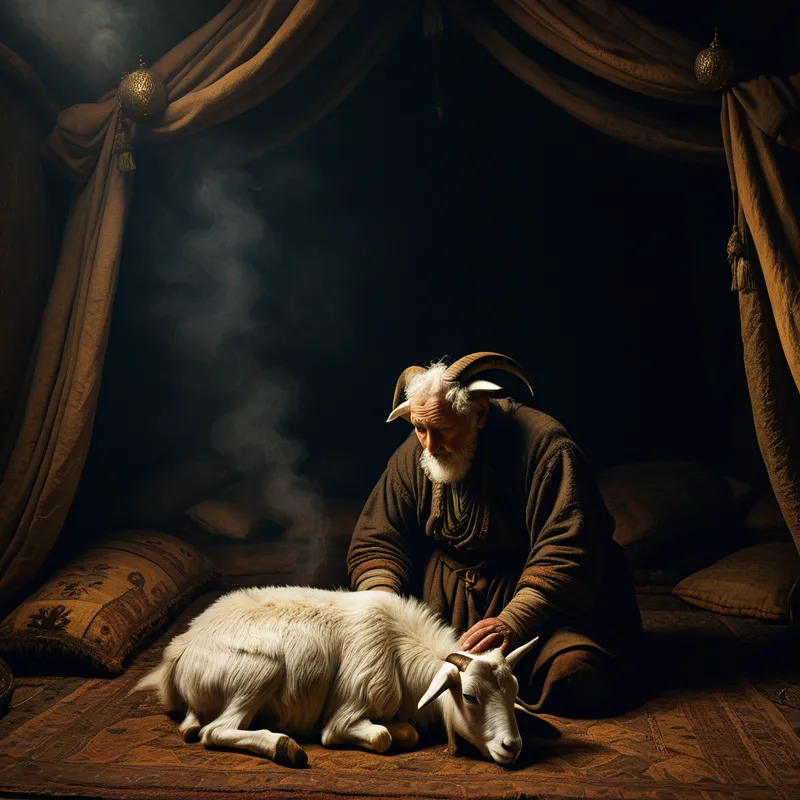
Years later, when Isaac was old and his eyes dim, he called Esau to him. “Take your weapons, hunt game, and prepare for me savory food, that I may eat and bless you before I die.” Rebekah heard. Her heart, a vessel of prophecy and partiality, moved. She commanded Jacob to fetch two young goats. She prepared the savory food Isaac loved. Then she took the skins of the kids and put them on Jacob’s smooth hands and neck. She dressed him in Esau’s best garments, which smelled of the field. Thus disguised, Jacob entered his father’s tent.
“Who are you, my son?” Isaac asked, his blind hands reaching. “I am Esau, your firstborn,” Jacob lied. “Come near, that I may feel you.” Isaac felt the hairy skins. “The voice is Jacob’s voice, but the hands are the hands of Esau.” He ate, he drank, and he blessed the one before him: “May God give you of the dew of heaven and the fatness of the earth… Let peoples serve you, and nations bow down to you. Be lord over your brothers.” The words, once spoken, were irrevocable. The blessing, like a living spirit, had passed to the younger.
When Esau returned and learned the truth, he wept a great and bitter cry. “Bless me, even me also, O my father!” But only a lesser, fraught blessing remained for him: he would live by the sword and serve his brother, yet one day he would break his yoke. Esau’s heart filled with murder. Jacob fled.
Decades passed. Jacob became a man of many flocks and many children. But the ghost of his brother walked before him. Commanded by God to return, he sent gifts ahead, a river of flocks to appease Esau. On the night before their meeting, Jacob sent his family across the ford of the Jabbok. He remained alone in the dark.
And a man wrestled with him until the breaking of the dawn. They grappled in the dust, a silent, brutal struggle of muscle and will. When the being saw that he did not prevail, he struck Jacob’s hip socket, wrenching it. Still, Jacob would not let go. “I will not let you go unless you bless me.” The being asked his name. “Jacob.” “Your name shall no longer be Jacob, but Israel, for you have striven with God and with men, and have prevailed.” Jacob named the place Peniel, “For I have seen God face to face, and yet my life has been delivered.” He limped into the dawn, a changed man.
As the sun rose, he looked up and saw Esau coming with four hundred men. Jacob bowed to the ground seven times. But Esau ran to meet him, embraced him, fell on his neck, and kissed him. And they wept. The hunter and the supplanter, the blessed and the bereft, met not in battle, but in an embrace that held a lifetime of struggle. “To see your face,” said Jacob, “is like seeing the face of God.”
Cultural Origins & Context
This narrative forms a critical strand in the Torah, specifically the Book of Genesis. It is part of the Patriarchal cycle, oral traditions that were woven together, edited, and codified during the Babylonian Exile and the Second Temple period. The story functions as an etiological myth, explaining the complex political and kinship relationships between the Israelites (descended from Jacob/Israel) and the Edomites (descended from Esau), a neighboring nation often in tension with Judah.
Told around fires and in communal gatherings, it served not just as history but as moral and theological instruction. It explores difficult questions of divine election, human agency, and the fraught nature of the promised blessing. The story refuses simple heroes and villains, presenting deeply flawed individuals caught in a web of parental favoritism, prophecy, and their own raw desires. It was a mirror for a people understanding their own identity as both chosen and wrestling, blessed yet perpetually grappling with their destiny and their moral choices.
Symbolic Architecture
At its core, this is the myth of the divided self. Jacob and Esau are not merely brothers; they are two halves of a single psychic reality, born of the same source but destined for conflict.
The birthright is not an object but a state of being—the conscious ownership of one's deepest identity and destiny. To despise it is to live only in the immediate hunger of the moment.
Esau represents the shadow and the primordial man: instinctual, embodied, connected to nature, ruled by appetite and impulse. He is the "hairy man," a figure of untamed potency. Jacob represents the developing ego-consciousness: cunning, strategic, future-oriented, dwelling in the "tents" of culture and calculation. His smoothness is not weakness but a different kind of adaptation.
The stolen blessing is the painful, often deceptive process by which consciousness claims its authority from the unconscious. It is not a clean transaction but one fraught with guilt, disguise, and the breaking of natural law. The father, Isaac, symbolizes the old order, tradition, and the blessing of the past, which must be engaged with—even through fraught means—for the new consciousness to emerge.
The night wrestle at the Jabbok is the pivotal alchemical moment. The "man" or divine being is the numinous aspect of the shadow itself—the unconscious now met directly, not through manipulation (like the stew or the disguise) but through raw, embodied confrontation.
One does not integrate the shadow by outsmarting it, but by wrestling with it until it reveals its true name and bestows its paradoxical blessing: a wound and a new identity.
The resulting limp is the permanent mark of this integration; wholeness is not perfection, but a bearing of the sacred wound that proves the struggle was real. The embrace with Esau is the reconciliation of the ego with its long-rejected shadow, now met not as an enemy to be feared, but as a brother whose face reflects the divine.
The Dreamer's Resonance
When this myth stirs in the modern psyche, it often manifests in dreams of fierce competition with a sibling or a shadowy double, of discovering a fraudulent identity, or of a relentless, physical struggle in the dark with an unknown assailant. The somatic signature is profound: a feeling of being "hungry unto death" for something immediate that costs a deeper part of the self, or a sensation of limping, of a hip or leg being injured, carrying a lasting stiffness from an unseen battle.
Psychologically, the dreamer is in the throes of a profound identity crisis. They are grappling with the "Esau" within—the raw, instinctual, perhaps neglected talents and passions (the hunter) that have been traded for a bowl of "lentils": security, approval, or a narrow, "smooth" identity. Alternatively, they may be the "Jacob," feeling the guilt of having advanced through cunning or inauthenticity, now sensing the vengeful brother of their own suppressed truth approaching. The dream wrestle signifies an ego confronting a content of the unconscious so potent it feels divine or daemonic. The outcome—whether one prevails, is wounded, or receives a new name—charts the course of the dreamer's individuation.

Alchemical Translation
The myth of Jacob and Esau is a precise map of psychic transmutation, the individuation process. It begins in division: the Self is split into conscious (Jacob) and unconscious (Esau) elements, with the conscious identity feeling secondary, grasping at the heel of a more primal, dominant force.
The first operation is confrontation and trickery (the stew, the stolen blessing). The nascent ego, unable to meet the shadow directly, uses guile to claim the "birthright"—the authority of the Self. This stage is necessary but incomplete, leaving a trail of guilt and exile. The conscious personality must leave the familiar "land" and undergo a period of labor and growth (Jacob's time with Laban).
The critical alchemical fire is the nocturnal struggle. This is the nigredo, the blackening, where the ego engages its divine/daemonic opposite in utter darkness, with no witnesses. The goal is not victory but holding on. The blessing demanded is the secret knowledge the shadow holds. The wound received—the dislocated hip—is the mortificatio, the humbling of the ego's pride. From this dies the old name "Jacob" (the supplanter) and is born "Israel" (the God-wrestler).
The final stage is not the annihilation of the shadow, but its conjunctio—the sacred embrace. The integrated Self moves forward bearing the wound (the limp), capable of seeing the face of the once-feared "other" as the face of God. The birthright, once stolen, is now earned through struggle, and the blessing is made whole in the reconciliation of the divided parts.
Associated Symbols
Explore related symbols from the CaleaDream lexicon: