Ixtaccihuatl and Popocatepetl Myth Meaning & Symbolism
A warrior's love and a princess's despair turn to stone, creating two volcanoes that stand as an eternal monument to thwarted union and sacred grief.
The Tale of Ixtaccihuatl and Popocatepetl
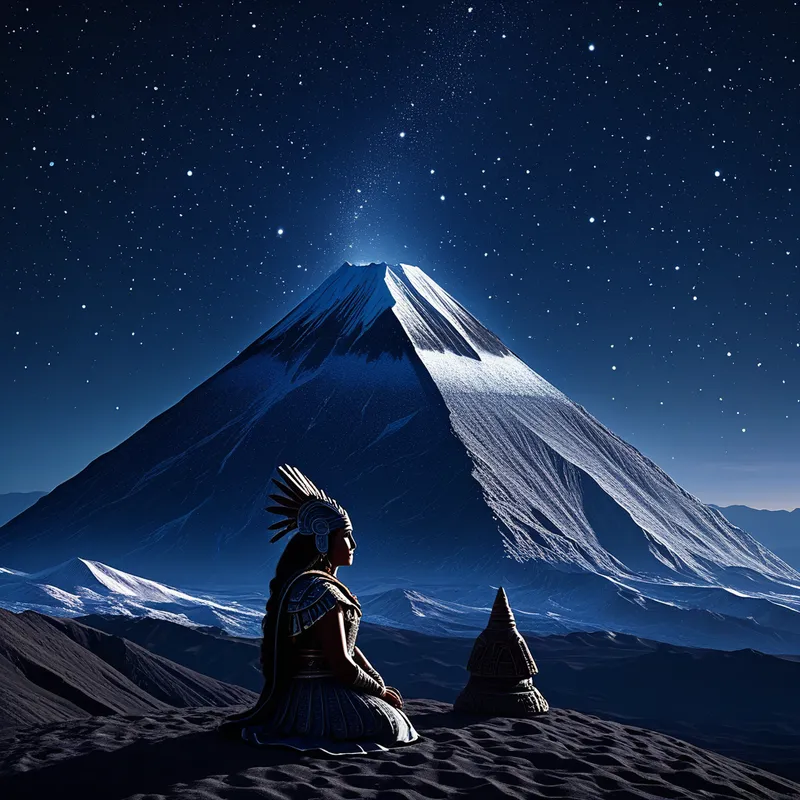
Hear now the tale that the wind sings between the two great peaks, a story carved not in stone but from the very bones of the earth. In the time of the Mexica, when the Valley of Anáhuac was a jewel among lakes, there lived a princess named Ixtaccíhuatl, the "White Woman." Her beauty was not of mere flesh, but of spirit—a calm, luminous presence like moonlight on still water. And there was Popocatépetl, "Smoking Mountain," the empire's most formidable warrior, whose valor in battle was matched only by the quiet depth of his heart, which belonged utterly to the princess.
Their love was a quiet pact, a known truth in the court of her father, the Tlatoani. He promised Popocatépetl his daughter's hand, but only upon the warrior's return from a crucial campaign against a fearsome enemy. "Bring me victory," the ruler said, "and she shall be yours." With a last, lingering look at Ixtaccíhuatl, whose eyes held both a promise and a fear, Popocatépetl marched to war.
The campaign was long and brutal. Time stretched thin in the princess's chamber. Then, a rival, consumed by envy for the warrior's glory and the princess's love, returned to the capital with a poisoned story. He proclaimed that the great Popocatépetl had fallen in battle. The news struck Ixtaccíhuatl not as a sword, but as a slow, cold frost. Grief, that silent assassin, entered her heart and stopped its rhythm. She did not rage or weep; she simply lay down, and her spirit departed, leaving a beautiful, lifeless form.
When Popocatépetl returned, draped in the hard-won honors of victory, the city greeted a hero. But his triumph turned to ash in his mouth. He was led not to his living love, but to her silent, stone-like bier. The world, in that moment, lost all its color and sound. The cries of celebration became a distant roar, meaningless. He ordered a great mound to be built for her upon the plain. He carried her body himself, laying her upon it with a tenderness that defied his warrior's strength. Then, taking two mighty torches, he knelt at her side, vowing to watch over her sleep for all eternity.
And there, under the gaze of the gods and the silent stars, the great magic of the world took hold. The elements themselves bore witness to a love too vast for mortal realms. A deep snow, pure and eternal, began to fall, covering Ixtaccíhuatl's form, sculpting her into a range of gentle, sleeping slopes—the Iztaccíhuatl volcano. And Popocatépetl, his vigil unending, was transformed beside her. His kneeling body hardened into a mighty, conical peak, his twin torches becoming the plume of smoke that forever issues from his summit—the Popocatépetl volcano. There they remain, locked in a near embrace, separated by a valley, together for all time.
Cultural Origins & Context
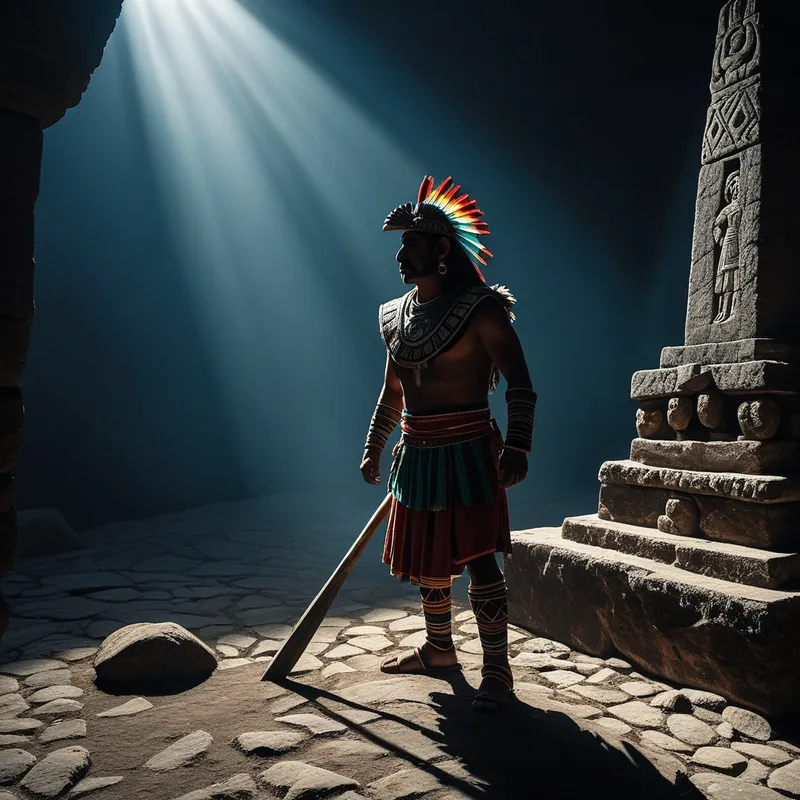
This myth originates from the Nahua peoples of Central Mexico, most famously preserved by the Mexica of Tenochtitlan. It is a legend of place, an etiological narrative that explains the origin of the two majestic volcanoes that dominate the horizon east of the Valley of Mexico. Unlike state-sponsored myths of Huitzilopochtli that emphasized cosmic war and sacrifice, this was likely a more populist, romantic tale, passed down through oral tradition by storytellers and poets.
Its function was multifaceted. On one level, it humanized the terrifying, sublime forces of nature—volcanoes were not merely destructive gods but beings of profound emotion. It reinforced cultural values of bravery, loyalty, and the tragic cost of deception. Furthermore, it served as a permanent, visible monument in the landscape, a daily reminder that the land itself is composed of stories, that geography is solidified memory. The tale was a bridge between the human heart and the seemingly impassive, monumental earth.
Symbolic Architecture
At its core, this is a myth of the coniunctio thwarted, the sacred marriage that is desired but eternally suspended. Ixtaccíhuatl symbolizes the anima—the inner feminine principle of receptivity, feeling, and relatedness. Her death by grief represents what happens when the anima is betrayed by falsehood and severed from its conscious counterpart. She becomes frozen, inaccessible, a beautiful but remote ideal.
The mountain is the solidified mass of an unbearable emotion, the geological record of a heartbreak that shook the world.
Popocatépetl embodies the heroic ego, the aspect of the psyche that goes out into the world to conquer, achieve, and prove its worth. His transformation signifies the fate of an ego that attains its worldly goal, only to find its deepest meaning—its connection to the soul—has perished in its absence. His eternal vigil with smoking torches represents a consciousness forever turned inward, guarding the lost beloved, its energy (the fire/smoke) now devoted not to external battle but to an internal, melancholic remembrance. The valley between them is the temenos, the sacred space of unresolved tension where transformation is eternally potential, but not yet achieved.

The Dreamer's Resonance
When this myth pattern arises in modern dreams, it often signals a profound experience of psychic petrification. The dreamer may be navigating a situation where a deep longing or a soulful connection has been seemingly killed by betrayal, miscommunication, or the harsh demands of "the campaign"—be it career, duty, or other worldly obligations.
Somatically, this can feel like a weight in the chest, a cold numbness, or a sense of being frozen in time. Psychologically, it is the process of sacred grief: a mourning not just for a lost person or opportunity, but for a lost potential self, for a union that was promised but never realized. The dream ego may find itself building monuments (projects, ideologies) to the lost connection or standing perpetual, angry vigil (resentment, depression) over it. The dream is presenting the colossal, immovable form of the complex, showing the dreamer the monumental scale of the feeling that has been turned to stone within them.

Alchemical Translation
The alchemical journey modeled here is not of successful union, but of the nigredo—the blackening, the initial stage of putrefaction and despair that is the necessary precursor to any transformation. The myth shows us that some loves, some aspects of the self, do not achieve integration in a lifetime. They achieve monumentality.
The individuation process sometimes requires us to become the mountain, not to climb it. To allow the pain to define our landscape so utterly that it becomes our sacred, visible form.
For the modern individual, the "alchemical translation" lies in the conscious recognition and honoring of this eternal vigil. It is the work of moving from being unconsciously petrified by grief to consciously holding the tension of the unfulfilled. Popocatépetl's fire, though born of despair, is still fire—it is consciousness, attention, and enduring commitment. The psychological task is to take that torch of awareness and, instead of letting it merely smoke with regret, use its heat to warm the frozen parts of the soul. To see the sleeping beloved (the lost anima/animus, the abandoned creative spark, the betrayed trust) not as dead, but in a state of suspended animation, preserved by the very cold of our grief. The transformation is from active striving to sacred guardianship, from seeking conquest to embodying a testament. In this, the separated peaks become not a failure, but the most profound landmarks of a soul's terrain.
Associated Symbols
Explore related symbols from the CaleaDream lexicon:
- Mountain — The solidified emotion and eternal monument of the psyche, representing both the colossal weight of grief and the enduring testament of love.
- Love — The central, thwarted force that binds the two entities, representing a union of opposites that is desired but perpetually suspended, creating the landscape of the soul.
- Sacrifice — Popocatépetl's sacrifice of his worldly life and future for an eternal vigil, and Ixtaccíhuatl's ultimate sacrifice of her life to false grief.
- Fire — Represented by Popocatépetl's smoking torch, it is the active, vigilant consciousness, the enduring passion, and the internal heat of remembrance that contrasts with the ice of loss.
- Death — Not an end, but a transformation into a different state of being; the catalyst that turns human drama into eternal, geological myth.
- Grief — The silent, cold force that petrifies Ixtaccíhuatl, depicted as a tangible element that can reshape reality and freeze potential into permanent form.
- Journey — Popocatépetl's physical campaign and the longer, internal journey of both characters from human lovers to elemental deities, a path of no return.
- Stone — The final state of both beings, representing permanence, memory, and the weight of truth that sinks through layers of time to become the foundation of the world.
- Sleep — Ixtaccíhuatl's eternal state, representing not oblivion but a suspended animation, a potential that is preserved but not active, awaiting a awakening that may never come.
- Warrior — The archetype embodied by Popocatépetl, whose ultimate battle is not against external enemies, but against the finality of loss, fought with the weapons of vigil and memory.
- Betrayal — The deceptive message that severs the connection between the lovers, the poisonous seed from which the entire tragic transformation grows.
- Sky — The vast, witnessing dome under which the drama unfolds, connecting the human story to the cosmic order and the realm of the gods.