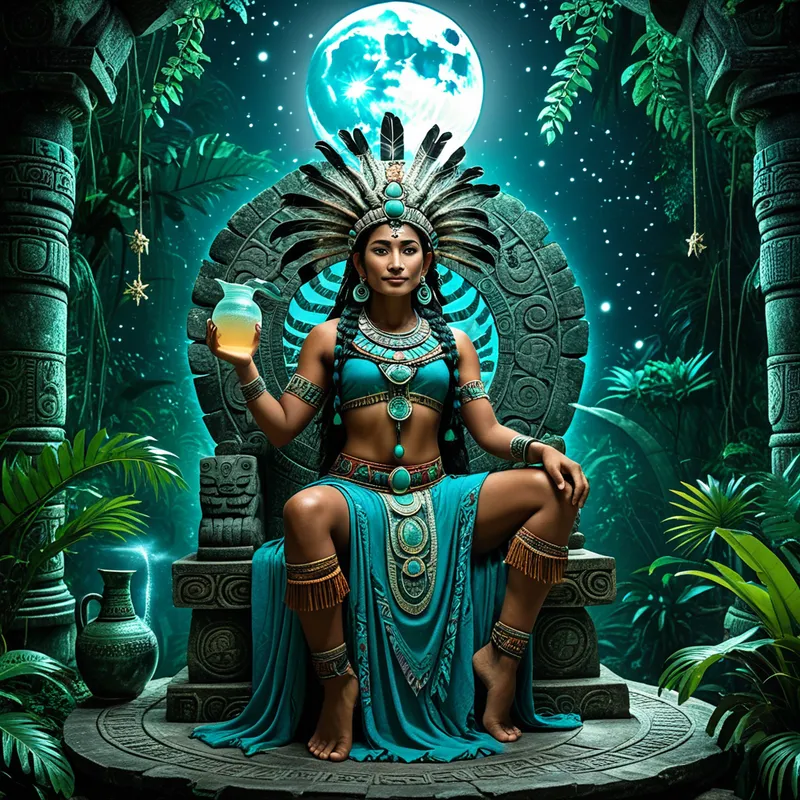
Ixchel Myth Meaning & Symbolism
The story of Ixchel, the jaguar goddess of the moon, weaving, and medicine, who navigates celestial floods and earthly cycles to bring forth life and wisdom.
The Tale of Ixchel
Listen, and let the night air carry the story. Before time was counted in Tzolk'in, when the sky was lower and the waters slept deep, there was She of the Rainbow Loom: Ixchel. Her skin held the pallor of the full moon, her hair the black of the void between stars, and in her eyes swirled the grey of gathering storms.
She was the weaver of destinies, her fingers dancing with threads of dawn-light and shadow. But her heart was a vessel too vast for the calm sky. It held the tides of creation and the ache of the void, and from this fullness, the great waters of the heavens broke. A celestial flood poured forth, not from clouds, but from the very womb of potential. The world drowned in a silver deluge, and Ixchel, in her sorrow and power, was cast out. The sun, her brother and sometimes consort, turned his fierce face away.
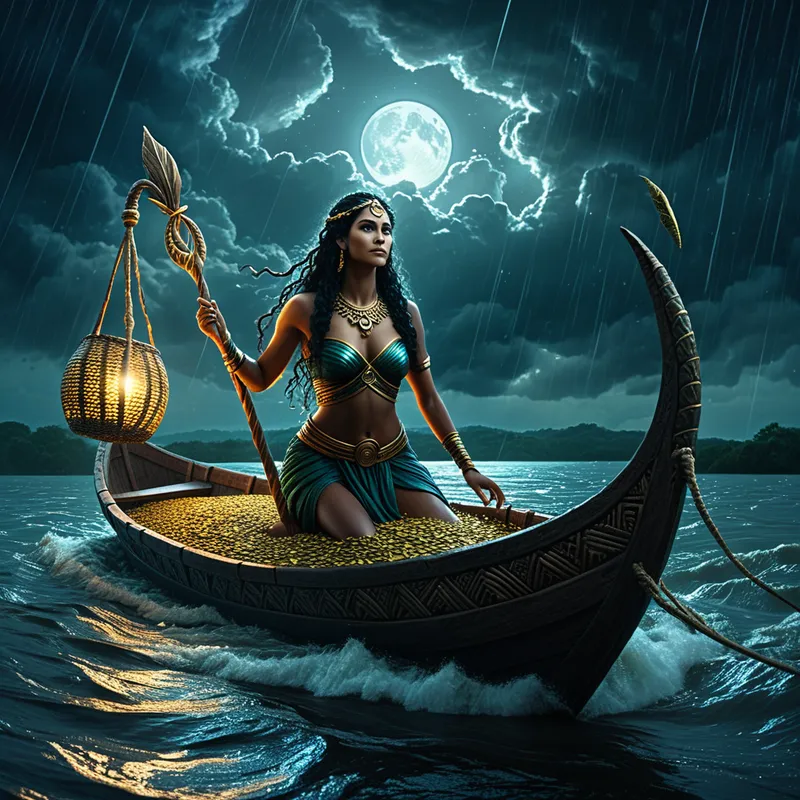
Yet, a goddess is not undone by her own nature. From the floodwaters, she fashioned a boat—not of wood, but of a great, coiled serpent. Upon this living vessel, she sailed the star-strewn torrents. In her arms, she carried a basket. Not a basket of reeds, but one woven from her own thoughts, containing the seeds of all healing herbs, the first patterns of the loom, and the sacred knowledge of blood and birth.
She sailed through the chaos she had unleashed. Jaguars, her sacred beasts, swam beside her, their spotted coats like islands of shadow in the silver sea. Spiders, the first weavers, spun silvery lines from her boat to the drowned treetops, charting a path. She sailed until the waters receded, not into nothingness, but into the earth, becoming the underground rivers and the morning dew. She sailed until she found the shore of the world, reborn and damp.
There, she poured her basket onto the fertile mud. Vines of healing snaked out. Cotton plants burst forth, white as moonlight. She took her place in the sky, no longer a constant presence, but a cycle—waxing, full, waning, dark. She became the crescent moon, a curved bowl holding medicinal waters. She became the old woman emptying her jug to bring the rains, and the young maiden holding the rabbit, the symbol of abundance. She did not conquer the flood; she became its rhythm. The great weave was not broken, but made more complex, its pattern now holding both the deluge and the healing, the destruction and the tender, relentless return of life.
Cultural Origins & Context
The stories of Ixchel are woven into the very fabric of the Postclassic Maya, particularly from Cozumel and the Yucatán coast, where she was a paramount deity. She was not merely a character in a tale but a living, breathing force invoked in the most critical thresholds of human life. Her primary centers of worship, like the sanctuary on Cozumel, were pilgrimage sites where women, in particular, would journey to seek her blessings for fertility and safe childbirth.
Her myth was not a single, canonical text but a constellation of attributes, titles, and artistic depictions passed down through priestly lineages, midwives, and weavers. She was known as “Lady Rainbow,” connecting sky to earth; “She of the Pale Face,” the moon itself; and the fearsome “Goddess O,” depicted in the codices as an old woman emptying a jug of water, often with a serpent headdress and jaguar associations. Her societal function was profound: she governed the biological and creative cycles. The midwife calling upon Ixchel during labor, the healer using herbs under a waning moon, and the weaver at her loom were all participating in her ongoing myth, channeling her power to navigate the floods of pain, the tides of creativity, and the delicate weave of life itself.
Symbolic Architecture
Ixchel is not a goddess of singular, static virtue. She is an archetypal embodiment of the creative matrix itself, with all its terrifying and nurturing polarity. The flood she unleashes is not a punishment, but the inevitable overflow of creative potential—the uncontained emotional, psychic, or libidinal energy that precedes formation.
The vessel must first be shattered by its own contents before it can be remade as a cradle.
Her serpent-boat is the quintessential symbol of navigating the unconscious. The serpent, representing primal earth wisdom and cyclical renewal, becomes the vehicle through chaos. The jaguar, lord of the underworld and the night, is her companion, signifying that this journey requires embracing the predatory, instinctual self, the shadow that sees in the dark. The spiderweb is the emergent order, the first fragile structure of meaning spun from within the chaos.
Most critically, she is the weaver. The loom is her primary tool, symbolizing the conscious act of creating coherence from disparate threads—of experience, of lineage, of time. She weaves the Tzolk'in, the sacred calendar, into existence. Thus, her myth posits that fate is not a pre-written scroll, but a living tapestry whose pattern we participate in creating, even from the threads of our personal floods.
The Dreamer's Resonance
When the pattern of Ixchel stirs in the modern dreamer, it often announces a profound somatic and psychological process related to creative or life-giving forces. This is not the hero’s quest, but the caregiver’s, the creator’s, the weaver’s ordeal.
One might dream of overwhelming floods—not of water, but of feeling, responsibility, or unexpressed creative impulses. The dream-ego may be adrift, searching for a vessel. The appearance of weaving implements—a tangled loom, a spindle, a severed thread—points to a struggle to make sense, to connect disparate parts of the self or one’s life story. Dreams of potent, sometimes frightening animals like jaguars or serpents in a protective role suggest the need to ally with instinctual, bodily wisdom.
Somatically, this process can feel like a pressure building—a fullness that demands release. It may correlate with life phases of intense creativity, caregiving burnout, or navigating major biological cycles (pregnancy, menopause, healing). The psyche is signaling that the old vessel of identity is too small. The flood is both the crisis and the necessary medium for rebirth. The dream asks: What in you is overflowing its banks? And what nascent boat—what new structure of understanding—can you build to sail upon it?
Alchemical Translation
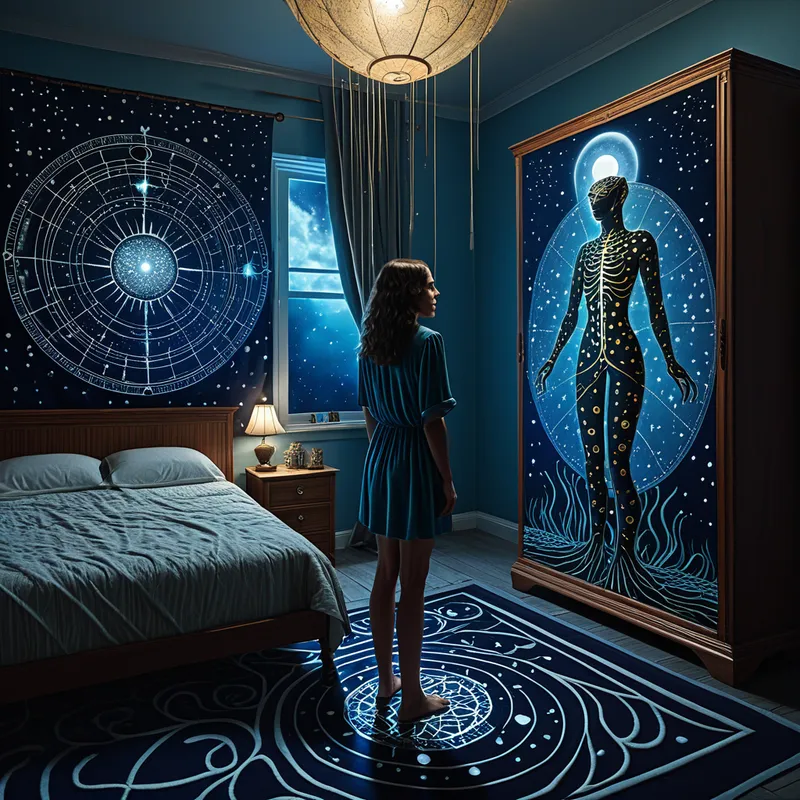
The alchemy of Ixchel is the transmutation of chaotic, potential-laden prima materia into the sacred, patterned fabric of an individuated life. Her myth models a non-linear path of psychic integration.
The first stage is The Acknowledged Deluge. This is the conscious descent, the allowing of the flood—the grief, rage, passion, or inspiration that has been dammed up. To deny it is to deny the source of one’s own creative power. The second stage is Fashioning the Serpent-Boat. This is the act of finding or creating a vessel of meaning from within the chaos itself. It is the journal begun in turmoil, the therapeutic framework adopted, the daily practice clung to. It is not about stopping the flood, but learning to navigate it.
Individuation is not the avoidance of personal mythology, but the courageous act of weaving its darkest and brightest threads into a single, resilient cloth.
The final, ongoing stage is Weaving at the New Loom. Having sailed the flood, the returned waters now feed the roots of being. The task becomes the conscious, patient weaving of the experience into the fabric of the self. The healed wound becomes a source of empathy (the medicine). The survived trauma informs a new pattern of strength (the woven destiny). The individual becomes, like Ixchel, a cyclical being—able to hold the full moon of expression and the dark moon of introspection, the flood of feeling and the careful stitch of integration. One becomes both the source of the waters and the weaver of their course, a self-contained cosmos echoing the ancient, lunar rhythm of destruction and tender, relentless return.
Associated Symbols
Explore related symbols from the CaleaDream lexicon: