Iðunn's Apples Myth Meaning & Symbolism
The gods grow old and weak until the goddess Iðunn, keeper of the golden apples of youth, is stolen away, threatening the cosmos with decay.
The Tale of Iðunn's Apples
Listen, and hear the tale of the gods’ own fragility. In the high halls of Asgard, where the mead flows and boasts echo, a creeping shadow was felt. It was not the shadow of Jötnar or the coming of Ragnarök, but a quieter, more insidious foe: time itself. The mighty Odin found his one eye growing weary. Thor’s grip, which could shatter mountains, began to feel the faintest tremor. Their hair, once like spun gold or raging fire, showed threads of frost. A deep weariness settled in their bones, a rust upon their divinity. They were fading, and with them, the order of the worlds.
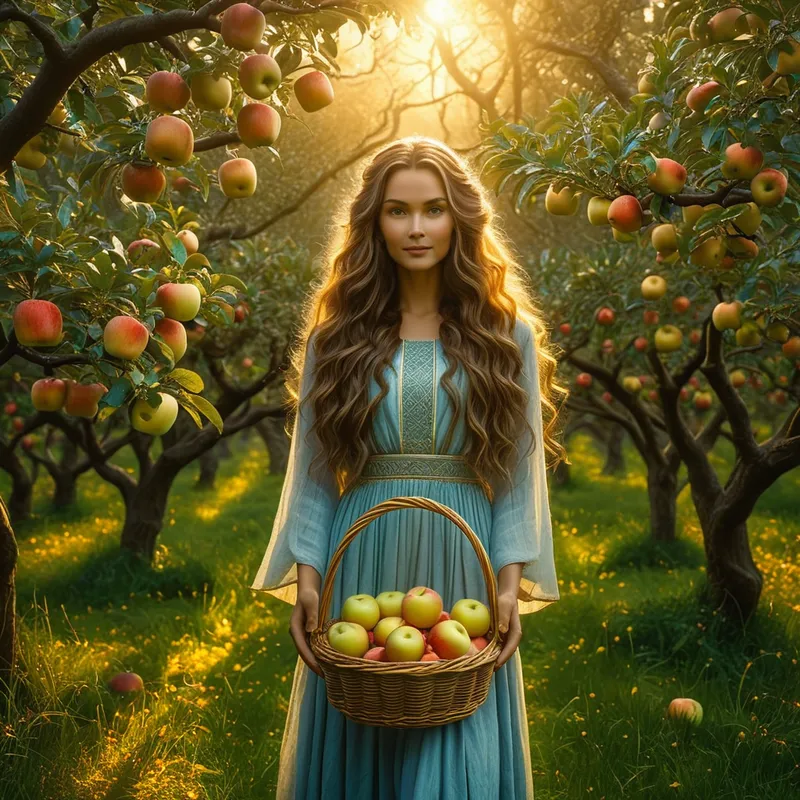
But in their midst was Iðunn, whose presence was like the first breath of spring after a long winter. She moved with a lightness that defied the heaviness slowly claiming the others. In her care was a casket of ash wood, simple and unadorned. Within it lay her treasure: apples of a gold so pure it seemed woven from sunlight itself. When the gods felt the weight of years, Iðunn would come. She would offer the fruit, and with a single bite, the weariness would vanish. Wrinkles smoothed, strength returned, eyes cleared with the vigor of eternal prime. She was the silent, gentle heart that kept the great machine of Asgard turning.
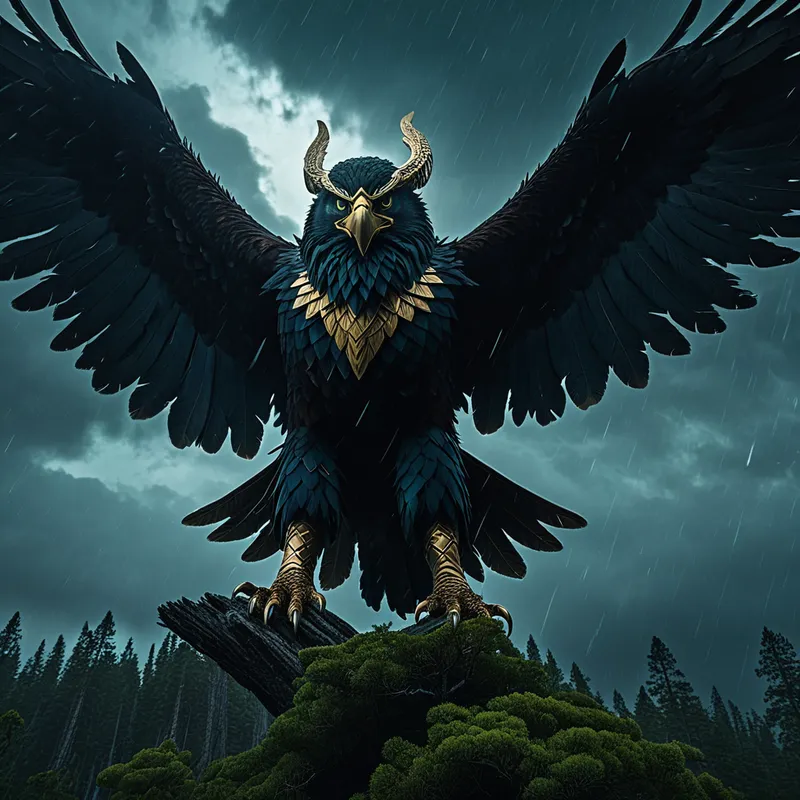
The peace was shattered by a journey. Loki, Bragi, and Njörðr traveled into the wild lands of Midgard. They took shelter, built a fire, and hunted an ox. As the meat roasted, a colossal eagle descended from the peaks, its shadow blotting out their firelight. It was the jötunn Thjazi in disguise. With a voice like grinding stone, he demanded the finest cuts. Enraged, Loki struck at the eagle with a great pole, but the weapon stuck fast to the creature, and Loki’s hands were glued to it. With a mighty beat of its wings, the eagle soared into the sky, dragging the shrieking god over rocks and trees, tearing him against the very fabric of the world.
In agony, Loki bargained for his life. Thjazi demanded a price only the trickster could pay: the goddess Iðunn and her apples. Loki, broken and desperate, agreed. Returning to Asgard, he wore a mask of cunning over his shame. He found Iðunn in her orchard, a place of perpetual blossom. With silver words, he spoke of a tree in a nearby wood that bore fruit even more marvelous than her own. Trusting, ever-innocent, Iðunn took her casket and followed him beyond Asgard’s walls. There, in the gloom of the pine forest, the shape of Thjazi blotted out the sun. His talons, cold as iron, closed around Iðunn, and he bore her away to his barren fortress of Þrymheimr.
In Asgard, the decay came swiftly. Without Iðunn’s gentle visits, the gods withered. Their backs bent, their beards grew long and grey, their laughter turned to weary sighs. The very walls of the halls seemed to groan with age. They gathered, a council of crumbling elders, and knew with dread certainty: Loki was the key. They seized him, their weakened hands still capable of threat. Under the promise of a torturous death, Loki confessed.
His salvation required a borrowed skin. He flew to the high halls of Freyja and begged the use of her falcon cloak. Donning the feathers, he became a bolt of feathered lightning, streaking across the sky to Thjazi’s mountain fastness. He found Iðunn alone, her apples still held close. With a whisper, he transformed her into a single, perfect nut. Clutching it in his talons, he shot back toward Asgard.
But Thjazi, returning, saw the empty cage and the fleeing falcon. His rage shook the mountains. He took his eagle form, a tempest of feathers and fury, and gave chase. The wind of his wings screamed across the world. Loki, straining every sinew, saw the walls of Asgard ahead. The aged gods, watching from the ramparts, saw the chase—the small falcon desperately fleeing the monstrous eagle darkening the sky. On Odin’s command, they piled kindling onto the walls of Asgard and set a blazing fire just as Loki shot over the battlements. Thjazi, blind with pursuit, could not stop. His vast wings caught the fire, his feathers ignited, and he fell, burning, into the courtyard of the gods, where he was slain.
And Iðunn, restored to her form, opened her casket. One by one, the gods came forward. They took the golden apples, and as they ate, the years fell from them like shed scales. Strength flooded back into their limbs, light returned to their eyes. The shadow was lifted, not by battle or conquest, but by recovery. The gentle heart of the world had been returned, and with it, the promise of renewal. But in the feast that followed, the eyes of the gods occasionally drifted to Loki, who smiled, knowing the debt was paid, but the trust was forever broken.
Cultural Origins & Context
This myth survives primarily within the Poetic Edda, in the poem Haustlǫng, and is recounted more fully in the later Prose Edda by Snorri Sturluson. It was not a scripture, but a living narrative performed by skalds (poets) and storytellers, a vital thread in the tapestry of oral tradition that defined pre-Christian Norse worldview. Its function was multifaceted: it explained the cyclical nature of vitality and decay in a world perceived as inherently fragile, it reinforced the social importance of the keeper (often a woman) of vital resources, and it served as a cautionary tale about the cosmic consequences of betrayal and greed. Telling this story around the fire during the darkening autumn months (haust, meaning autumn, is in the poem's title) would have been a powerful ritual act, a symbolic defiance of the encroaching winter and a reaffirmation of hope for the return of spring and strength.
Symbolic Architecture
At its core, the myth of Iðunn is a profound allegory for the psyche’s need for periodic renewal. The gods, representing the established structures of consciousness—order, strength, wisdom—are not inherently immortal. They are subject to entropy, to the slow accumulation of psychic fatigue, dogma, and rigidity.
Iðunn is not the apples; she is the capacity for renewal. She represents the autonomous, nurturing function of the psyche that guards and distributes the essence of vitality.
Her apples are the symbolic nutrient of the soul: inspiration, creativity, psychological flexibility, and the life force itself. Loki’s betrayal symbolizes how the trickster aspect of the mind—our cunning, our compromises, our shortsightedness—can bargain away our connection to this vital source, delivering our inner Iðunn to the giant of stagnation (Thjazi). The subsequent aging of the gods is the psychic depression and literal ennui that follows when we lose touch with what truly rejuvenates us. The recovery mission, requiring Freyja’s cloak (the gift of intuition and connection to the deep feminine), models the necessary journey into the unconscious (Thjazi’s remote fortress) to reclaim and re-integrate this lost capacity for self-renewal.
The Dreamer's Resonance
When this myth pattern stirs in the modern dreamer, it often manifests as a profound sense of depletion. One may dream of withering plants, dying batteries, crumbling buildings, or finding oneself suddenly old and frail. The specific symbol of a lost or stolen precious object—a jewel, a child, a vital document—can parallel Iðunn’s casket. The dreamer is undergoing a somatic and psychological process of recognized depletion. The psyche is sounding an alarm: the well is dry. The "giant" that has taken the renewing force may appear as a draining job, a toxic relationship, a consuming addiction, or simply the accumulated weight of unresolved trauma and responsibility. The dream is the first step in the "council of the gods"—the ego’s confrontation with its own weakened state, forcing an inquiry into what, or who, has been bargained away.
Alchemical Translation
The individuation process modeled here is the cycle of loss, quest, and recovery of the animating principle. We all, like the gods, build structures of identity and achievement. And we all, inevitably, experience the rust of these structures. The alchemical work begins not with adding more, but with acknowledging the terrifying loss of what secretly sustained us.
The first transmutation is the acceptance of decay. Only when the gods sit, grey and weak, can they muster the unified will to send the trickster back to retrieve what he lost.
Loki, our flawed, adaptable, and resourceful shadow, must be compelled to undertake the dangerous flight. This represents harnessing our own cunning and flexibility—not for short-term gain, but for the sacred task of recovery. Transforming Iðunn into a nut for the journey is crucial: the renewing force must be condensed into a portable, protected, essential seed-form to survive the passage back to consciousness.
The final, fiery confrontation at the walls of Asgard is the necessary destruction of the predatory complex (Thjazi) that fed on our vitality. It cannot be reasoned with; it must be consumed by the very fire of conscious attention we raise against it. The triumphant return and sharing of the apples signifies the re-integration of this life force, not as a temporary fix, but as a restored, ongoing relationship with the inner Iðunn. The psyche learns it must periodically eat of the golden apple—engage in what truly rejuvenates it—or face the inevitable winter of the soul. The myth thus becomes an eternal map for the human spirit: we are not made to endure forever in one form, but we are endowed with the means, however perilously guarded, to be perpetually reborn.
Associated Symbols
Explore related symbols from the CaleaDream lexicon: