Itzpapalotl Myth Meaning & Symbolism
A fearsome goddess of death and rebirth, the Obsidian Butterfly embodies the paradox of beauty and terror, destruction and creation.
The Tale of Itzpapalotl
Listen, and let the smoke of copal carry you back. Not to the world of the Fifth Sun, but to the time before, to the lost paradise of Tamoanchan. Here, the air is thick with the scent of eternal flowers, and the trees bear fruit of jade. It is a place of beginnings, but also of profound forgetting.
Into this garden of potential comes a band of the Centzon Mimixcoa. They are hunters, sons of the earth, reveling in the bounty. But a shadow falls upon their feast. A command echoes from the heavens: they must make war, must offer sacrifice to the sun. They refuse, choosing instead the nectar of the maguey and the soft embrace of the garden. For this defiance, a punishment is devised.
A beautiful woman appears among them. She is not of Tamoanchan. Her beauty is a blade wrapped in silk, her eyes holding the cold glitter of distant stars. She dances, and the hunters are ensnared. One, bolder than the rest, is chosen by lot to pursue her, to claim her. He follows her deep into the wild places of the garden, his heart a drum of desire.
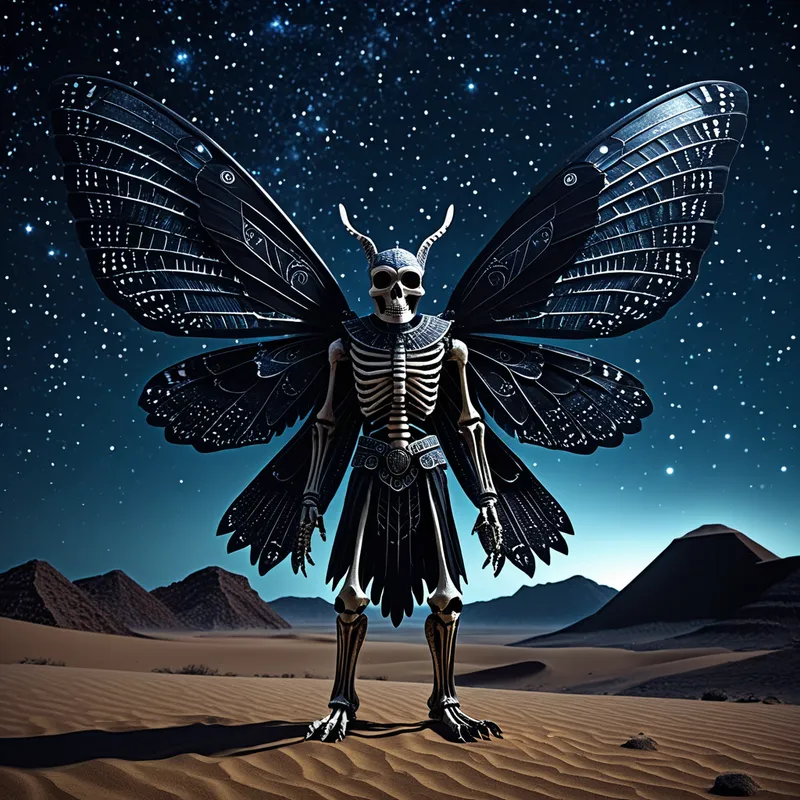
But as he reaches for her, the world cracks. The beautiful skin sloughs away like dried clay. What stands before him is no mortal woman. It is Itzpapalotl. Her true face is a starry skull. From her back erupt wings—not of feather or membrane, but of countless, razor-sharp blades of black obsidian, catching the light of a sky that is now a cold tapestry of constellations. She is the Tzitzimitl of the heavens, a devourer of the sun.
Terror roots the hunter to the earth. Itzpapalotl, the Obsidian Butterfly, opens her maw and unleashes a cry that is the sound of ice forming in the void. From her wings, a blizzard of obsidian shards flies forth. They do not merely cut flesh; they flay spirit, they carve memory from bone. The hunter is not just killed; he is unmade, his essence scattered like dust before the cosmic wind. His companions, hearing the cosmic scream, flee in a panic that seeds future wars and migrations. The paradise is forever stained with the knowledge of this terrible, beautiful truth: that creation and destruction are two beats of the same heart.

Cultural Origins & Context
The myth of Itzpapalotl is a deep, ancestral memory preserved in the codices, such as the Historia Tolteca-Chichimeca and the Codex Borgia. She belongs not to the central, state-sanctioned cult of Huitzilopochtli, but to an older, more chthonic and stellar stratum of belief, possibly originating with the Chichimec and other nomadic groups of the northern deserts. Her story is one of origin and warning.
She was a goddess of the First Sun, a time destroyed by jaguars. This places her at the very foundation of cosmic time. As a Tzitzimitl, she was a being of the night sky, feared for her power to descend during solar eclipses and devour the sun—the ultimate threat to cosmic order. Her myth was likely told not to glorify empire, but to explain the fragility of paradise, the price of neglecting sacred duty, and the inescapable presence of a feminine power that was both generative and terrifyingly destructive. She was the embodiment of the hard, necessary truths of a world where life springs directly from sacrifice.
Symbolic Architecture
Itzpapalotl is not a monster in a simple sense. She is a complex symbolic organism, a paradox made manifest. Her very name holds the key: the beautiful, delicate butterfly, a universal symbol of the soul and transformation, married to obsidian, the black volcanic glass used for sacrificial knives and mirrors for scrying. She is transformation that kills, the mirror that shows a truth too stark to bear.
The chrysalis is not a safe haven; it is a dissolution chamber. To become, one must first consent to be unmade.
Her starry, skeletal form connects her to the cosmos (Cipactli) and to the ancestors. The skeleton represents the irreducible core, the enduring structure beneath the flesh of temporary identity. The obsidian blade-wings symbolize the cutting away of illusion, the painful but necessary discernment that separates truth from deception, whether the deception is a languid paradise or a beautiful face hiding a cosmic mandate. She represents the Fierce Feminine that does not nurture, but initiates through ordeal; not the mother who gives life, but the midwife who presides over the death of the old self.

The Dreamer's Resonance
When the pattern of Itzpapalotl stirs in the modern psyche, it announces a profound and often feared initiation. To dream of her is to dream of a looming, beautiful terror. One might dream of a captivating but ultimately hollow relationship that suddenly reveals its soul-destroying nature. Or of a career or identity that feels like a paradise (Tamoanchan) but is secretly starving the spirit, demanding a sacrifice one is refusing to make.
Somatically, this can feel like a tightening in the chest, a sense of being flayed or exposed. Psychologically, it is the moment when a cherished self-image—the "beautiful" persona we present to the world and ourselves—cracks open to reveal the stark, skeletal truth beneath. This is not depression, but a brutal encounter with the Shadow in its most cosmic form. The dreamer is the hunter, confronted by the fact that what they desired was actually the agent of their necessary dissolution.

Alchemical Translation
The alchemical journey modeled by Itzpapalotl is the Nigredo—the blackening, the putrefaction, the deepest despair of the soul. In individuation, this is the stage where conscious attitudes are ruthlessly deconstructed. The "paradise" of our adapted personality, our comfortable illusions, must be shattered by a truth we have been avoiding.
The obsidian blade does not wound to inflict suffering, but to perform a surgery of the soul, cutting away the necrotic tissue of a life no longer true.
The modern individual undergoing this process is not literally hunted by a star demon. Instead, they may face a devastating loss, a betrayal, a failure, or a depression that feels annihilating. This is Itzpapalotl’s work. Her terrifying revelation is an invitation, though it feels like a sentence. The key is not to flee like the Mimixcoa, but to stand in the terrifying presence of the unveiled truth. To allow the obsidian shards to strip away what is false. Only through this unmasking can the irreducible, starry core of the Self—the skeletal truth of who we are beyond our roles and desires—be revealed. From that black, polished obsidian core, reflecting nothing but its own essential nature, a new and more authentic life can eventually be built. The Butterfly does not emerge without the dissolution of the caterpillar. Itzpapalotl is the goddess of that fatal, glorious metamorphosis.
Associated Symbols
Explore related symbols from the CaleaDream lexicon: