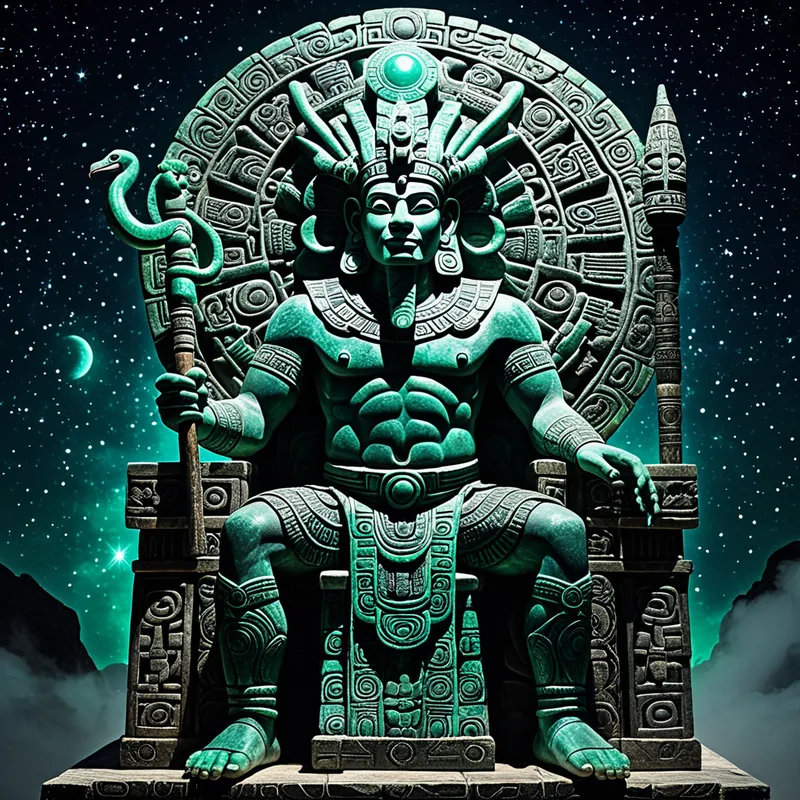
Itzamna Myth Meaning & Symbolism
The story of Itzamna, the celestial lizard who shaped the world from primordial chaos, bringing order, language, and medicine to humanity.
The Tale of Itzamna
In the beginning, there was only the black, starless sea. No sky arched above, no stone rested below. Only the silent, dreaming waters, Huracan churning in its sleep. From the depths of this unformed potential, a presence stirred. Not born, but becoming. He was the first thought in the mind of the void.
He was Itzamna, the Lizard House, the Iguana. His body was the architecture of possibility—scales like polished obsidian, eyes holding the cold fire of distant suns. He did not walk, for there was nowhere to walk. He unfolded. With a great exhalation that was the first wind, he pushed the waters apart. His massive, reptilian back breached the surface, and where his spine rose, the first mountains pushed their stony heads into the new air. The land was his body, offered.
But a world of stone is a silent world. So Itzamna reached into the vault of his own being and plucked a shard of his essence. He breathed upon it, and it became the sun, Kinich Ahau, his daylight face, to warm the stone and draw green life from it. From another shard, he fashioned the moon, to guard the secrets of the night.
Yet the world was still mute. The wind had no song, the rivers no story. So Itzamna took a bone from his own hand—the hand that shapes—and with its tip, he began to write upon the fabric of reality. Each stroke was a sound. Each glyph, a thing. He wrote "chaac" and the first rain fell. He wrote "witz" and the mountains grew forests. He wrote the names for jaguar, for corn, for hummingbird, and they blossomed into being from the parchment of the world.
Finally, he looked upon the creatures of the earth and saw they had no way to call his name, no means to know the patterns he had written. So he descended, not as the cosmic lizard, but as a wise elder with a face lined with knowledge. He gathered the first people and taught them the sacred art: how to shape the symbols he had invented. He gave them the calendar to measure the breath of the cosmos, and the secrets of plants to mend their fragile bodies. He did not give them fire—that was for tricksters to steal—but he gave them something more enduring: the means to hold time, history, and thought in their minds and in their hands. He built the first house of learning, and there he sat, the eternal scribe, as the world he spoke into being continued to write its own story around him.

Cultural Origins & Context
The myth of Itzamna is not a single story bound in one codex, but a foundational presence woven through the entire tapestry of Classic and Postclassic Mayan civilization. His name appears in the codices, such as the Dresden Codex, and is etched into stone stelae at sites like Quiriguá and Copán.
He was the paramount deity of the ruling priestly class, the ah kinob. His myth was not merely told for entertainment; it was the cosmological bedrock of state power and social order. The king, or k'uhul ajaw (holy lord), was considered his earthly representative, the conduit through which Itzamna's ordering principle flowed into society. The myth justified hierarchy, calendrical science, and the sacred duty of scribes. It was passed down through formal training in the popol nah (mat house), where young nobles learned the glyphs, astronomy, and rituals that kept the world in balance. The story of Itzamna was the story of civilization itself—its divine origin, its structured beauty, and its ultimate dependence on maintaining a connection to the celestial architect.
Symbolic Architecture
Itzamna is not a god of dramatic battles or tragic loves. He is the archetype of the foundational principle, the intelligence that precedes and enables all action. His symbolism is an intricate map of cosmic order.
He is the union of opposites: celestial and terrestrial (the Lizard House spans heaven and earth), male and female (often paired with the goddess Ix Chel), day and night (as both the sun god and lord of esoteric knowledge). His reptilian nature connects him to the primordial, pre-human world and to regeneration. The lizard, which can shed its skin, symbolizes the capacity for the cosmos to renew itself.
The first act of creation is not an explosion, but a distinction. It is the drawing of a line between the waters, the establishment of here and there. This is the birth of consciousness itself.
His gifts—writing, the calendar, medicine—are all technologies of order. Writing fixes fluid thought. The calendar fixes fluid time. Medicine fixes fluid health. He represents the human impulse to pattern chaos, to translate the roaring, incomprehensible universe into a system of knowable, communicable signs. He is the archetypal Scribe of Reality, and his myth tells us that to name a thing is to participate in its creation, and to know its pattern is to hold a fragment of divine power.
The Dreamer's Resonance
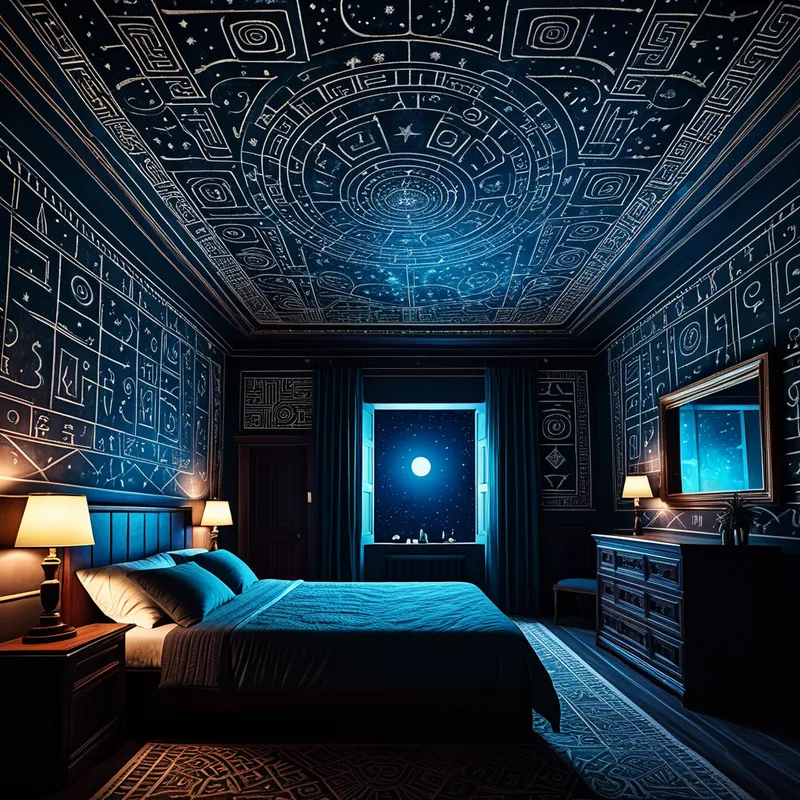
When the pattern of Itzamna stirs in the modern psyche, it often manifests not as a dramatic figure, but as an atmosphere or a specific, compelling need. One might dream of discovering a room in their house they never knew existed, filled with ancient, beautifully bound books or complex blueprints. They may dream of desperately trying to learn a forgotten language or decode a message written in light on a wall.
Somatically, this can feel like a pressure in the forehead or a deep, centering calm—a sense of things "clicking" into place. Psychologically, this myth activates when the dreamer is at the threshold of a new phase of life that requires internal structuring. It is the psyche's response to chaos—be it emotional, professional, or intellectual. The dream is not offering a hero to save you, but the tools to architect your own stability. The conflict felt is the tension between inner chaos and the nascent, demanding call to impose a personal order, to "write the glyphs" of one's own values, schedule, or understanding.
Alchemical Translation
The individuation process modeled by Itzamna is one of conscious structuration. It is the "Creator" archetype applied not to art for art's sake, but to the very fabric of the self. The primordial sea is the undifferentiated unconscious—a soup of potentials, traumas, instincts, and talents. The ego, in its early state, is adrift in this sea.
The alchemical work is not to fight the chaos, but to become the land that rises from it. To allow the spine of personal truth to form the bedrock.
The first step is the Itzamna gesture: the courageous act of distinction. "This is me. That is not." This is setting the first boundary, articulating the core value, writing the first line of one's own story. It is the creation of an inner axis mundi.
The subsequent gifts are the tools for this inner work: Writing becomes active self-reflection and journaling, the fixing of fleeting emotions into comprehensible narrative. The Calendar becomes the conscious structuring of one's time and energy, respecting natural rhythms. Medicine becomes the knowledge of what heals and nourishes the unique ecosystem of one's own body and mind.
To integrate Itzamna is to move from being a passive creature of circumstance to becoming the architect of your inner world. You stop waiting for the world to make sense and begin the diligent, sacred work of creating a personal cosmology—a system of meaning, order, and healing that is uniquely your own, yet connected to the ancient, star-etched patterns of the whole. You become, in your own sphere, the scribe and the sovereign.
Associated Symbols
Explore related symbols from the CaleaDream lexicon: