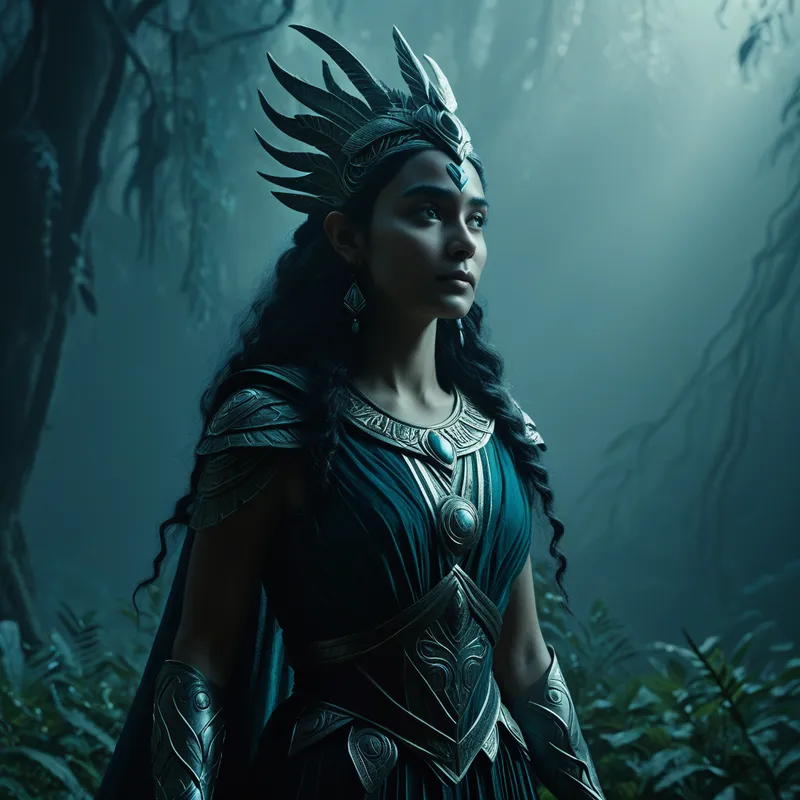
Ishtar and Tammuz
The Babylonian myth of goddess Ishtar's perilous journey to the underworld to retrieve her lover Tammuz, explaining the cycle of seasons through divine love and loss.
The Tale of Ishtar and Tammuz
The tale begins not in darkness, but in the full, fecund light of [the world](/myths/the-world “Myth from Tarot culture.”/) above. [Ishtar](/myths/ishtar “Myth from Babylonian culture.”/), the Queen of Heaven, goddess of love, fertility, war, and political power, whose domain was the vibrant pulse of life itself, had taken the shepherd-king [Tammuz](/myths/tammuz “Myth from Mesopotamian culture.”/) as her beloved. Their union was [the sacred marriage](/myths/the-sacred-marriage “Myth from Various culture.”/), the hieros gamos, that blessed the land, ensuring the fertility of flocks, fields, and womb. [The world](/myths/the-world “Myth from Tarot culture.”/) was in harmony, a reflection of their divine embrace.
Yet, in [the way](/myths/the-way “Myth from Taoist culture.”/) of all things mortal and immortal touched by passion, tragedy was woven into the joy. The details of Tammuz’s [death](/myths/death “Myth from Tarot culture.”/) are shrouded in the fragmentary nature of the ancient tablets, but the essence is clear: he perished. Some whispers say he was gored by a wild boar; others suggest his death was the inevitable price for the goddess’s fierce and demanding love. Regardless, his spirit was taken to the Kur, the land of the dead, ruled by Ishtar’s sister and opposite, the formidable goddess Ereshkigal.
Ishtar, clothed in the majesty of her seven divine powers, could not abide this loss. The world above, once vibrant, began to wither in sympathy with her grief; love ceased, animals would not mate, the green things of [the earth](/myths/the-earth “Myth from Hindu culture.”/) grew still. Driven by a love that was also a possessiveness, a divine rage against the finality of death, she resolved to do what no god should: descend into [the underworld](/myths/the-underworld “Myth from Greek culture.”/) to reclaim him.
Before the gates of the Kur, she confronted the gatekeeper, demanding entry. Ereshkigal, suspicious and perhaps envious of her sister’s dominion over life, instructed the gatekeeper to admit her but only after stripping her of her symbols of power. At each of the seven gates of the [underworld](/myths/underworld “Myth from Greek culture.”/), a portion of her regalia was removed: her crown, her earrings, her necklace, the jewels from her breast, her girdle of birthstones, the bracelets from her wrists and ankles, and finally, her royal robe. Naked and powerless, Ishtar entered the throne room of Ereshkigal.
There, she was met not with sisterly compassion, but with the raw, unmitigated gaze of death. Ereshkigal fixed her with the “eyes of death,” and Ishtar was turned to a lifeless lump of meat, hung upon a hook. With the goddess of life and fertility imprisoned in death, all generative processes on earth ceased entirely. The world was plunged into a sterile, eternal winter.
In the heavens, the gods grew alarmed. Without Ishtar, the cycle of life was broken. The wise god Ea, lord of wisdom and [water](/myths/water “Myth from Chinese culture.”/), crafted a plan. He created Asu-shu-namir, a being of ambiguous and captivating beauty, and sent this emissary to the underworld. Asu-shu-namir, using cunning and flattery, appealed to Ereshkigal, who, in a moment of vulnerability, granted a boon. The being asked for the waters of life to revive Ishtar. Enraged at being tricked yet bound by her oath, Ereshkigal released Ishtar, who was sprinkled with the life-giving water and restored. She was led back through the seven gates, her regalia returned at each stage as she re-ascended.
But the laws of the Kur were absolute: no one may leave unless a substitute is provided. Ishtar emerged, but Tammuz could not. In some versions, it is Ishtar herself who decrees his fate; in others, it is the council of gods. The compromise, born of divine necessity and profound sorrow, was cyclical. Tammuz would spend half the year in the underworld, and during that time, Ishtar would mourn, and the earth would wither. For the other half, he could return to the land of the living and to her arms, and the world would burst forth in blossom and fruit. Thus, through love’s desperate journey and loss’s bitter decree, the rhythm of the seasons was born.
Cultural Origins & Context
The myth of Ishtar and Tammuz (Sumerian [Inanna](/myths/inanna “Myth from Sumerian culture.”/) and Dumuzid) is one of the most enduring narratives from ancient Mesopotamia, with roots stretching back to the third millennium BCE. It was not merely a story but a central pillar of the cultic and agricultural calendar. Tammuz was a shepherd deity associated with the springtime growth of flocks and the date palm harvest. His death was ritually lamented, most notably by women, in the month named for him (Tammuz in the Babylonian calendar, coinciding with the summer solstice and the onset of the harsh, barren summer).
The myth encodes the brutal environmental reality of Mesopotamia, where the life-giving floods of [the Tigris and Euphrates](/myths/the-tigris-and-euphrates “Myth from Mesopotamian culture.”/) were followed by a period of devastating heat and drought. The “death” of the green world was an annual catastrophe, experienced as a literal divine abandonment. Ishtar’s descent represents the disappearance of fertility itself into the earth, and her return—without her full prize—signifies nature’s compromised but vital resurgence. The ritual laments for Tammuz, attested even in the Hebrew Bible (Ezekiel 8:14), were a form of sympathetic magic, a human cry meant to participate in the divine drama and ensure the god’s, and thus the harvest’s, return.
Symbolic Architecture
The myth’s [structure](/symbols/structure “Symbol: Structure in dreams often symbolizes stability, organization, and the framework of one’s life, reflecting how one perceives their environment and personal life.”/) is a profound map of a psychological and cosmic process. The seven gates are not just physical barriers but stages of a necessary [dissolution](/symbols/dissolution “Symbol: The process of breaking down, dispersing, or losing form, often representing transformation, release, or the end of a state of being.”/). Ishtar does not battle her way into the [underworld](/symbols/underworld “Symbol: A symbolic journey into the unconscious, representing exploration of hidden aspects of self, transformation, or confronting repressed material.”/); she is systematically deconstructed.
The descent is an inversion of the creative act. To enter the realm of formlessness, one must surrender all form. Ishtar’s jewels and garments are not accessories but the crystallized attributes of her identity. Their removal is a symbolic death preceding the literal one, a stripping of the persona to confront the naked Self in the shadow realm.
Her confrontation with Ereshkigal is the ultimate encounter with the opposite. Ereshkigal is not evil; she is the necessary counterpart to Ishtar’s [life](/symbols/life “Symbol: The symbol of ‘Life’ represents a journey of growth, interconnectedness, and existential meaning, encompassing both the joys and challenges that define human experience.”/)-giving [chaos](/symbols/chaos “Symbol: In Arts & Music, chaos represents raw creative potential, uncontrolled expression, and the breakdown of order to forge new artistic forms.”/). She is the [stillness](/symbols/stillness “Symbol: A profound absence of motion or sound, often representing inner peace, creative potential, or existential pause in artistic contexts.”/) that contains all potential, the silence that holds every cry. Ishtar’s [petrification](/symbols/petrification “Symbol: A state of being turned to stone, representing paralysis, permanence, or transformation in the face of overwhelming fear, trauma, or awe.”/) is the [moment](/symbols/moment “Symbol: The symbol of a ‘moment’ embodies the significance of transient experiences that encapsulate emotional depth or pivotal transformations in life.”/) the active principle is swallowed by the receptive, a state of [suspended animation](/symbols/suspended-animation “Symbol: A state where biological processes are halted or slowed dramatically, often used in science fiction for space travel or medical preservation.”/) that is both a [punishment](/symbols/punishment “Symbol: A dream symbol representing consequences for actions, often tied to guilt, societal rules, or internal moral conflicts.”/) and a [initiation](/symbols/initiation “Symbol: A symbolic beginning or transition into a new phase, status, or awareness, often involving tests, rituals, or profound personal change.”/) into a deeper law.
The [rescue](/symbols/rescue “Symbol: The symbol of rescue embodies themes of salvation, support, and liberation from distressing circumstances.”/), effected not by force but by cunning (Asu-shu-namir) and the “waters of life,” points to the necessity of indirect means—art, [beauty](/symbols/beauty “Symbol: This symbol embodies aesthetics, harmony, and the appreciation of life’s finer qualities.”/), [trickster](/symbols/trickster “Symbol: A boundary-crossing archetype representing chaos, transformation, and the subversion of norms through cunning and humor.”/) intelligence—to negotiate with the absolute. The final compromise, the cyclical alternation, is the myth’s great psychological [insight](/symbols/insight “Symbol: A sudden, deep understanding of a complex situation or truth, often arriving unexpectedly and illuminating hidden connections.”/): wholeness is not achieved through permanent possession, but through the rhythmic [acceptance](/symbols/acceptance “Symbol: The experience of being welcomed, approved, or integrated into a group or situation, often involving validation of one’s identity or actions.”/) of [loss](/symbols/loss “Symbol: Loss often symbolizes change, grief, and transformation in dreams, representing the emotional or psychological detachment from something or someone significant.”/) and return. The beloved is not rescued from [death](/symbols/death “Symbol: Symbolizes transformation, endings, and new beginnings; often associated with fear of the unknown.”/), but through an [agreement](/symbols/agreement “Symbol: A harmonious arrangement in artistic collaboration, symbolizing unity, shared vision, and creative consensus.”/) with it, his return is made possible, albeit temporary.
The Dreamer’s Resonance
To dream of this myth is to dream of a love that demands a journey to the root of one’s being. Ishtar’s descent mirrors the soul’s plunge into depression, grief, or a profound crisis of identity, where everything that once defined us is stripped away. The feeling of being “hung on a hook” in a sterile inner landscape is a recognizable psychic state—one of paralysis and meaninglessness following a deep loss.
The myth tells the dreamer that such a descent is not a failure, but a terrifying necessity for renewal. [The ego](/myths/the-ego “Myth from Jungian culture.”/), with all its glittering achievements and attributes (the seven regalia), must be surrendered to meet what has been lost or repressed. The encounter with the Ereshkigal within—the cold, merciless, often silent aspect of our own [psyche](/myths/psyche “Myth from Greek culture.”/) that governs endings and inertia—is unavoidable for true healing. The return is never to the previous state, but to a new, more conscious arrangement. We learn that what we love most cannot be held permanently; it must be released to the underworld of the unconscious at times, trusted to return in its own season. The heart’s seasons are not optional; they are law.
Alchemical Translation
In the alchemical vessel of the soul, the myth describes the process of [solve et coagula](/myths/solve-et-coagula “Myth from Alchemical culture.”/)—dissolve and coagulate. Ishtar and Tammuz together represent the initial union of opposites (conscious and unconscious, spirit and nature). His death is the mortificatio, the necessary putrefaction that breaks down the old, fixed union.
Ishtar’s journey is the nigredo, the blackening, the descent into the primal matter where all distinctions are lost. Her nakedness is the materia prima, the chaotic base state from which new life can be formed. The negotiation for her release and the establishment of the cycle is the albedo and citrinitas, the whitening and yellowing, leading not to a static gold but to the cyclical rubedo—the red of passion, life, and blood, which must always acknowledge its origin in and debt to the darkness.
The cycle itself is the [opus circulatorium](/myths/opus-circulatorium “Myth from Alchemical culture.”/), the circular work. The goal is not a linear escape from death or winter, but the mastery of the cycle, the conscious participation in the rhythm of attachment and release, engagement and withdrawal. The true philosopher’s stone is this understanding: that life gains its depth and poignancy precisely from its temporality, and love is perfected not in endless summer, but in the faithful return after the acknowledged fall.
Associated Symbols
Explore related symbols from the CaleaDream lexicon:
- Descent — The voluntary or compelled journey into the depths of the underworld, the unconscious, or a state of profound crisis, essential for retrieval and transformation.
- Gate — A threshold of transition and testing, where one must surrender something of the old self to pass into a new state of being or understanding.
- Season — The cyclical, inevitable rhythm of growth, fruition, decay, and dormancy that governs both nature and the inner landscape of the soul.
- Love — A force that compels both creation and sacrifice, capable of driving a divine being to confront absolute death for the sake of reunion.
- Death — Not merely an end, but a necessary phase of dissolution and sojourn in a realm of stillness, which makes cyclical renewal possible.
- River — The flowing boundary between worlds, often associated with the journey to the underworld and the fluid, transitional nature of life and death.
- Mirror — The confrontation with one’s opposite or shadow self, as Ishtar meets Ereshkigal, revealing the hidden, necessary counterpart to one’s visible identity.
- Circle — The symbol of the eternal return, the cyclical nature of the myth, and the completion found not in a linear goal but in the acceptance of the recurring pattern.
- Sacrifice — The compulsory offering, the substitute required by cosmic law, representing the price that must be paid for any gain or return from the depths.
- Rebirth — The emergence from a state of symbolic or literal death, revitalized but changed, as Ishtar returns or Tammuz ascends, bringing life back to the world.
- Grief — The active, lamenting state of the world and the goddess during the beloved’s absence, the emotional winter that is part of the sacred cycle.
- Lover — The beloved other whose presence signifies wholeness and fertility, and whose absence defines a period of longing and barrenness essential to the story of the soul.