Irene Myth Meaning & Symbolism
Irene, daughter of Zeus and Themis, personifies peace. Her myth explores the fragile, cultivated harmony that sustains civilization and the soul.
The Tale of Irene
Listen, and hear the tale of a presence more felt than seen, a force as necessary as breath and as fragile as dawn’s first light. In the age when the gods walked the halls of Olympus with thunder in their fists and passions in their hearts, a different kind of power was born.
She was Irene, daughter of mighty Zeus and Themis, the unshakable rightness of things. Her sisters were Eunomia, she of good law, and Dike, she of justice. Together they were the Horae, the Hours, the beautiful turnings of the seasons and the guardians of the gates of heaven. But Irene’s domain was the most precious and the most perilous: the quiet space between clashes, the fertile ground that follows the storm.
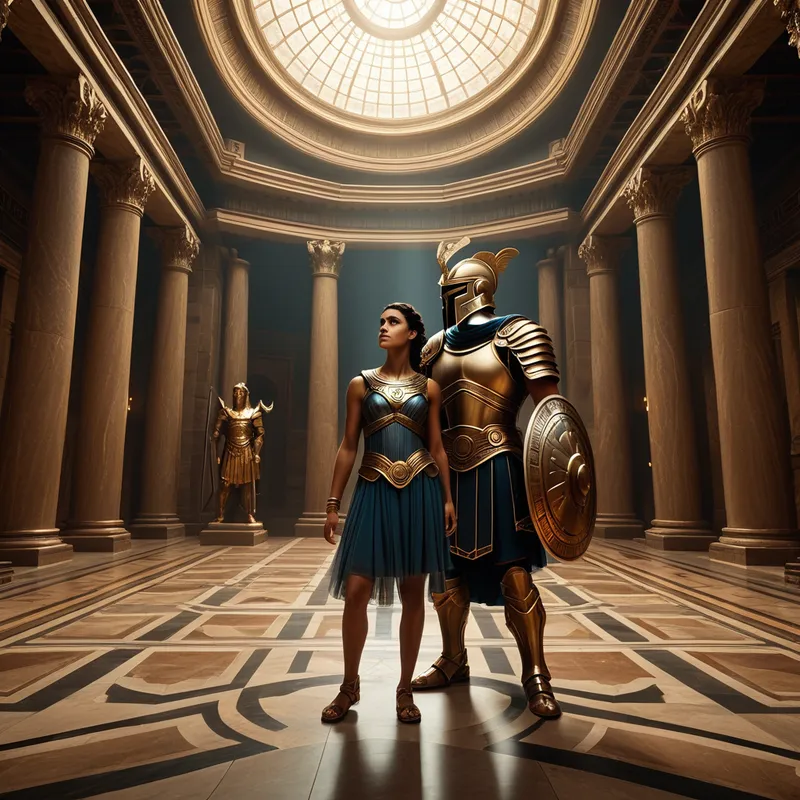
Her story is not one of great quests or monstrous battles, but of a constant, gentle pressure against chaos. Picture the great hall of Olympus after a council has frayed. The air still crackles with the aftermath of Ares's bellicose rhetoric, smelling of hot bronze and ambition. The cool, strategic gaze of Athena holds a sharp edge. Even the laughter of Dionysus feels like a challenge. Into this tense silence, Irene would move.
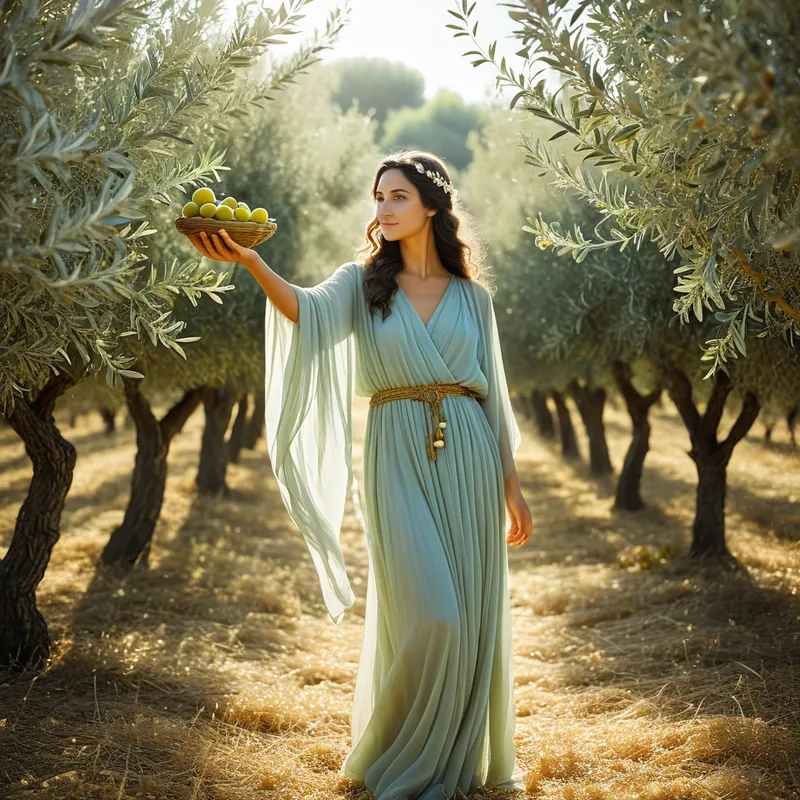
She did not shout. She did not command. She carried with her the scent of ripening wheat and the cool shade of ancient olive trees. In her arms she bore a cornucopia, spilling forth figs, grapes, and golden grain—tangible proof of what her presence bestowed. Where she walked, the heated words seemed to lose their sting. The clenched fists of warriors would slowly relax, remembering the feel of soil, not sword hilts. She was the living argument for a different path, the embodiment of the prosperity that only comes when the swords are sheathed and the fields are tended.
Her most profound act was not an act of force, but of presence. She was the necessary balance, the "and" in the law and order of her sisters. For what is law without peace to enact it? What is justice without a peaceful society to dispense it? Irene was the condition that made the work of Eunomia and Dike possible. She was the deep, collective exhale of a people not at war, the hum of a thriving marketplace, the quiet contentment of a hearth fire burning safely through the night. Her myth is the story of that fragile, cultivated state—not as the absence of conflict, but as the active, nurturing presence of its opposite.
Cultural Origins & Context
Irene, as one of the Horae, finds her roots deep in the Greek understanding of cosmic and social order. The Horae were originally deities of the seasons and the orderly progression of time in nature. This agricultural foundation is crucial; peace, for the ancient Greeks, was not an abstract political ideal but a concrete, seasonal reality. It was the time for planting and harvest, for the safe passage of ships for trade, for the celebration of festivals.
Her worship was intrinsically linked to this practical, life-sustaining function. While she lacked the vast, dramatic cults of gods like Zeus or Apollo, her presence was woven into the fabric of civic and personal life. She was invoked in prayers for the prosperity of the city-state, the polis. Artists and poets depicted her frequently, especially in the prosperous, reflective atmosphere of 5th-century Athens, where she was closely associated with the democratic ideal and the wealth it generated. Her image on vases and in sculptures, often alongside her sisters or holding her cornucopia, served as a constant visual reminder of the fruits of civil harmony. The myth was passed down not as a single epic poem, but as a pervasive cultural concept—a personified value essential for survival and flourishing.
Symbolic Architecture
Irene is not the naive hope for a conflict-free existence. She is the sophisticated, hard-won achievement that follows the establishment of justice and the imposition of good order. She represents the fruit, not the seed.
Peace is not a vacant silence, but a fertile field cultivated between the walls of law and the waters of justice.
Psychologically, Irene symbolizes the state of inner harmony and psychic integration. She is the feeling of resolution after an internal conflict has been faced and adjudicated by our inner Dike (conscience, moral faculty) and structured by our inner Eunomia (the organizing principle, the ego’s structure). She is the contentment and creative energy that flows when we are not at war with ourselves. Her cornucopia symbolizes the abundance—of ideas, love, vitality—that is only accessible from this place of inner ceasefire.
She also embodies the principle of nurturance over domination. In a pantheon filled with gods of conquest and mastery, Irene’s power is generative and receptive. She does not take; she enables growth. She represents the feminine principle of containing and nurturing life, a critical counterbalance to the heroic, outward-striving masculine energy that dominates much of mythology.

The Dreamer's Resonance
When the archetype of Irene stirs in the modern dreamer, it often signals a profound somatic and psychological shift from a state of inner conflict to one of nascent integration.
You may dream of finding a hidden, sunlit garden in the midst of a ruined city. You might be gently holding together two broken pieces of pottery, feeling a warm light glow from the seam. Perhaps you are feeding birds in a sudden, unexpected calm after a dream of chaotic chase or battle. These are Irene’s motifs: the oasis of calm, the act of gentle repair, the nurturing of small, fragile things.
Somatically, this can correlate with the release of chronic tension—the unclenching of a jaw you didn’t know was tight, a deep, sighing breath that seems to come from the soles of your feet, or a feeling of warmth spreading in the chest. Psychologically, it marks the end of a period of self-criticism, moral dilemma, or chaotic emotional turmoil. The dream is not announcing that all problems are solved, but that the internal war council has adjourned. A treaty has been signed within the psyche. The dreamer is moving from a state of stasis (blocked conflict) to one of eirene (fertile peace), where energy is now available for growth, not just defense.

Alchemical Translation
The alchemical journey mirrored in Irene’s myth is the process of moving from the nigredo—the blackening, the chaotic clash of inner opposites (the Ares and Athena within)—through the albedo—the whitening, the establishment of order and justice (the work of Eunomia and Dike)—to the ultimate goal: the citrinitas or rubedo, the golden or reddening, which is not a flash of glory but a state of sustained, fruitful harmony.
Individuation is not a victory parade, but the quiet, daily cultivation of the garden that grows after the battlefields are cleared.
For the modern individual, Irene’s path teaches that peace is an active, nurturing discipline. It is not about avoiding conflict, but about tending to what emerges after the conflict has been consciously engaged. The "alchemical operation" is nurturance. It is taking the raw, reconciled elements of the self—the disciplined warrior, the wise judge, the passionate lover—and providing the peaceful, holding environment in which they can co-exist and collaborate.
This translates to practical inner work: the daily practices of self-compassion that soften inner criticism, the creation of routines (inner Eunomia) that provide stability, and the conscious choice to turn energy toward creation (the cornucopia) rather than internal warfare. To invoke Irene is to choose to be a caregiver to your own soul, to hold the space for your disparate parts to lay down their arms and discover the abundance that was always possible in their alliance. Her myth assures us that this peace is not a divine favor granted from Olympus, but a divine capacity born within, the birthright of being a child of cosmic order and profound, nurturing law.
Associated Symbols
Explore related symbols from the CaleaDream lexicon: