Inua Spirit Within All Things Myth Meaning & Symbolism
The Inuit understanding that a conscious, sentient spirit inhabits every person, animal, object, and force of nature, demanding respect and reciprocity.
The Tale of Inua Spirit Within All Things
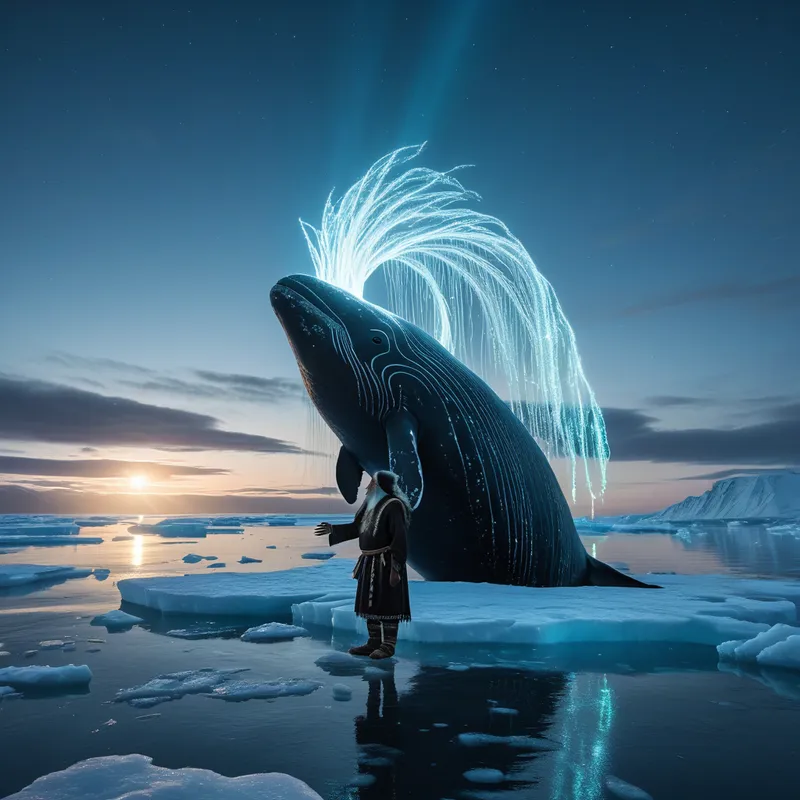
Listen. The wind does not simply blow. It speaks. It is the breath of Sila, and within that breath is a will. The great ice does not merely exist; it remembers. It holds the weight of ages in its blue heart, and within that heart is a memory. The caribou that gives its life does not just die; it consents. Within its swift limbs and gentle eyes resides a sovereign being.
In the time when the world was all song and all stories were new, the People knew this. They walked not upon a dead world, but within a great, breathing community of persons. Every stone that tripped the foot had a name. Every gust that stole the warmth from the seal-skin tent had intention. The blizzard was not a mere event, but the roaring mood of a powerful inua. The sun, Seqinek, was a woman who climbed into the sky, her light a conscious gift, not an accident of fire.
The hunter, his face lined by the bite of Sedna's realm, did not simply take. He prepared. In the quiet dark of the snow-house, he fasted. He dreamed. He spoke to the inua of the seal, asking, persuading, promising. His harpoon was not just a tool, but an extension of this sacred conversation. When the strike came, it was a pact. The seal’s inua released its hold on the flesh, offering itself so the People might live. In return, the hunter performed the rituals. A drink of fresh snowmelt for the spirit. Careful treatment of the bones, so the inua might find a new body. Disrespect meant the inua would depart, leaving only empty, lifeless forms behind. The world would grow silent, cold, and hollow.
The shaman, the angakkuq, was the traveler of this web of consciousness. In trance, his own inua would slip free, journeying to the bottom of the sea to comb the tangled hair of Sedna, calming her rage so the animals would return. He would fly on the breath of Sila to negotiate with the spirits of the weather. His task was not command, but diplomacy—maintaining the balance of respect within the great, animate whole. For to harm a thing carelessly was to insult a person. To take without gratitude was to sever a relationship. And in a world where everything is alive, such a rupture could mean the end of all things.
Cultural Origins & Context
This understanding of inua is not a single, codified myth but the foundational bedrock of the Inuit worldview, spanning the Arctic regions from Greenland to Alaska. It was not written but lived, breathed, and taught through endless daily practice and oral tradition. Elders taught it to children by showing them how to place a tool respectfully, how to speak to an animal they hoped to hunt, how to listen to the messages in the cracking ice or the patterns of the wind.
The societal function was one of profound ecological and psychological integration. The concept of inua enforced a system of sustainable ethics long before the term was coined. It created a relational, rather than a hierarchical, existence. Humans were not masters of nature, but one kind of person among many—dependent on the goodwill of the seal-inua, the weather-inua, the land-inua. Stories of hunters who failed in respect, and whose families starved as a consequence, were powerful pedagogical tools. This worldview was mediated and deepened by the angakkuq, whose visionary journeys were essential for diagnosing communal disharmony with the spirit-persons of the world.
Symbolic Architecture
The inua is the ultimate symbol of intrinsic value and latent consciousness. It represents the soul of the world itself, not as a vague pantheistic force, but as a plurality of individual subjectivities.
To see with inua-sight is to perceive the world not as a collection of its, but as a community of thous.
Psychologically, the inua is akin to what depth psychology might call the objective psyche or the anima mundi (world soul) manifesting in discrete forms. Each entity’s inua is its unique point of consciousness within the collective field. The myth challenges the modern, dissociative psyche that sees the world as inert matter for consumption. It posits that alienation from the environment is, fundamentally, a failure of perception—a blindness to the inherent "personhood" of all existence. The core conflict is not between good and evil, but between respect and negligence, relationship and exploitation.
The angakkuq's journey symbolizes the ego's necessary descent into the unconscious—the sea-bottom of Sedna—to engage directly with these autonomous psychic realities, to untangle the knots of neglect (Sedna's hair) that cause psychic and literal famine.

The Dreamer's Resonance
When this mythic pattern stirs in modern dreams, it often manifests as a profound re-animation of the dreamer's environment. One might dream of a speaking stone, a grieving house, or a defiant, conscious caribou that looks at the dreamer with accusing intelligence. These are not mere fantasies; they are somatic signals of a reawakening relational capacity.
The psychological process is one of re-enchantment and the integration of projection. The dream ego is being confronted with the psychic reality it has denied in waking life. The talking computer or the sorrowful caribou represents a part of the dreamer's own psyche that has been treated as an "it"—a function, an instinct, a resource—rather than as a living, subjective entity with its own needs and rights. The dream is initiating a process of apology and re-negotiation with these inner "spirits." The somatic feeling is often one of awe, shame, or a chilling, humbling realization that one is not alone, even in solitude. Everything is watching. Everything remembers.

Alchemical Translation
For the modern individual striving for wholeness (individuation), the myth of inua models the alchemical stage of solutio—dissolution. It is the dissolution of the hardened, modern ego that believes itself to be a separate observer in a dead universe.
The first step in psychic transmutation is to grant a soul to what you have made soulless.
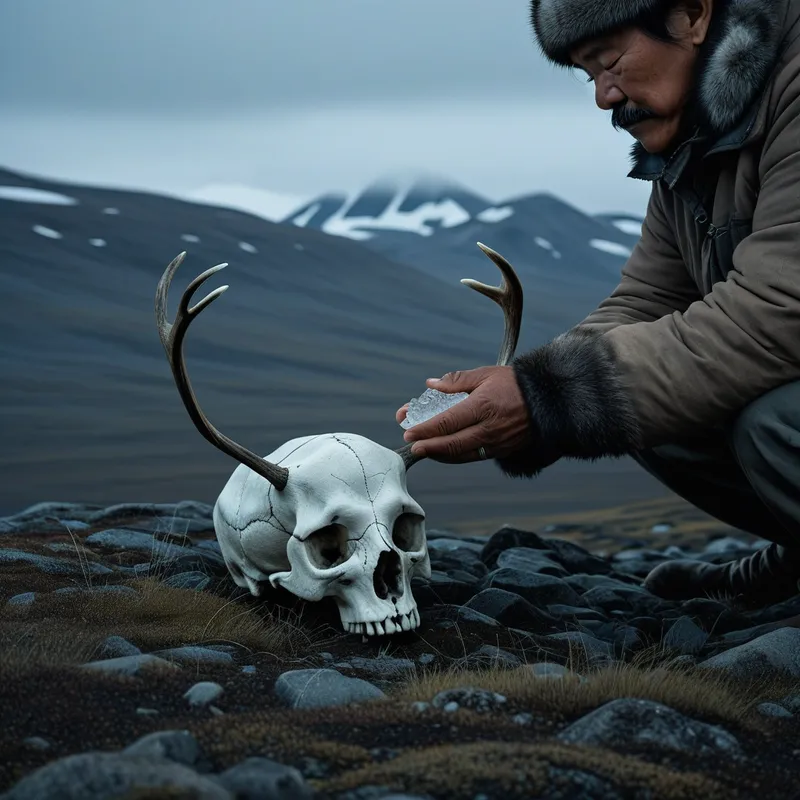
The "hunt" is no longer for physical survival but for psychic integration. The modern seeker must become the angakkuq of their own inner landscape. This requires fasting from certainty—quieting the ego's noise. It requires journeying to the bottom of one's personal sea, to Sedna's realm, to confront the tangled, neglected aspects of the soul (complexes, instincts, wounds) that hold life-energy captive. The offering of fresh water to the caribou's skull translates to the conscious act of respect and attention we must pay to our own instincts, emotions, and bodily wisdom.
The ultimate transmutation is from a psyche of isolation to a psyche of communion. One does not simply "have" a complex; one enters into a respectful relationship with the inua of that complex. One does not "conquer" a fear; one listens to the message of the fear-inua. In doing so, the individual ego aligns itself with the greater web of being. It becomes a responsible participant in the animate cosmos, both within and without. The ice remembers, the wind speaks, and the soul of the world breathes through every fragment of existence, waiting only for our recognition to complete the circle.
Associated Symbols
Explore related symbols from the CaleaDream lexicon:
- Spirit — The core concept of inua itself, representing the conscious, sentient essence inherent in every facet of existence, from a pebble to a person.
- Water — Symbolizes the fluid, life-giving, and often perilous medium of Sedna's realm, essential for offerings and representing the flow of consciousness between all things.
- Mirror — Represents the reflective quality of a world where every entity is a conscious "thou," showing us our own capacity for relationship and respect in its gaze.
- Door — The shamanic trance or state of respectful perception that acts as a threshold into the animated spirit world hidden within the apparent world.
- Ocean — The vast, deep unconscious realm of Sedna, home to the inua of all marine life and the source of nourishment, which must be approached with ritual care.
- Mountain — The enduring, steadfast inua of the land itself, a powerful and ancient person that shapes life and demands reverence.
- Ritual — The essential acts of offering, speech, and treatment that maintain the reciprocal relationship between humans and all other inua, preventing psychic and literal famine.
- Shadow — The denied or disrespected inua of a thing or a part of the self, which when ignored, withdraws its vitality and power, creating emptiness and lack.
- Dream — The primary landscape where the modern psyche can first re-encounter the animated inua of objects and instincts, initiating the process of re-enchantment.
- Ancestral Spirit — Connects to the understanding that inua persists beyond a single form, linking the living to the wisdom and ongoing presence of those who came before.
- Spirit World — Not a separate heaven, but the very same world perceived with inua-sight, where everything is alive, conscious, and engaged in relationship.
- Bear Spirit — A powerful and respected animal inua, exemplifying the strength, independence, and sacred danger of the non-human persons with whom Inuit share the land.