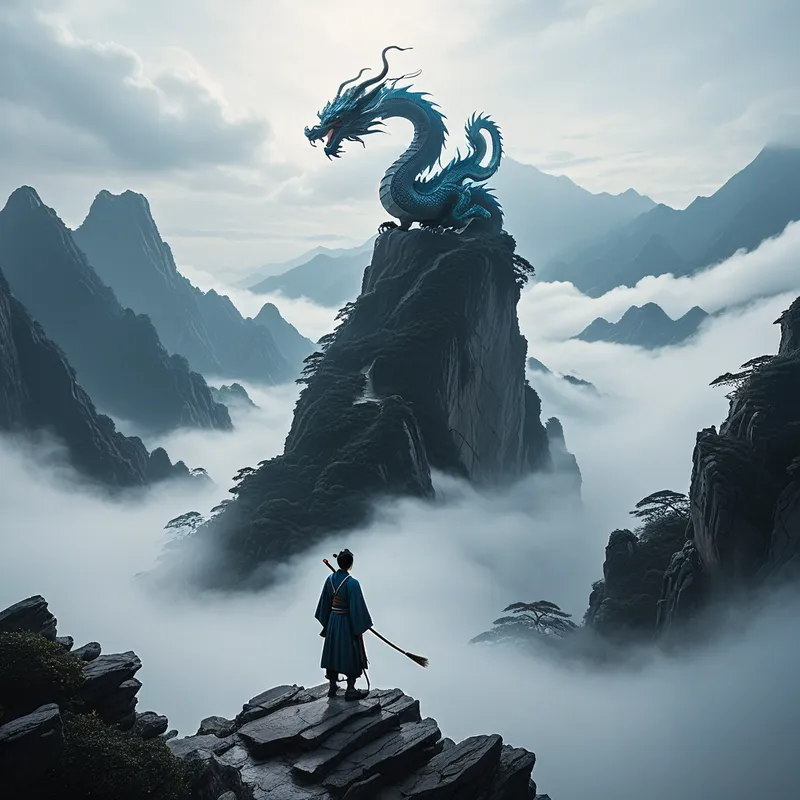
Ink Wash Painting Myth Meaning & Symbolism
A myth where the primordial artist, Wu Daozi, battles formlessness to birth a world from the marriage of ink and water, revealing the soul in the empty spaces.
The Tale of Ink Wash Painting
Before the world knew its own name, there was a silence so profound it hummed. In this age, the cosmos was a scroll of pure, unblemished silk, stretched taut across the frame of the heavens. There was no mountain, no river, no sighing pine—only the potential for all things, a luminous, aching emptiness.
Into this void walked the one known as Wu Daozi. He was not born; he emerged from the mist between being and non-being, his robes the color of twilight, his eyes holding the patience of bedrock. In his hand, he carried no ordinary brush, but the Bi Hun, the Brush-Soul, a shaft of bamboo that had drunk the moonlight for a thousand years. At his side hung an inkstone, dark as a pupil, and a vessel of water clearer than a conscience.
The conflict was not with a monster, but with the formlessness itself. The pristine silk was a perfect mirror, reflecting only the terror of the uncreated. To mark it was an act of supreme audacity, a violation of the primordial peace. Yet, within that peace festered a profound loneliness. The world longed to see its own face.
Wu Daozi stood before the expanse. He did not grind the inkstick with haste. The circular, grinding motion on the stone was a meditation, a summoning of darkness from the heart of the pine-soot and glue. He mixed the ink, watching the black plume unfurl in the water, a chaotic nebula seeking order. This was the first marriage: the assertive, defining Mo embracing the receptive, yielding Shui.
He loaded the Brush-Soul. The moment hung, a droplet of infinite black poised at the tip of a bamboo universe.
Then, he touched the silk.
It was not a drawing. It was a release. The ink, guided by spirit yet surrendered to the thirsty weave of the silk and the caprice of the water, happened. A stroke began as a fierce, black ridge—a mountain peak born in an instant. But as the water carried the ink, the solid edge softened, feathered, dissipated into a mist that veiled the mountain's shoulders. In the areas he did not touch, the blank silk ceased to be mere emptiness; it became the luminous sky, the deep river, the vast, breathing space between cliffs.
He painted not by adding, but by orchestrating a dance between presence and absence. A few deft strokes suggested a fishing boat; the untouched silk around it became the whole expanse of the river. A ragged blot became a distant forest, its details left to the mind's eye. He painted the Qi Yun, the rhythm of the vital breath, not the mere shape of things.
When the last tremor of the brush stilled, the scroll was no longer silk and pigment. It was a world. You could feel the damp of the mist, hear the wind in the gorges he had implied. The conflict was resolved. The formless had been given a voice, not through domination, but through a sacred collaboration between the artist's intent, the material's nature, and the courageous, generative void.
Cultural Origins & Context
This is not a single myth recorded in one ancient text, but a living meta-narrative woven from the philosophy and practice of Shuimo Hua across dynasties. Its "bards" were the scholar-artists of the Tang, Song, and Ming dynasties—figures like Wang Wei or Su Shi—who wrote poems and treatises on painting. They spoke of it not as a craft, but as a Dao, a path to harmony with the fundamental principles of the cosmos.
The myth was passed down through master-discipline lineages, in studio conversations where the grinding of ink was the first lesson in patience. Its societal function was multifaceted: for the ruling class, it demonstrated refined cultivation; for the scholar-official, it was a retreat from politics into a purer realm of spirit; for the culture at large, it codified a uniquely Chinese worldview where humanity is not a conqueror of nature, but its most sensitive interpreter and participant.
Symbolic Architecture
At its heart, the myth of ink wash painting is a profound map of consciousness. The blank silk represents the undifferentiated psyche, the unus mundus or primal state before ego-formation. It is both terrifying and full of potential.
The void is not an enemy to be filled, but the womb from which all authentic form is born.
The ink (Mo) symbolizes the active, defining principle: consciousness, will, assertion, and the shadowy depths of the unconscious from which definite images arise. The water (Shui) is the receptive principle: the fluid unconscious, emotion, intuition, and the eros principle that connects and dissolves. The painting itself is the emergent psyche—the individual personality or world—born from their sacred marriage. The brushstroke is the decisive moment of consciousness, the act of living, which must be both intentional and surrendered.
Most critically, the unpainted spaces—the Liu Bai—are not mere background. They are the symbolic representation of the transcendent function, the unknown, the numinous. They are what makes the painted forms meaningful. In psychological terms, they are the silence around the complex, the unconscious context that gives conscious content its depth and resonance.
The Dreamer's Resonance
When this myth stirs in the modern soul, it often manifests in dreams of fluidity versus rigidity. One might dream of trying to write with a pen that bleeds uncontrollably, of black water rising to dissolve the sharp edges of a familiar room, or of a cherished, detailed photograph slowly fading to a grey wash, leaving only an impression.
These dreams signal a somatic and psychological process of dissolution and re-formation. The ego's hard lines—our fixed identities, compulsive thoughts, and rigid defenses—are being softened by the waters of the deeper unconscious. It can feel like a loss of control, a terrifying "blurring." Yet, this is the necessary prelude to a more authentic expression. The psyche is grinding its ink, preparing for a new stroke that must be more integrated, one that acknowledges both the defining mark and the yielding space.
Alchemical Translation
The alchemical journey modeled here is the transmutation of the prima materia—the chaotic stuff of our unexamined lives—into the lapis philosophorum, the integrated self. The process is one of individuation through paradox.
First, the Nigredo: confronting the blank silk, the dark ink of the shadow. This is the depression, the confusion, the sense of formlessness that initiates the work. We must "grind the ink" of our suffering and complexity.
Next, the Albedo: the marriage of ink and water. This is the conscious engagement with the unconscious (active imagination, dream work, mindful feeling). We learn to let our will be permeated by intuition, our thoughts by emotion.
The goal is not to paint a perfect, detailed replica of the world, but to capture its living breath, its Qi Yun, with the fewest strokes necessary.
The Rubedo is the moment of the brushstroke—the lived action, the creative expression, the relationship forged—that emerges from this prepared state. It is decisive yet humble, intentional yet open to the "bleed" of the unknown. Finally, the Citrinitas is the appreciation of the completed work, which includes a reverence for the empty spaces, the Liu Bai. This is the stage where we value not just our accomplishments and solid identities, but also our mysteries, our gaps in memory, our unspoken potentials, and the silent, transcendent ground of being that holds our individual existence.
To live this myth is to become the artist of one's own soul, learning to wield the brush of consciousness with a spirit that respects both the power of the mark and the sacred necessity of the void. It is to understand that we are painted, and painting, upon a scroll of infinite dimension.
Associated Symbols
Explore related symbols from the CaleaDream lexicon: