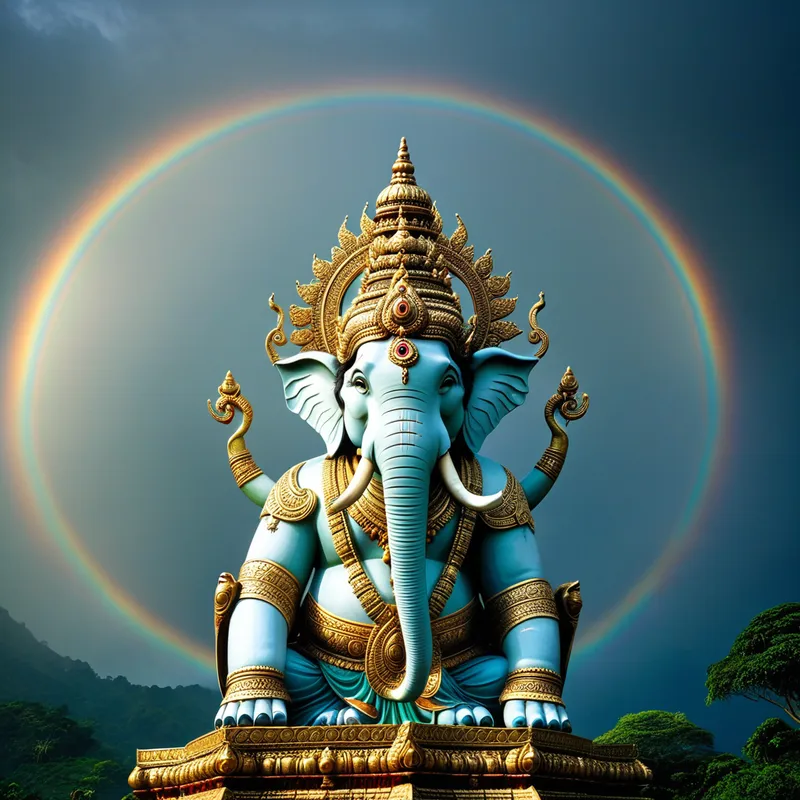
Indra's Bow Myth Meaning & Symbolism
A celestial bow, forged from a rainbow, that protects the cosmic order and symbolizes the integration of primal power into conscious structure.
The Tale of Indra's Bow
Hear now the tale of the weapon that is not a weapon, the bridge that is not a bridge, the promise written in light across the shattered sky. In the time when the worlds were young and the balance between order and chaos was a breath held in the throat of the cosmos, the Indra stood as the guardian of the heavens.
His dominion was the furious, life-giving sky. He rode the thunderclouds upon his mighty elephant, Airavata, and in his hand, he carried the terrible Vajra, forged from the bones of the sage Dadhici. But there was another tool in his celestial arsenal, one born not of sacrifice but of sheer, sublime manifestation. When the cosmic waters above, held back by the firmament, grew too heavy with the promise of life, it was Indra who would release them. And as the first monsoon rains began to fall, cleansing the parched earth, he would draw back not the Vajra, but something far more magnificent.
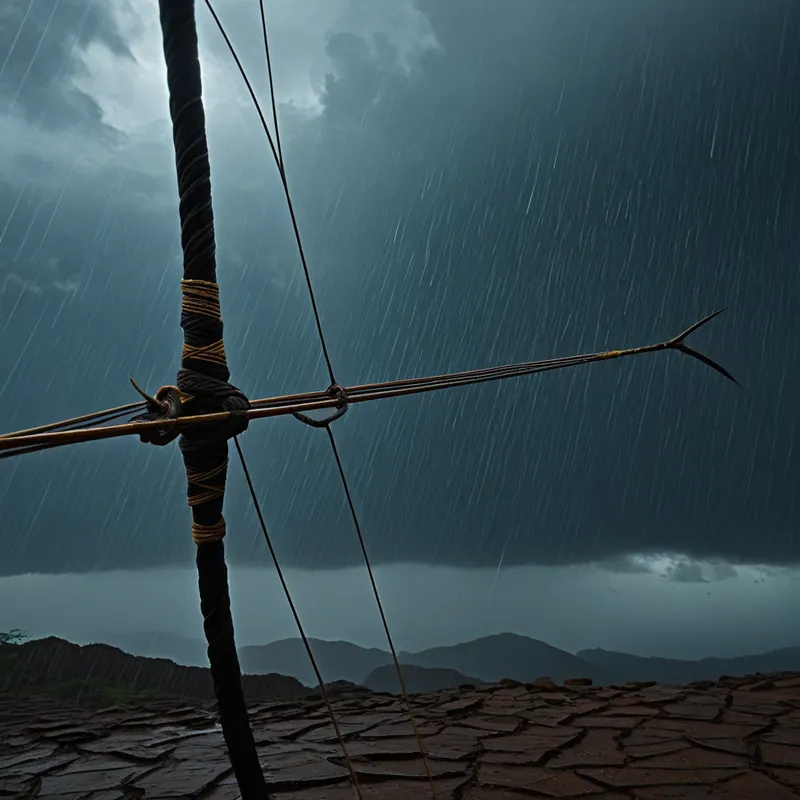
From the very essence of the storm’s aftermath, from the interplay of sunlight and retreating rain, he would manifest his bow. It arched across the heavens, a bridge of seven hues—violet, indigo, blue, green, yellow, orange, red—a spectrum of potential made visible. This was Indra's Bow, the Indradhanush. It had no string of fibre, but was strung with light itself. It was not used to launch arrows of destruction, but to signal a covenant. Its appearance was a proclamation: the battle between drought and deluge was over; the chaotic fury of the storm had been transformed into the orderly, nourishing fall of rain. It was the divine signature on the contract between heaven and earth, a symbol that raw, disruptive power had been successfully channeled into a structure that sustained all life. The bow stood in the sky, a silent, awe-inspiring testament to the moment when fury became fertility, when the roar of thunder resolved into the whisper of falling rain.
Cultural Origins & Context
The image of Indra's Bow is woven deeply into the Vedic and post-Vedic imagination. While not the subject of a single, extended narrative epic like the Ramayana or Mahabharata, it is a pervasive and potent symbol. Its origins are meteorological, born from the ancient observation of the rainbow that follows the life-bringing monsoon storms so crucial to the Indian subcontinent. In the Rigveda, Indra is the paramount god, the champion who slays the drought-demon Vritra and releases the waters. The rainbow naturally became associated with this act of cosmic liberation.
The myth was passed down not just through priestly hymns but through daily life and oral tradition. Farmers looking at the sky after a storm, artisans painting temple walls, poets seeking metaphors for divine beauty—all engaged with this symbol. Its societal function was multifaceted: it was a sign of hope and renewal for an agrarian society, a symbol of the king-of-the-gods' benevolent power, and a reminder of the beautiful, orderly resolution that follows periods of necessary conflict and upheaval. It taught that the divine is not only in the destructive power of the Vajra but also in the peaceful, colorful arc of reconciliation that appears afterward.
Symbolic Architecture
The bow is an instrument of tension and release. Indra's Bow, specifically, symbolizes the moment of release after the tension has been successfully resolved. It is the artifact of a completed action.
The rainbow is the storm's memory of itself, transformed into a covenant of light.
Psychologically, the myth represents the integration of powerful, unconscious contents (the storm, the chaotic waters) into the structure of the conscious personality (the ordered sky, the fertile earth). Indra, as the ego or ruling psychic principle, does not suppress the storm; he weathers it and, through his action, facilitates its transformation. The bow is the visible symbol of that integration. Its seven colors reflect the spectrum of human experience and potential, now harmonized into a single, graceful arc. It represents the bridge between opposites: heaven and earth, fury and peace, destruction and creation, the unconscious flood and the conscious container.
The bow itself, being intangible and made of light, signifies that this integrated state is not a heavy, permanent structure, but a fleeting, perfect alignment—a state of grace that must be continually re-earned through engagement with life's inner and outer storms.
The Dreamer's Resonance
When this myth stirs in the modern dreamer, it often follows a period of intense emotional or psychological turmoil—a personal "storm." To dream of a rainbow, especially one that feels vast, celestial, or like a weapon-turned-artifact, signals a profound somatic and psychological shift.
The dreamer may be in the process of releasing a long-held tension. The somatic experience is one of relief, a deep exhale held in the body after a crisis has passed. Psychologically, it marks the transition from a state of conflict, anxiety, or fragmented emotion into a new, more holistic perspective. The dream-bow appears as a promise from the unconscious itself: the chaos had meaning, the struggle had purpose, and a new synthesis is now possible. It is the psyche's way of depicting the moment when overwhelming feelings—rage, grief, passion—are not eliminated, but alchemized into a broader, more colorful understanding of the self. If the bow is broken or fading in the dream, it may reflect the fragility of this new integration or a fear that the hard-won peace will not hold.
Alchemical Translation
The journey modeled by Indra's Bow is the alchemy of psychic rulership. It is not the hero's journey of slaying the external dragon, but the ruler's task of administering the kingdom of the self after the battle.
Individuation is not the elimination of the storm, but the development of a bow strong enough to span its aftermath.
The modern individual faces inner Vritras: complexes, repressed emotions, and chaotic impulses that hold the "waters" of our vitality captive. The initial, necessary act is often the Vajra-strike—the conscious, forceful confrontation (therapy, difficult life choices, facing a truth). But this is only half the work. The true alchemical translation happens in what follows: the patient, often silent process of holding the space for the integration. This is the drawing of the bow in the sky.
The "rain" is the released vitality, now nourishing instead of flooding. The "bow" is the newly expanded structure of the personality that can contain and give beautiful form to that vitality. It is the realization that our power lies not just in confronting our darkness, but in our capacity to create meaning, beauty, and order from that confrontation. To manifest your own Indra's Bow is to recognize that your greatest trials can become the very spectrum through which you perceive and engage with the world, transforming raw experience into the arc of a meaningful life.
Associated Symbols
Explore related symbols from the CaleaDream lexicon: