Inari Myth Meaning & Symbolism
The story of the kami who brings sustenance, shapeshifts as a fox, and guides souls through the liminal spaces between worlds and consciousness.
The Tale of Inari
Listen, and let the mist of the mountain settle upon your mind. In the time before time was measured in seasons, when the world was raw spirit and stone, the people hungered. They scratched at the earth, but the earth gave only bitterness. Their bellies were hollow drums, their children’s cries the only song.
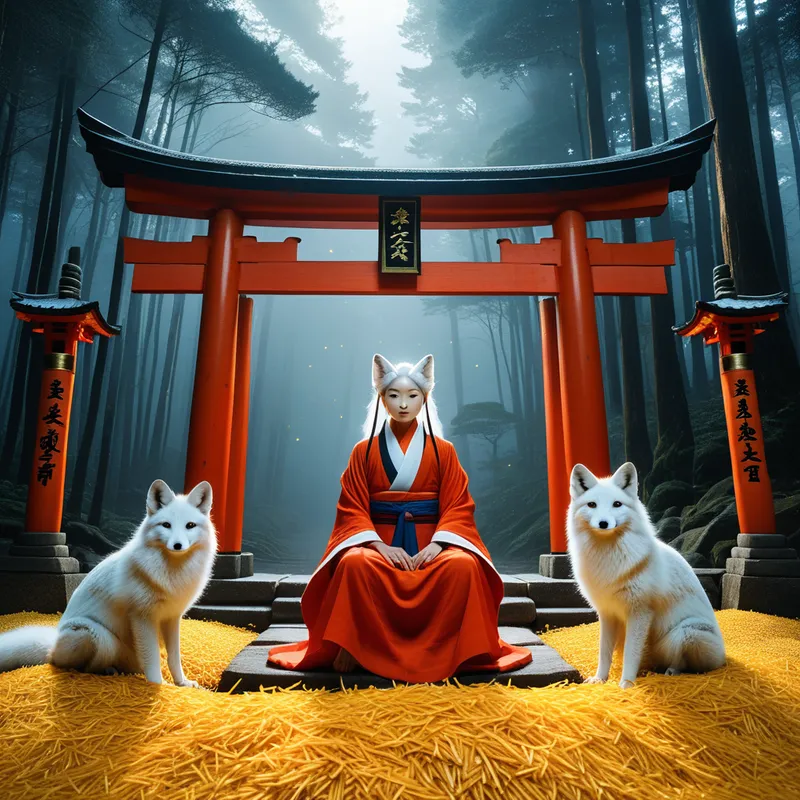
Then, from the kami-yama, a presence descended. Not with thunder, but with a whisper through the bamboo groves. It was Inari. No mortal eye could fix their form—sometimes a venerable elder with a beard of snow, bearing a sack of endless seed; sometimes a radiant woman whose robes were the colors of sunrise on ripe grain; sometimes neither and both, a being of pure, benevolent potential. And always, at their side or as their very essence, the foxes. Kitsune, with coats of celestial white or autumn fire, eyes holding lantern-light of ancient wisdom.
Inari walked to the poorest field, where the soil was tired and grey. From the sack, a single grain of rice fell. Where it touched the earth, the grey became rich, dark brown. A green shoot pierced the soil, then another, and another, until the field was a sea of emerald stalks dancing in a wind that carried the scent of promise. Inari taught the people the sacred dance of planting, the prayer of tending, the gratitude of harvest. The hollow drums of their bellies were filled with the sweet, sustaining white pearl of the earth.
But Inari’s gift was not just of the soil. They were the master of the sakai, the border. Their foxes, their chosen messengers, would flit at the edge of vision—a flash of white in the forest gloom, a watching silhouette on a shrine wall at twilight. They carried messages between the world of humans and the world of kami. They guarded the rice, the source of life, from unseen pests and spiritual blight. A farmer might leave an offering of fried tofu, and in the morning, find the footprints of a fox in the dew, and know the harvest was protected.
The conflict was not a battle of gods, but the eternal struggle against lack, against despair, against the barren winter of the soul. Inari’s rising action was the slow, miraculous greening of the world, the turning of scarcity into overflowing abundance. The resolution was a covenant, written not on stone but in the cyclical rhythm of the seasons and in the silent, watchful partnership between humanity and the spirit of the mountain, mediated by the cunning, loyal fox.
Cultural Origins & Context
The veneration of Inari is ancient, rooted in the animistic heart of Shinto. Originally a kami of rice and food, its worship likely began among agrarian communities in the Fushimi area, where the mountainous terrain was seen as a natural repository of fertile power. As Japanese society evolved from a rice-based agrarian economy to include trade, craftsmanship, and commerce, Inari’s domain expanded remarkably. The kami became a patron of smiths (who used fire, a element associated with foxes and transformation), of merchants, and of worldly success.
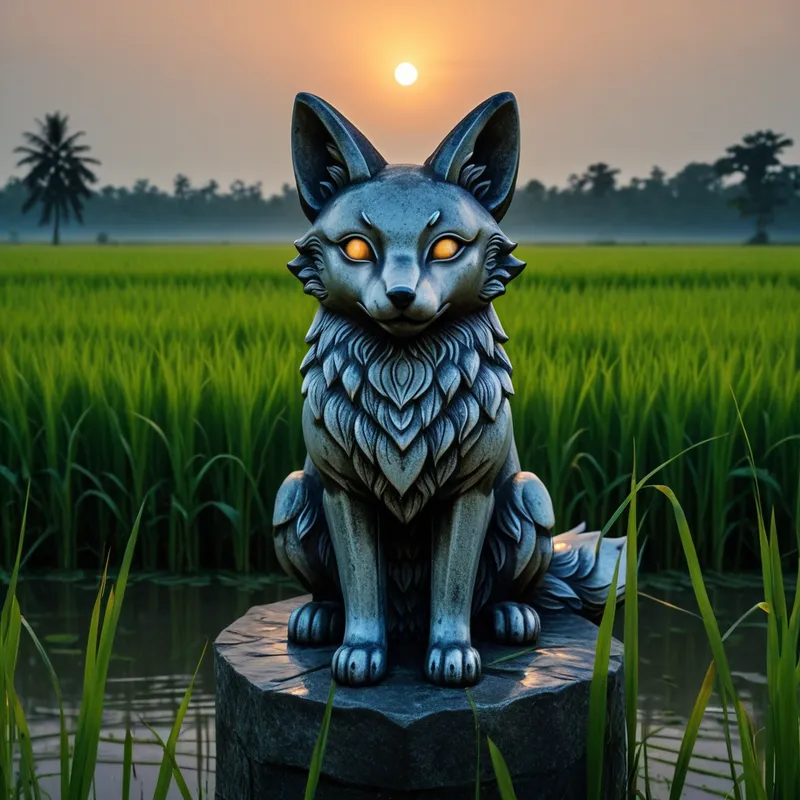
This myth was not passed down in a single, canonical text like the Greek epics. Instead, it is a living narrative woven through practice: the construction of thousands of vibrant vermilion torii gates snaking up sacred mountains, the placement of stone fox statues with symbolic items (a key to the rice granary in its mouth, a jewel of wisdom under its paw), and in annual festivals where portable shrines are paraded. The myth is told by the landscape itself and enacted by the community. Its societal function was and is profoundly integrative—connecting the practical need for food and prosperity with the spiritual need for protection, guidance, and a sense of participating in a sacred, animate world.
Symbolic Architecture
At its core, the myth of Inari is a profound symbol of generative, sustaining life force. The rice is not merely a crop; it is the alchemical product of transforming earth, water, and sunlight into the substance that literally builds the human body and society. Inari represents this transformative principle itself.
The true granary is not the storehouse, but the principle of exchange—between earth and sky, effort and blessing, the human realm and the unseen.
The kitsune are perhaps the richest symbol. As shapeshifters, they embody liminality, the fluidity of identity, and the wisdom that comes from moving between states of being. They are guardians of thresholds, psychopomps guiding not just messages but intuitive knowledge. Their reported ability to generate <abbr title=""Will-o'-the-wisp" or mysterious flames, often associated with foxes and supernatural phenomena">kitsunebi (fox-fire) symbolizes illusory or enlightening knowledge, a light in the darkness that can either mislead or reveal truth depending on one’s purity of intent.
The androgyny or fluidity of Inari’s primary form points to a wholeness beyond gender, a complete and self-sufficient source of creation. The mountain (kami-yama) from which Inari descends is the archetypal axis mundi, the center of the world where heaven and earth meet, the source from which all abundance flows.

The Dreamer's Resonance
When the imagery of Inari surfaces in modern dreams, it often signals a process at the threshold of the psyche. Dreaming of a fox, especially one that watches or leads you, suggests the unconscious is offering guidance through a liminal life phase—a career change, a creative block, a search for sustenance (emotional or spiritual). The fox is the dream-ego’s connection to instinctual wisdom and cunning.
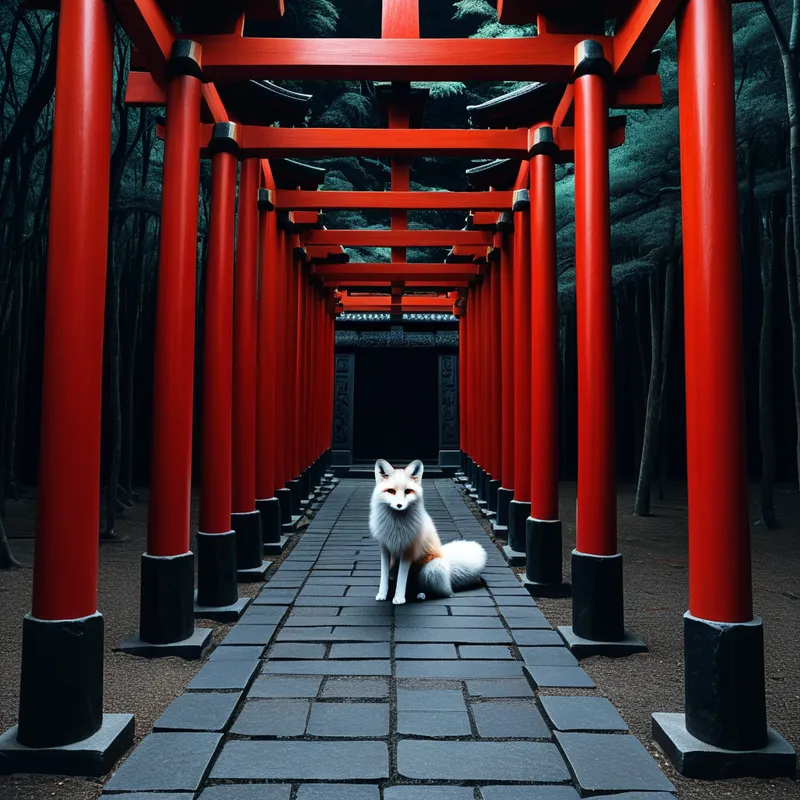
A dream of endless torii gates, or of moving through a tunnel or corridor that evokes a shrine pathway, speaks to a journey of initiation. The somatic feeling is often one of awe mixed with anxiety, a sense of moving toward something sacred but unknown. This is the psyche navigating its own sakai, the border between a known but outdated identity and a new, more integrated one. To dream of offering or receiving rice can indicate a need to acknowledge what truly nourishes you, or to integrate a fertile new idea into your conscious life.
Alchemical Translation
The individuation process, the journey toward psychic wholeness, is mirrored perfectly in Inari’s myth. It begins with a state of scarcity—the barren field of the soul, where old patterns yield no nourishment. The call comes not as a shout, but as a whisper from the inner mountain, the deep Self (Inari). The first task is to accept the single, potent grain—the germ of a new potential, a talent, insight, or feeling long ignored.
Individuation is the cultivation of the inner rice field. It requires the patient, cyclical work of planting the seed, tending the vulnerable shoots, and protecting the growing self from the pests of doubt and the blight of old complexes.
The kitsune represent the trickster-guardians of this process. They are the unpredictable, intuitive flashes that help us navigate the borderlands between consciousness and the unconscious. They force us to question appearances (shapeshifting) and to find our way by unconventional light (<abbr title=""Will-o'-the-wisp" or mysterious flames, often associated with foxes and supernatural phenomena">kitsunebi). Integrating this aspect means making peace with the parts of ourselves that are cunning, fluid, and not entirely "respectable" by the ego’s standards.
The ultimate alchemical translation is the harvest—the achievement of a sustainable inner abundance. It is not a final state, but a cyclical one. The mature individual becomes, like Inari, a source of nourishment for their own world and a guardian of the thresholds for others. They hold the key to the granary (self-knowledge) and the jewel of wisdom, having successfully transmuted the base elements of experience into the sustaining gold of a life lived in dialogue with both the visible field and the spirit-mountain that watches over it.
Associated Symbols
Explore related symbols from the CaleaDream lexicon: