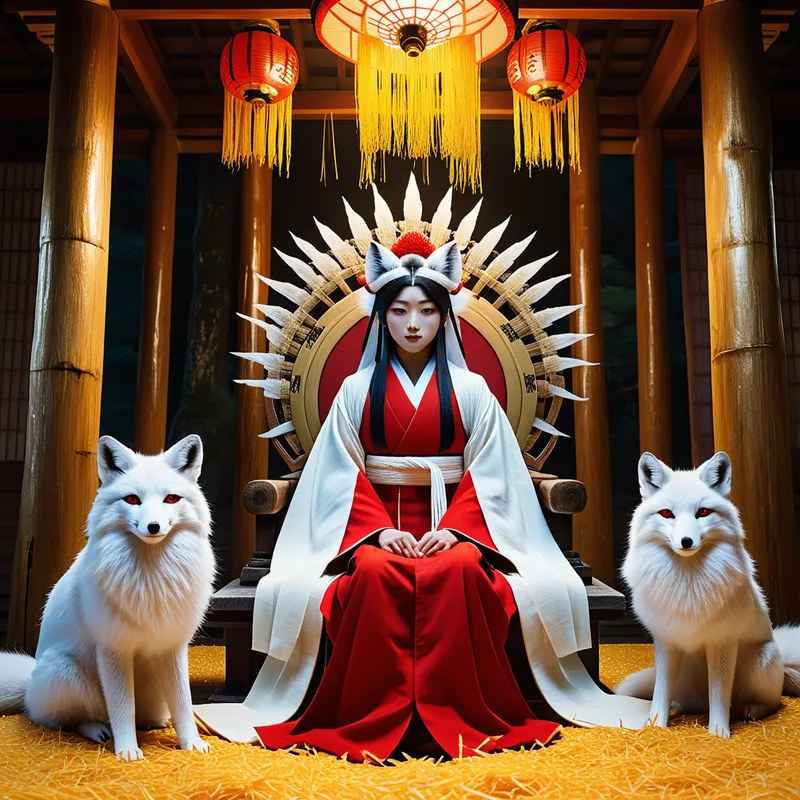
Inari Ōkami Myth Meaning & Symbolism
A Shinto deity of rice, foxes, and industry, embodying the sacred cycle of cultivation, prosperity, and the liminal magic of transformation.
The Tale of Inari Ōkami
Listen. Before the first seed was sown by human hand, the world was a place of raw potential. The mountains breathed mist, the forests whispered secrets, and the soil held its breath. Then, from the interplay of the primordial forces—Kami and Yo—a presence coalesced. Not with a thunderclap, but with the quiet certainty of a sprout breaking the earth.
This was Inari Ōkami. Its form was fluid, seen by some as a bearded elder holding a sheaf of rice, by others as a graceful woman bearing a jewel, and by still others as an androgynous figure of impossible beauty. Its essence was the promise of life sustained. It descended to the Ashihara no Nakatsu Kuni, not to conquer, but to cultivate.
The people were hungry, their spirits thin. They saw the wild grasses and did not understand the secret of the grain. Inari walked among them, and where its feet touched the earth, the soil grew dark and rich. It took a single, humble stalk and showed them the rhythm: the planting in mud, the patient waiting under sun and rain, the joyous reaping. It taught them the alchemy of turning hard seed into soft, nourishing food. Prosperity, like a green tide, began to flow across the land.
But this bounty needed guardians, messengers who could move between the worlds of the seen and the unseen. Inari called, and from the shadows of the forests and the edges of the fields, they came: the kitsune. Their eyes held ancient intelligence; their forms were swift and silent. Inari bestowed upon them a portion of its own power, making them its tsukai. The white foxes, especially, became its sacred envoys, their purity a mirror of the deity's intent.
The people built simple shrines at the foot of mountains, gateways to Inari's realm. They offered the first fruits of the harvest, rice wine, and fried tofu—a food the foxes were said to love. And Inari listened. The myth does not end with a battle or a wedding, but with an enduring covenant. It is the story of a bond forged not in fire, but in fertile soil; a pact between humanity, the divine, and the clever, liminal creatures who run along the border between them, ensuring the sacred cycle of sowing and reaping, of offering and blessing, continues unbroken, season after season.
Cultural Origins & Context
The veneration of Inari Ōkami is one of the most widespread and adaptable in Shinto. Its origins are deeply rooted in the agrarian heart of ancient Japanese society. Initially a kami of the rice harvest, Inari's worship began to solidify in the early Heian period (8th-12th centuries), closely associated with the powerful Fujiwara clan.
The myth was not codified in a single, canonical text like those of Greek or Norse mythology. Instead, it lived and grew through oral tradition, local shrine histories (engi), and folk practice. This fluidity is key. As Japan's economy evolved from purely agricultural to include commerce, craftsmanship, and industry, Inari's domain expanded effortlessly. The deity of rice, the literal staple of life and currency, naturally became a patron of prosperity, business, and worldly success in all its forms.
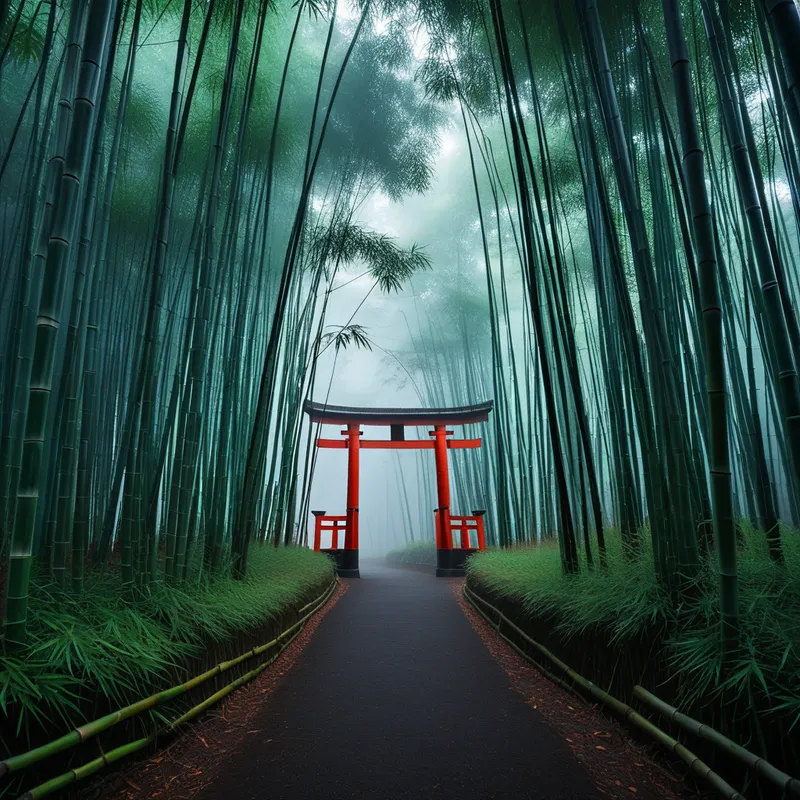
Societally, Inari functioned as a unifying spiritual force. From the imperial court to the rural farmer, all depended on the kami's grace for sustenance and stability. The thousands of Inari jinja, most notably Fushimi Inari Taisha in Kyoto with its iconic paths of thousands of vermilion torii gates, became centers of communal prayer and thanksgiving. The myth was passed down not just by priests, but by every merchant who prayed for good trade, every blacksmith who sought skill, and every household that offered a portion of their meal.
Symbolic Architecture
At its core, the myth of Inari is a profound map of generative transformation. Rice is the ultimate symbol: a hard, inedible seed undergoes a literal alchemical process—burial in mud (the unconscious), gestation, and rebirth as a life-giving, golden grain. This is the archetypal pattern of death and rebirth on which civilization is built.
The seed must consent to its own dissolution to become the feast. This is the non-heroic, sacred contract of abundance.
The kitsune are the myth's master symbol of liminality. They are wild yet serve the divine; earthly animals believed to possess magical powers, including shape-shifting. They occupy the threshold between the human village and the wild mountain, between the material and spiritual worlds. They represent the necessary trickster intelligence that facilitates exchange and translation between different realms of reality—be it trading goods, conveying prayers, or navigating the unseen forces that influence fortune.
Inari's own fluid gender and form reject fixed categorization. This represents the totality of creative power, which contains and transcends binary opposites. The deity is both giver and the gift itself, the cultivator and the cultivated.
The Dreamer's Resonance
When the imagery of Inari's myth surfaces in modern dreams, it often signals a psychic engagement with themes of nourishment, resource, and cunning adaptation. Dreaming of a fox, especially one that is watchful or leading the dreamer, may point to the activity of the intuitive function—a guidance that comes not from linear logic, but from a sly, instinctual knowing at the periphery of consciousness. It is the psyche's messenger, urging attention to overlooked opportunities or subtle exchanges.
A dream of endless torii gates, or a path into a mountain, often correlates with a process of initiation into a new "field" of one's life—a career, a creative endeavor, a relationship. It is the journey into a sacred space of potential, requiring patience and respect for the process. The somatic feeling can be one of quiet awe mixed with trepidation.
Conversely, dreams of barren rice fields or hostile foxes may reflect anxieties about personal fertility (creative, financial, or spiritual), a fear that one's resources or skills are insufficient, or that one's "cunning" has become manipulative or isolated from a higher purpose. The myth asks the dreamer: What are you cultivating? What messengers are you ignoring? What are you willing to offer to ensure your inner and outer harvest?

Alchemical Translation
For the modern individual navigating a world far removed from rice paddies, the Inari myth models a profound process of psychic transmutation. The "rice" becomes our latent potential, our skills, our creative energy. The "cultivation" is the disciplined, often mundane work of planting that potential in the fertile soil of daily practice and patiently tending it.
Individuation is not a heroic raid on the unconscious, but a faithful cultivation of the soul's own field.
The kitsune represents the agile, transformative intelligence we must develop. It is the ability to move between inner and outer worlds, to translate intuition into action, to negotiate and build bridges. This is the "magician" archetype at work—understanding and influencing the unseen patterns that govern reality.
The final, crucial stage is the offerings at the shrine. This translates psychologically as the act of giving back, of gratitude, and of participating in a cycle larger than oneself. We transmute our personal harvest into something that nourishes the community or contributes to a greater whole. Without this step, prosperity becomes hoarding, and magic becomes selfish manipulation. The myth of Inari, therefore, guides us toward a prosperity that is sacred, interconnected, and rooted in the eternal cycle of receiving, transforming, and giving.
Associated Symbols
Explore related symbols from the CaleaDream lexicon: