Inanna/Ishtar Myth Meaning & Symbolism
The Queen of Heaven descends to the land of the dead, is stripped, killed, and resurrected, embodying the ultimate cycle of sacrifice and renewal.
The Tale of Inanna/Ishtar
Hear now the tale that echoes from between the rivers, from the time when the world was young and the gods walked close to the earth. It is the story of Inanna, who is also called Ishtar by the people of the north. She is the morning and evening star, the force that turns the heart to love and the hand to battle. She is sovereign of the heavens, yet a restlessness stirs within her, a desire to know that which is forbidden, to possess that which is hidden.
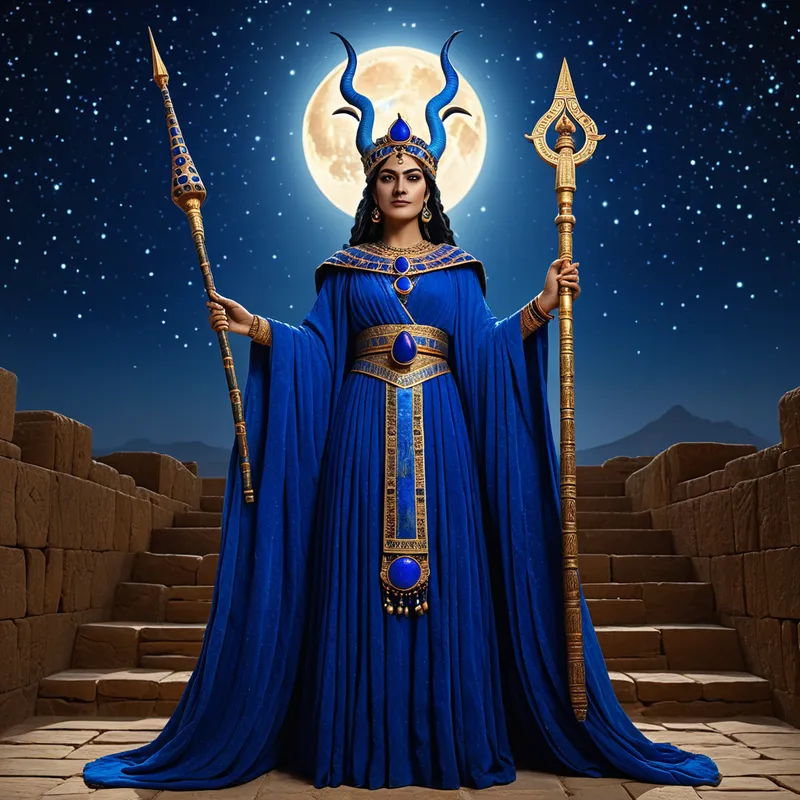
Her heart turned toward the Great Below, the Kur, the dusty, silent realm of her elder sister, Ereshkigal. No one who enters that land returns. The air does not stir, the light does not shine, and the food is dust, the water stagnation. Yet Inanna fastened the seven me to her body—the symbols of her kingship, her priesthood, her arts of war and love. She placed the shining shugurra upon her head, took the lapis lazuli measuring rod and line, and draped beads of lapis about her neck. Thus arrayed in the full glory of her station, she descended.
At the first lapis lazuli gate of the underworld, she was met by Neti, his face impassive. “Who are you?” he demanded. “I am Inanna, Queen of Heaven, on my way to the east,” she declared. But the ways of the underworld are absolute. “Stay here, Inanna. I must speak to my queen.” He returned with the decree of Ereshkigal, whose heart was a stone of grief and loneliness. “Let her enter,” the message said, “but as she passes through each of my seven gates, let her be stripped of her royal garments. Let the norms of the underworld be fulfilled.”
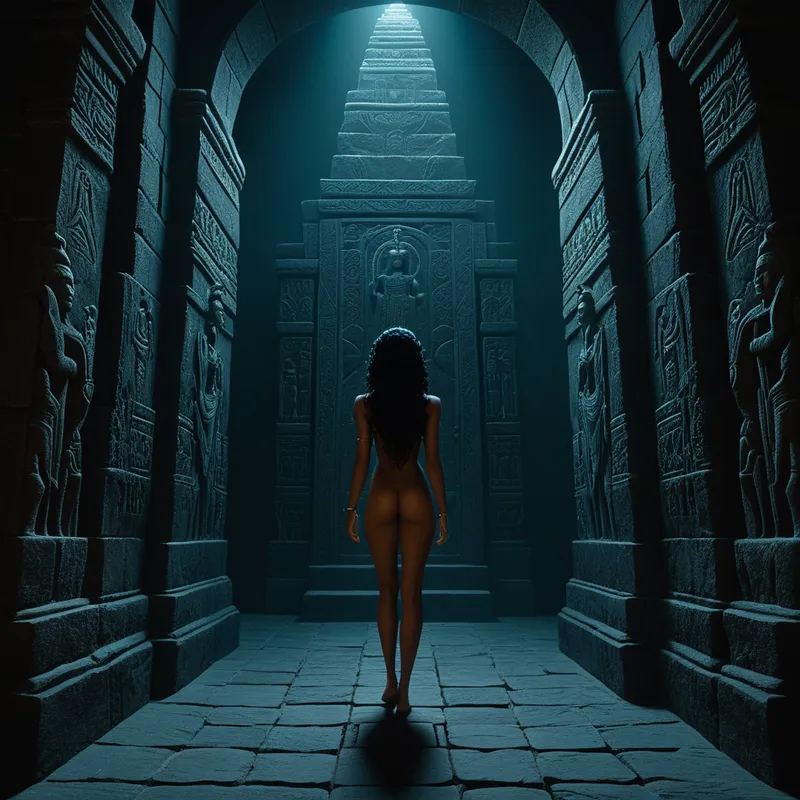
And so, at each massive gate, a piece of her divine identity was taken. First, the shining crown. Then the rod and ring of office. The lapis beads from her neck. The sparkling stones from her breast. The gold bracelet from her wrist. The dress of ladyship from her body. At the seventh gate, the final garment, the robe of sovereignty, was removed. Naked and bowed low, Inanna entered the throne room of Ereshkigal. The seven judges of the underworld, the Anunnaki, fixed their eyes upon her. They passed their judgment. Ereshkigal, in her wrath and perhaps her envy, fastened the eye of death upon her sister. Inanna was turned into a corpse, a piece of rotting meat, and hung upon a hook on the wall.
Above, in the world of the living, all life began to wither. Love ceased, war lost its fervor, the songs of the tavern fell silent. The god of wisdom, Enki, saw the stagnation and from the dirt under his fingernails, he fashioned two beings, the kurgarra and galatur. He gave them the food and water of life and sent them slipping like shadows into the underworld. They found Ereshkigal, who groaned in the agony of childbirth, crying out in her loneliness. They did not flinch. They mirrored her cries, saying, “You! You!” in shared suffering. Moved by this empathy, Ereshkigal granted them a boon. They asked for the corpse hanging on the wall. They sprinkled the food and water of life upon the lifeless meat. Inanna arose.
But the laws of the underworld are immutable. One who ascends must provide a substitute. Inanna, now resurrected but shadowed by demons, returned to her city. She found her beloved shepherd-king, Dumuzi, not mourning on his throne, but seated upon it, clad in fine garments, playing a flute. A cold fury seized her heart. She looked upon him with the eye of death, and the demons seized him. Thus, through a cycle of grief and negotiation, the seasons were born: Dumuzi would spend half the year in the underworld, and his compassionate sister, Geshtinanna, the other half. And so, with the descent and return of the shepherd, the grain dies and is reborn, and Inanna, forever changed, reigns once more.
Cultural Origins & Context
This myth, known as “Inanna’s Descent to the Underworld,” is one of the most complete and psychologically complex narratives to survive from ancient Mesopotamia. It was inscribed in cuneiform on clay tablets in the Sumerian language around the 18th century BCE, though its oral origins are far older. It was recited and performed, likely by temple priests and priestesses, as part of sacred rituals. The figure of Inanna/Ishtar was not a minor deity; she was the patron goddess of the city of Uruk and later a central figure across Akkadian, Babylonian, and Assyrian empires, embodying the volatile, vital forces of fertility, political power, and destructive warfare.
The societal function of this myth was multifaceted. On one level, it was a foundational etiological story, explaining the cycle of the seasons through the fate of Dumuzi (later known as Tammuz). On a deeper, ritual level, it may have been connected to the sacred marriage rite, where the king (embodying Dumuzi) would enact a union with the goddess (through her high priestess) to ensure the fertility of the land and the legitimacy of his rule. The descent narrative served as a powerful metaphor for the necessary death that precedes renewal, a concept critical to an agricultural society utterly dependent on the cycles of nature. It affirmed that even divine power must submit to the fundamental laws of the cosmos.
Symbolic Architecture
The myth is a masterclass in symbolic depth, mapping the architecture of a complete psychic transformation. Inanna’s journey is not one of conquest, but of utter deconstruction.
The descent to the underworld is not a defeat, but the soul’s necessary pilgrimage to the seat of its own forgotten authority.
The seven gates represent the seven layers of the persona, the constructed identity we present to the world—our titles, our achievements, our social masks. To enter the realm of the deep Self, all must be surrendered. The crown of authority, the rod of power, the beads of allure: each is a me, a cultural construct that defines but also confines. Her nakedness before Ereshkigal is the ultimate vulnerability, the ego stripped bare before the contents of the personal and collective unconscious, often perceived initially as a monstrous, devouring force (the Terrible Mother). Her death on the hook is the symbolic annihilation of the old conscious attitude, a necessary mortificatio.
Ereshkigal herself is not merely a villain; she is Inanna’s own shadow sister, the repressed aspect of the goddess—the one who rules in darkness, who holds grief, rage, and the raw, unadorned power of life-in-death. The rescue is not achieved through force, but through the kurgarra and galatur’s act of empathetic mirroring. They offer no solutions, only the profound recognition: “We see your pain.” This is the key that unlocks the underworld—the acceptance of our own deepest, most rejected sufferings.
Finally, the substitution of Dumuzi introduces the law of sacrifice and cyclicality. The resurrected consciousness cannot return unchanged; a price must be paid. Part of the psyche (the innocent, youthful lover-king) must descend to maintain connection with the depths, ensuring the cycle of death and rebirth continues. This establishes the rhythm of life itself.
The Dreamer's Resonance
When this myth stirs in the modern dreamer, it announces a profound initiation. To dream of being stripped of clothing, rank, or possessions in a descending sequence (an elevator going down, losing items on a staircase) points directly to the Inanna process. The somatic experience is often one of acute vulnerability, shame, or exposure, coupled with a strange sense of inevitability.
Psychologically, the dreamer is undergoing a forced but necessary de-identification. The conscious personality structure is being dismantled by the Self. This can manifest in waking life as a sudden loss: of a job, a relationship, a long-held belief, or a sense of purpose. The dreamer feels “hooked,” paralyzed, in a state of depressive stagnation—the “corpse” phase. Dreams during this time may feature sterile landscapes, waiting rooms, or being trapped in a basement.
The emergence of helper figures in dreams—often non-human or ambiguous beings—signals the activation of inner resources from the deep unconscious (Enki’s creative wisdom). The critical turn is the dreamer’s capacity to witness their own “Ereshkigal” pain without judgment. A dream of comforting a crying figure in a dark place, or simply sitting with them in silence, marks the beginning of the anima mundi’s healing intervention, the sprinkling of the water of life.

Alchemical Translation
The myth of Inanna is a precise roadmap for the alchemical process of individuation—the journey toward psychic wholeness. It models the stages of nigredo, albedo, and the beginning of a new synthesis.
The conscious ego (Inanna in her regalia) must willingly, or by necessity, turn toward the neglected and feared aspects of the psyche (the underworld). The systematic stripping at the gates is the separatio and mortificatio—the breaking down of complex psychic compounds into their raw, essential matter. This is a painful, ego-shattering dissolution.
The hook is the point of maximum tension, where the old self hangs dead, so that the new consciousness, forged in the absolute acceptance of shadow, can be conceived.
The resurrection is not a return to the previous state, but a rebirth into a more integrated consciousness. The key alchemical agent is not fire or sword, but empathy—the kurgarra and galatur’s mirroring. In psychological terms, this is the transcendent function, which arises from holding the tension between conscious and unconscious without identifying with either pole. It produces a third, reconciling perspective.
Finally, the establishment of the cycle with Dumuzi and Geshtinanna represents the coniunctio oppositorum—the union of opposites (above/below, light/dark, life/death) not as a static resolution, but as a dynamic, rotating equilibrium. The modern individual who integrates this myth learns that sovereignty is not about invulnerable control, but about the capacity to navigate the full cycle of one’s nature. One must periodically let a part of oneself “descend” to stay fertile and authentic. The triumph is not in avoiding the underworld, but in learning its laws and emerging, again and again, with a deeper, more compassionate authority.
Associated Symbols
Explore related symbols from the CaleaDream lexicon: