
Imuk the General of Hell
A formidable general who commands the armies of the Korean underworld, embodying martial order and infernal authority.
The Tale of Imuk the General of Hell
In the profound silence that exists before the wail of the newly dead, before the lamentations of the living reach the cold, administrative depths, there is the sound of marching. It is not the chaotic clamor of damned souls, but the measured, rhythmic tread of an eternal legion. At its head is Imuk, the General of Hell. His is not a story of a single heroic deed, but the perpetual tale of cosmic order enforced in the realm of absolute consequence.
When a soul crosses the threshold of death, leaving the Samsara of its earthly life, it does not fall into formless chaos. It is processed. It is judged. And the machinery of that judgment is protected and maintained by Imuk’s infernal armies. He stands as the chief enforcer for the Ten Kings of the Underworld (Siwang), a figure of terrifying martial authority who ensures that the decrees of the underworld courts are executed without dissent.
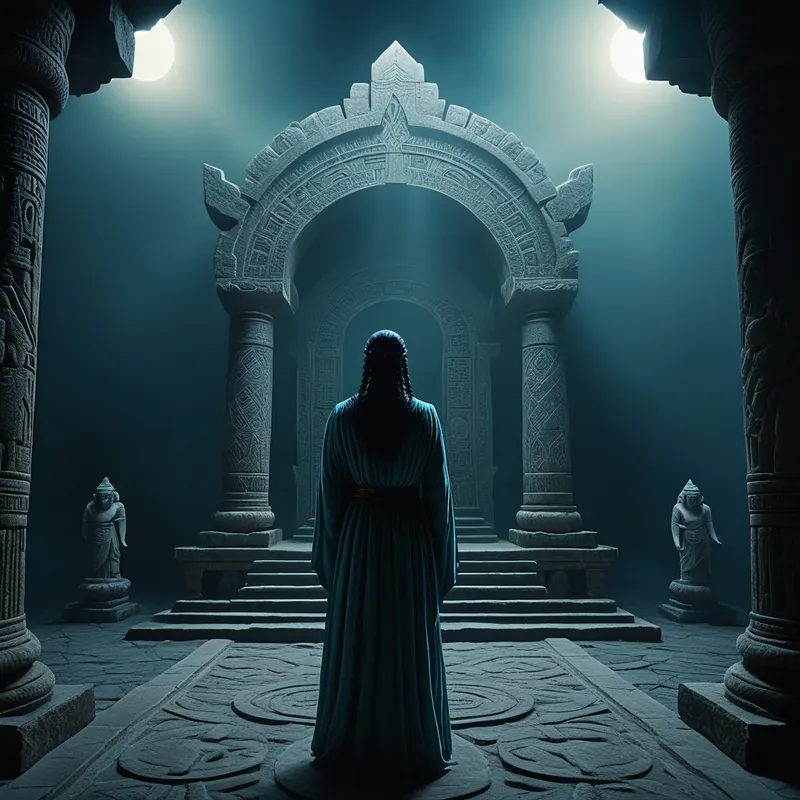
Imagine the scene: the vast, shadowed plains of Joseon, lit by the cold phosphorescence of wandering spirits and the distant, baleful glow of punitive furnaces. Here, legions of demonic soldiers, their forms a fusion of armored humanoid and bestial fury, stand in perfect, silent ranks. Imuk moves before them, his presence a vortex of disciplined menace. He does not merely punish; he commands the very forces of punishment. When a soul is condemned for a grave sin—betrayal of family, corruption of office, acts of profound cruelty—it is not a faceless hell that reacts. It is Imuk’s logistical command that dispatches the appropriate wardens, that oversees the soul’s passage through the specific horrors designed for its atonement. He is the iron will that turns cosmic law into concrete, terrifying experience.
His tale is woven through the Jinogi and in the didactic narratives known as Beompae. In these, he is the final, insurmountable barrier to escape or appeal. To face King Yama is to face judgment. To face Imuk is to face the inexorable execution of that judgment. He is the embodiment of the principle that in the cosmos, as in the psyche, there is no crime without consequence, no transgression that does not eventually muster its opposing, retributive force.
Cultural Origins & Context
Imuk’s figure is a powerful syncretic formation, a product of Korea’s spiritual layering. His primary roots sink deep into the imported Buddhist cosmology that structured the afterlife during the Goryeo and Joseon dynasties. Here, he finds his place in the bureaucratic and militarized vision of hell adapted from Chinese Buddhist traditions, where Yama (Yomna in Korean) presides over a judicial system mirrored on imperial courts, requiring generals to keep order.
Yet, Imuk is not a mere copy. He is filtered through the Korean sensibility, which has always held a profound respect for martial order and hierarchical loyalty. The Yangban class valued civil over military authority, but the culture retained a deep-seated archetype of the loyal general, the steadfast commander who upholds the realm’s structure against chaos. Imuk becomes this archetype projected into the cosmos. He is the ultimate Janggun, serving a higher, divine sovereignty.
Furthermore, his character resonates with older, shamanic (Muism) undercurrents. The shaman, or Mudang, is a mediator who navigates the spirit world, often confronting malevolent forces to retrieve or pacify souls. In a sense, Imuk is the formalized, institutionalized version of this confrontational aspect. He is the established, fearsome power that the shaman must acknowledge, petition, or carefully bypass in her journeys to the underworld. He represents the point where the fluid, negotiable world of spirits hardens into the immutable law of karma and final judgment.
Symbolic Architecture
Imuk is not a symbol of evil, but a symbol of necessary severity. He represents the psyche’s own internal judiciary, the part of the self that enforces the painful but essential laws of psychological integrity. He is the inner general who mobilizes the forces of guilt, shame, and consequence when we have profoundly violated our own moral or existential boundaries.
He stands for the terrifying but vital truth that the soul has its own justice system, one that operates on principles deeper than conscious desire or rationalization. To encounter Imuk in dream or myth is to encounter the moment when the bill for self-betrayal comes due.
His authority is absolute because it derives from a cosmic order, a Dharma of cause and effect. He does not act from personal malice, but from impersonal duty. This makes him more frightening, not less, for there is no appeal to mercy in his purview. His domain is the execution of sentence, not the deliberation of the court. In this, he symbolizes the often brutal process of psychological integration, where repressed shadows and unpaid debts must be faced with military precision and unavoidable force.
The Dreamer's Resonance
To dream of Imuk, or a figure like him, is to be visited by the archetype of relentless inner authority. It signals a profound crisis of conscience or a looming confrontation with the consequences of one’s actions. This is not the gentle voice of the superego, but the mobilized army of the unconscious, arriving to lay siege to the citadel of the ego’s denials.
He appears when we have committed, in life or spirit, a kind of treason against the Self. This could be a major life choice made out of cowardice, a perpetuated act of cruelty, or a long-maintained lie that has fractured our integrity. Imuk’s arrival in the psychic landscape means the period of grace is over; the internal reckoning has begun. The dreamer may feel pursued, judged by an unmovable force, or find themselves in a stark, administrative nightmare of trials and punishments. This is the psyche’s own "hell," activated not for torment’s sake, but for the brutal realignment of the personality with its deeper, neglected truths.

Alchemical Translation
The alchemical process mirrored in Imuk’s myth is the stage of mortificatio and separatio—the killing and separating. This is not a physical death, but the death of illusion, the dissolution of the persona that believed it could act without consequence. Imuk is the agent of this dissolution, the sword that cuts away the corrupt material so that a purer substance may eventually emerge.
In the soul’s journey, the General of Hell does not exist to condemn forever, but to enforce the necessary dissolution that precedes any possibility of reconstruction. He is the fierce guardian at the gate between a life lived in ignorance and the painful, purgatorial wisdom that might lead to renewal.
His relentless enforcement of karmic law is, paradoxically, a service to the soul’s ultimate liberation. By compelling the soul to fully experience the consequences of its actions, he forces a depth of self-knowledge that mere pleasure could never provide. He is the shadow side of the healer, the surgeon who must wound to cure. To integrate the energy of Imuk is to develop a fierce, internal honesty, to become the general of one’s own soul, disciplining the chaotic impulses and cowardly evasions that lead to inner hells.
Associated Symbols
Explore related symbols from the CaleaDream lexicon:
- Hell — The realm of consequence and profound reckoning, where the soul encounters the unvarnished results of its earthly choices and actions.
- General — The archetype of command, strategy, and the enforcement of order upon chaos, representing disciplined will and hierarchical authority.
- Authority — The legitimate power to judge, command, and enforce, deriving from a cosmic or moral order beyond personal whim.
- Underworld — The hidden, chthonic realm of the psyche where shadows dwell, secrets are stored, and the soul undergoes its most fundamental trials.
- Order — The principle of cosmic and psychological structure that arranges chaos into a meaningful, often severe, system of laws and consequences.
- War — The state of profound conflict and mobilization, reflecting the internal battles between aspects of the self or the soul’s struggle against its own resistances.
- Judgment — The moment of divine or psychic assessment, where actions are weighed and a sentence—of punishment or liberation—is decreed.
- Scepter of Authority — The physical emblem of rulership and command, signifying the legitimate power to govern realms both visible and invisible.
- Warrior — The embodiment of disciplined strength and courage in conflict, facing darkness with resolve in service of a sovereign principle.
- Shadow — The repressed, denied, or unconscious aspects of the self that, when unacknowledged, form the armies that the inner general must ultimately command or confront.