Imhullu Myth Meaning & Symbolism
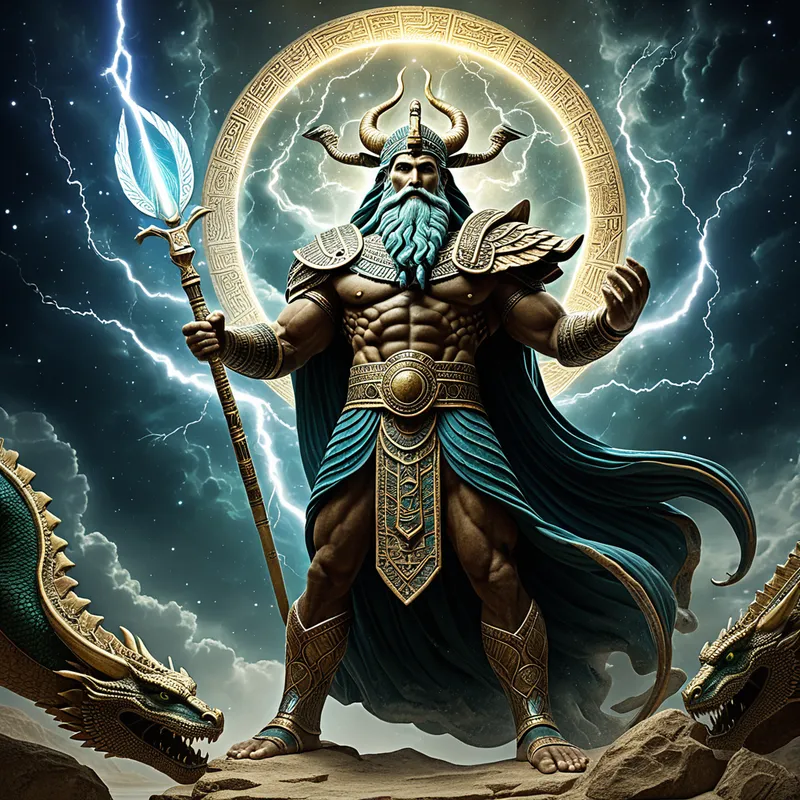
The myth of the god-king Marduk wielding the cosmic storm-weapon Imhullu to slay primordial chaos and forge the ordered world from her body.
The Tale of Imhullu
Hear now, of the time before time, when the world was not yet named. In the salt and sweet waters of the abyss, Apsu and Tiamat mingled, and from their union sprang the generations of the gods. The young gods danced in the belly of the deep, and their clamor was a torment to Apsu, who plotted their quietus. But the wise Ea uncovered the plot, and with a spell of profound sleep, he subdued Apsu, building his temple upon the stilled waters.
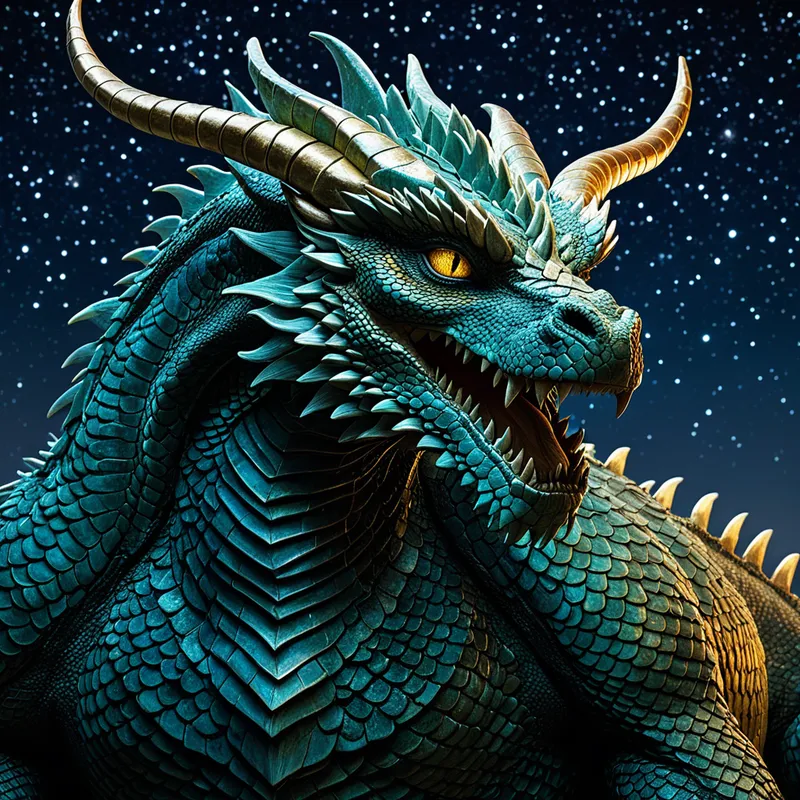
Yet a greater turmoil was born. Tiamat, the great mother dragon, raged at the slaying of her consort. Her heart churned the primordial seas into a froth of vengeance. From her own essence, she birthed a terrible legion: serpent-demons with venom for blood, scorpion-men, fish-men, and the Mushussu-dragon. At their head, she placed Kingu, her new mate, and clasped the Tablets of Destiny upon his breast, granting him the authority of the cosmos.
Terror seized the divine assembly. The elder gods sat in silence, their lights dimmed. None dared face the roaring abyss that was Tiamat. Until, from the chamber of deep counsel, a voice rang out. It was Marduk, son of Ea. His stature shook the foundations of the assembly. "I will stand against Tiamat and save your lives," he declared, "but if I am to be your champion, you must grant me unchallenged sovereignty. My word shall be law, unalterable."
The gods, desperate, agreed. They bestowed upon him the regalia of kingship: the scepter, the throne, and the royal robe. Then they gave him weapons no single god had ever wielded together. He fashioned a great bow, tipped it with lightning, and filled his quiver with flames. He crafted a massive net held by the four winds to ensnare the foe. But his primary weapon, the one born of his own command and the assent of the cosmos, was Imhullu—"The Evil Wind." It was not a mere tool, but a living, sentient tempest, a composite of the Seven Winds, a hurricane given will and purpose.
Marduk mounted his storm-chariot, drawn by four ferocious steeds, and rode to the edge of creation. There, Tiamat writhed, her mouth agape in a timeless scream. She saw Marduk and charged, her maw open to swallow him whole. But Marduk did not flinch. He unleashed Imhullu. The Evil Wind shot forth, a screaming vortex, and forced itself into her jaws. It filled her belly, distending her, pinning her jaws wide open. Rendered helpless, Tiamat could not close her mouth. Then Marduk took up his bow and shot the lightning arrow deep into her swollen belly. It pierced her heart. He severed her arteries, and the primordial blood watered the empty deep. He stood upon her carcass, the conqueror.
Then came the work of creation. He split her carcass like a clamshell. With one half, he hammered out the vault of the heavens, stationing guards to hold back her waters. With the other, he fashioned the earth, the mountains from her breasts, the rivers from her eyes. From the blood of the defeated Kingu, he mixed clay and created humankind, to bear the labor of the gods. Order was established from the body of chaos. And the weapon that made it possible, Imhullu, returned to its master, a tempest now leashed, the very breath of enforced cosmos.
Cultural Origins & Context
This epic, known as the Enuma Elish, was not merely a story but the foundational political and theological document of the Old Babylonian Empire (c. 1894–1595 BCE). It was recited annually during the Akitu festival, a ritual that reaffirmed the king’s divine mandate—his role as the earthly embodiment of Marduk—and the cosmic order of the state. The myth served a profound societal function: it legitimized Babylon’s supremacy over older Mesopotamian city-states (symbolized by the defeat of older gods like Tiamat) and presented a model of kingship based on decisive action, divine election, and the responsibility to maintain order against ever-present chaos.
The tale was preserved on cuneiform tablets, copied and studied by priestly scribes in temple schools. Its transmission was an act of sacred preservation, ensuring that the cosmological blueprint for reality and kingship was never forgotten. The myth provided an answer to the fundamental human anxiety about chaos—whether from invading armies, natural disasters, or social disintegration—by offering a narrative where chaos is not merely opposed, but transformed into the very structure of the habitable world.
Symbolic Architecture
At its heart, the myth of Imhullu is about the moment of differentiation, where potential becomes form. Tiamat represents the undifferentiated, creative, yet terrifying womb of all possibilities—the unconscious in its raw, pre-personal state. She is not "evil," but totality before distinction. Marduk represents the emerging principle of consciousness, the ego that must define itself against the boundless deep to exist.
Imhullu is the focused force of consciousness itself—the terrible, necessary violence of making a distinction.
The weapon is fascinatingly paradoxical. It is the "Evil Wind," yet it is divine and purposeful. It is chaos weaponized against chaos. Symbolically, Imhullu represents the act of naming, defining, and directing. It is the psychic energy required to say "I am this, not that." This is never a gentle process. It involves confronting the devouring mother/chaos, the part of the psyche that resists limitation and structure. The net of the four winds signifies the establishment of boundaries (the four directions), while Imhullu is the penetrating insight or will that immobilizes the diffuse power of the unconscious, allowing it to be engaged and transformed.
The subsequent creation from Tiamat’s body is the ultimate alchemical act. The psyche does not discard the conquered unconscious; it builds the architecture of the conscious self from it. Our inner heavens and earth—our values, disciplines, and identities—are fashioned from the very substance of our primal, chaotic nature.
The Dreamer's Resonance
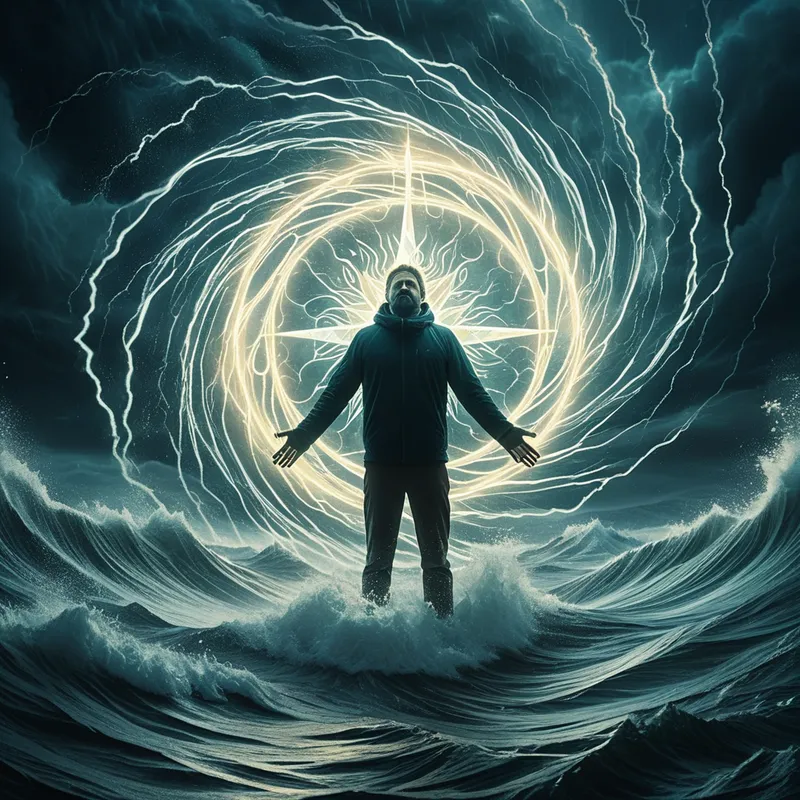
When this myth stirs in the modern dreamer, it often manifests not as a literal battle with a dragon, but as a profound confrontation with formless, overwhelming pressure. One may dream of being caught in a terrifying yet awe-inspiring storm (Imhullu itself), of facing a vast, murky, emotional tide (Tiamat), or of desperately trying to assemble a tool or weapon to face a shapeless threat.
Somatically, this can correlate with feelings of constriction in the chest or throat—the wind forced into Tiamat’s maw. Psychologically, it signals a critical juncture in the process of individuation: the ego is being called to muster its resources and define itself against an internalized, engulfing force. This could be a diffuse anxiety, a legacy of familial or cultural expectations that feels total and defining, or the chaotic swirl of unprocessed emotions. The dream is a rehearsal for the conscious, waking act of gathering one’s scattered energies (the four winds) into a directed force of will (the storm-weapon) to achieve self-definition.
Alchemical Translation
The journey from chaotic waters to ordered world is the blueprint for psychic transmutation. For the modern individual, the "Babylon" to be built is the integrated Self.
The Prima Materia: The process begins in the massa confusa of one’s life—the unresolved past, inherited traumas, compulsive behaviors, and nameless fears. This is your personal Tiamat, the unconscious content that threatens to overwhelm conscious life.
The Coniunctio & The Kingly Mandate: The "assembly of the gods" is the inner council of one’s potential, the talents, values, and archetypal energies. The election of Marduk is the difficult, conscious decision to take full authority for one’s life. It is the moment you stop blaming external forces and accept the "kingly" responsibility of your own psyche. You grant your emerging consciousness sovereignty.
Forging Imhullu: This is the heart of the work. You do not find this weapon; you fashion it from your own substance. It is the synthesis of your disparate experiences, insights, and disciplines into a focused, directed will. It is the cultivated ability to channel chaotic emotional energy into conscious action. Therapy, meditation, artistic practice, or deep reflection can be the forge.
The Confrontation & Creation: You must then direct this forged weapon inward. You allow Imhullu—your focused awareness—to enter the open maw of your chaos, to fully experience and name the diffuse terror or pain without being swallowed by it. This "slaying" is not destruction, but a radical transformation of function. The old, engulfing pain becomes the material for new structure. A depressive tendency might be transformed into a capacity for deep empathy; raw anger might become the energy for firm boundaries.
The ultimate triumph is not in the victory over chaos, but in the architectural genius that builds a livable world from its remains.
You create your heavens (your aspirations and spirit) and your earth (your grounded reality and body) from the experience. The myth of Imhullu teaches that order is not the default state, but a heroic, ongoing creation. The storm-weapon, once used for conquest, becomes the very breath of that creation—a reminder that our consciousness, however hard-won, must forever breathe life into the world it has dared to build.
Associated Symbols
Explore related symbols from the CaleaDream lexicon: