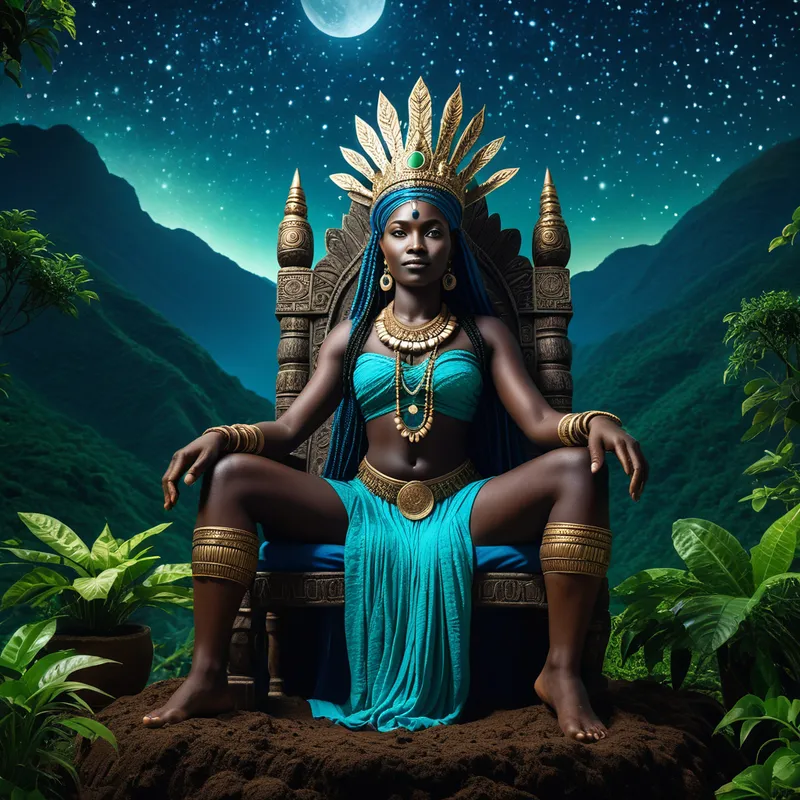
Ile the Sacred Earth Myth Meaning & Symbolism
The Yoruba creation myth of Ile, the primordial earth goddess, who offers her body as the foundation for all life, community, and destiny.
The Tale of Ile the Sacred Earth
In the beginning, there was only the vast, watery expanse of Odù and the endless, luminous dome of Orun. Between them, a silence so profound it was a presence. From the heart of Orun, the supreme source, Olodumare, sent forth a command—a vibration that was both a question and a longing. It sought form. It sought a place to become.
And from that longing, she emerged. Not from the waters, nor from the sky, but from the very intention of connection itself. She was Ilè. Her body was not flesh, but the promise of it: the scent of damp clay after first rain, the coolness of deep stone, the potential of the unbroken plain. She descended, not as a fall, but as a gentle, inevitable settling. Where her feet met the roiling chaos of Odù, the waters stilled. Where her form took space, the first solid ground was born—a mound of rich, dark earth rising from the endless sea.
She was alone, this first island in the void. But her solitude was not emptiness; it was readiness. She looked up to Orun, not as a subject, but as a counterpart. The sky gazed back, and in that gaze was the first covenant. The sky would give rain and sunlight; the earth would receive and transform. From this sacred marriage, life stirred within her. Grasses pushed through her skin, not as a wound, but as an offering. Trees grew from her bones, reaching for the sky she loved. Rivers began to flow from her heart, carving paths of blessing.
Yet, the world was still a quiet garden. Olodumare saw the beauty of Ilè, her patient, generative power, and knew more was destined. The Orisha were sent down from Orun. The fiery, creative Ogun needed ore from her depths. The stormy, transformative Shango needed her firmament to shake with his power. The nurturing, sweet-water Oshun needed her banks to hold her flow. To each, Ilè gave of herself. She yielded her minerals, bore the scars of lightning, and shaped herself to cradle the rivers.
But her ultimate sacrifice was for humanity. When the first humans, molded by the divine artist Obatala, were placed upon her, Ilè did not merely hold them. She opened herself. She allowed her body to be broken by the hoe, so that seeds might find a home. She allowed her skin to be trodden into paths, so that communities might connect. She absorbed the blood of battle and the tears of grief, transforming them silently in her dark womb. She became the foundation for every town, every shrine, every grave. Her body was the first altar, and every step upon her was a prayer. She asked for nothing but respect, and in return, she offered everything: stability, sustenance, and the final, tender embrace for all who walked upon her. She was no longer just land. She was home. She was mother. She was the sacred, living Earth.

Cultural Origins & Context
The narrative of Ilè is not a singular, canonical text but the foundational bedrock of Yoruba worldview, woven into Itan and expressed through ritual, proverbs, and daily practice. Originating from the Yoruba people of what is now southwestern Nigeria and parts of Benin and Togo, this understanding of the earth is both cosmological and utterly immediate. The myth was traditionally held and transmitted by Babalawos and Iyanifas, those deeply schooled in the mysteries of Ifá.
Its societal function is profound and practical. It establishes an ethic of ecological and communal responsibility. The earth is not a resource to be owned, but a sacred person to be in relationship with. This is why before any building project, farming activity, or even major community decision, propitiation is made to Ilè (ebo). The myth explains why the earth is revered as Iya wa, and why disrespect—pollution, wanton destruction—is considered a grave spiritual offense that disrupts the cosmic order (Ase). It grounds the people, literally and spiritually, in their environment, making the land itself an active participant in their history and destiny.
Symbolic Architecture
Ilè represents the archetypal principle of the Container and the Ground of Being. Psychologically, she symbolizes the foundational Self—the often-unconscious, enduring substrate of the psyche upon which the drama of consciousness (the Orisha, the human community) plays out.
She is the silent, receiving principle that makes action and form possible. Without ground, there is only chaos; without the Self, there is only a fragmented ego.
Her "sacrifice" is not one of loss, but of enabling transformation. She allows herself to be shaped, broken, and utilized. This symbolizes the necessary "suffering" of the foundational psyche—it must bear the weight of our experiences, our traumas, and our growth. It is the part of us that holds and metabolizes what the conscious mind cannot immediately process. The rivers flowing from her heart represent the emotional and instinctual life that springs from this deep, grounded core. Her acceptance of both seeds and graves speaks to the ultimate unity of life and death within the psychic substratum—all experiences are composted here to nourish new growth.
The Dreamer's Resonance
When the pattern of Ilè emerges in modern dreams, it often signals a profound somatic and psychological process of grounding or its painful absence. One might dream of crumbling earth, feeling unsteady or sinking, which points to an ego-structure built on shaky, unintegrated foundations—a life lacking in Ipònri. Conversely, dreams of rich, fertile soil, of planting hands deep in the earth, or of feeling an immense, stable presence beneath one's feet indicate a reconnection with the inner ground of being. This is the psyche seeking to re-establish its base after a period of chaos, flight, or dissociation.
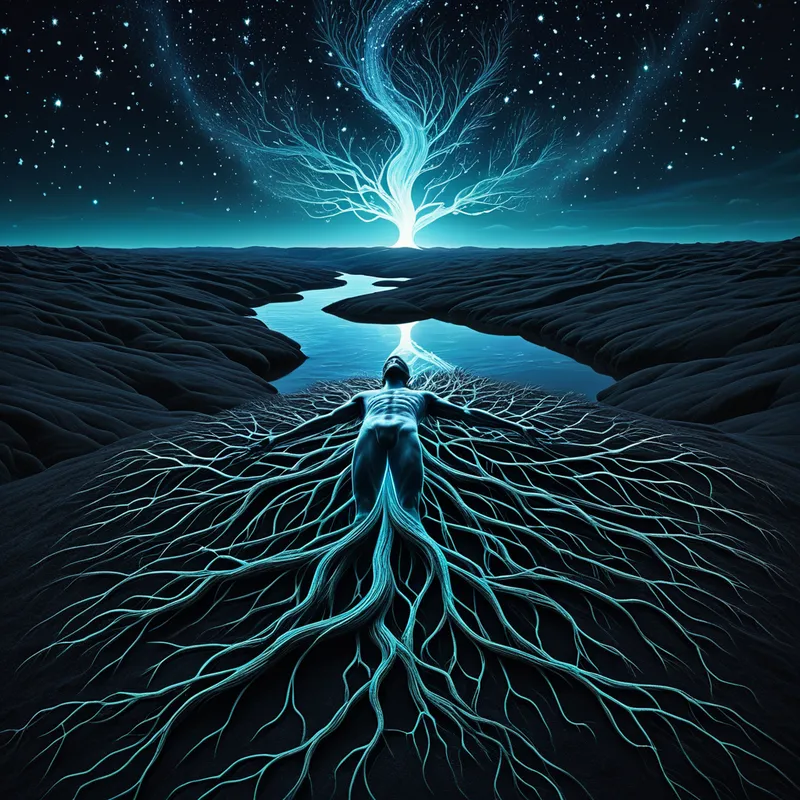
The dream may present as a landscape that is alive and breathing, or a figure whose body is made of geological features. This is the dreamer's system attempting to embody stability, to remember that consciousness is not a floating abstraction but is rooted in the physical and psychic earth. It is an invitation to descend from the "sky" of intellectual over-analysis and connect with the raw, instinctual, and nurturing wisdom of the body and the deep unconscious.
Alchemical Translation
The myth of Ilè models the individuation process as one of becoming grounded. The modern individual often begins in a state of Odù—formless potential mixed with chaotic emotion and undefined yearning. The first act of psychic creation is not a heroic charge outward, but a sacred descent inward: the formation of an inner temenos, a sacred space or ground.
Individuation requires that we first become our own earth—that we provide for ourselves the stability, containment, and fertile darkness that the outer world may not offer.
This involves the "sacrifice" of the ego's demand for constant agency and untouchable perfection. We must, like Ilè, allow ourselves to be "broken" by experience—to let the plow of life turn over our hardened defenses so that new insights can take root. We must learn to receive (rain, sunlight, love, criticism) and transform it within our own depths. The ultimate alchemical goal mirrored here is to become the stable vessel (the earthenware jug) that can hold the full spectrum of our being—the creative fire of Ogun, the passionate storms of Shango, the flowing emotions of Oshun—without shattering. To become Ilè is to achieve unshakable inner foundation, where one's sense of Self is not derived from external achievements or opinions, but from the quiet, enduring, and nourishing truth of one's own grounded existence.
Associated Symbols
Explore related symbols from the CaleaDream lexicon:
- Earth — The primary symbol of Ilè herself, representing the foundational Self, grounding, fertility, and the physical container of all life and experience.
- Mother — Ilè is the archetypal Mother Earth, the source of all nourishment, the unconditional container, and the ultimate receiver who gives form to potential.
- Sacrifice — Her allowing her body to be used for farming, building, and burial models the sacred sacrifice of the ground of being, which gives of itself to enable growth and transformation.
- Root — Symbolizes the deep, often unseen connection to the foundational psyche, the ancestral wisdom, and the source of stability and nourishment.
- Vessel — Ilè is the ultimate earthen vessel, the container that holds life, water, seeds, and the dead, representing the psyche's capacity to hold and transform contents.
- Stone — Represents the enduring, unchanging core of the Self, the bedrock of consciousness upon which temporary structures are built.
- Circle — Reflects the cyclical nature of life, death, and rebirth that Ilè governs, as well as the wholeness and completeness of the grounded, integrated Self.
- Heart — The rivers flow from Ilè's heart, symbolizing that deep emotional life and compassion spring from the grounded, centered core of being.
- Temple — The earth itself is the first and ultimate temple, a sacred space where the divine and the mortal meet, and where every act can be ritual.
- Grief — Ilè absorbs and transforms grief into fertile ground, symbolizing the psyche's deep capacity to compost painful emotions into wisdom and new growth.
- Rain-soaked Earth — Represents the sacred marriage of sky and earth, the fertilization of consciousness by spirit, and the awakening of latent potential through emotional or spiritual nourishment.
- Unearthed Treasure — Symbolizes the precious insights, strengths, and artifacts of the true Self that are discovered only by digging into one's own grounded, often shadowy, depths.