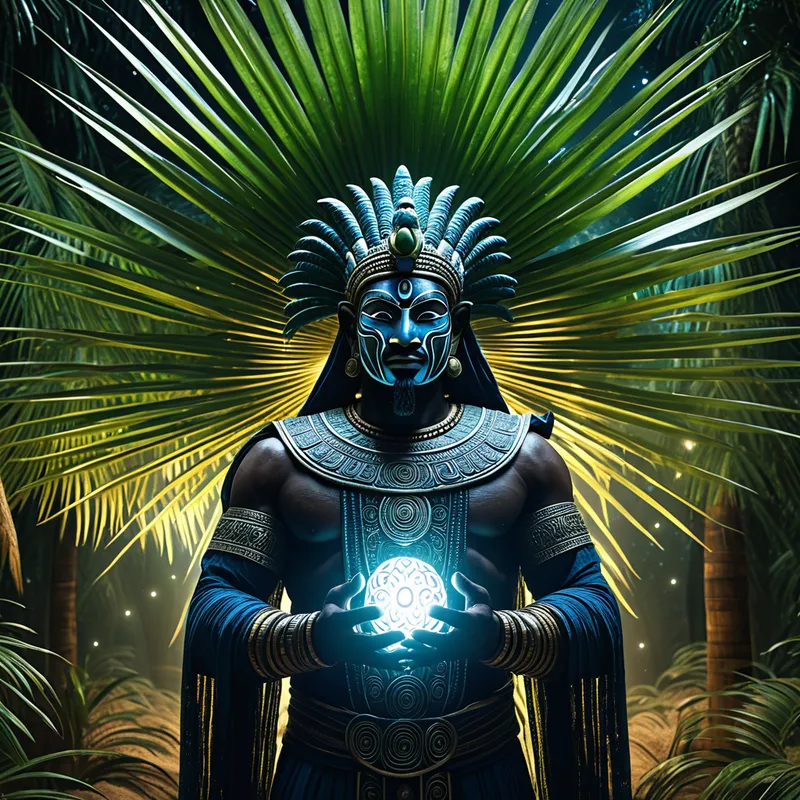
Ifá Divination Myth Meaning & Symbolism
The myth of how the god Orunmila gained the wisdom of Ifá divination, creating a sacred system to guide humanity through the complexities of fate.
The Tale of Ifá Divination
In the time before time, when the world was soft and the paths between heaven and earth were still being woven, there was a great silence. It was the silence of potential, of things not yet born, of choices not yet made. Into this silence walked Orunmila, the witness to destiny. He saw the confusion of the newly created humans, stumbling in the dark, their lives a tapestry of tangled threads. They cried out to the Orisha, but their prayers were echoes in a canyon—loud, but without direction.
Orunmila’s heart, a vessel of infinite compassion, grew heavy. He journeyed to the foot of the great Iroko, where the whispers of the ancestors rustled in its leaves. “There is a way to see the pattern,” the tree sighed. “But the price is of the essence itself.” The way was the art of Ifá, a language spoken by the universe, a map of all possibilities contained within 256 sacred chapters, the Odu. Yet, this language was locked away, its key forged from a sacrifice so profound it would scar the very fabric of the divine.
The keeper of this key was Ogun, the relentless shaper, the divine blacksmith. In his fiery forge at the crossroads of existence, Ogun hammered the raw ore of fate. Orunmila approached, the heat blistering the air. “I have come for the wisdom to guide creation,” Orunmila declared, his voice steady against the roar of the flames.
Ogun ceased his work, his eyes glowing like coals. “The tool that cuts the veil of ignorance is not of metal,” he rumbled. “It is of spirit. To gain the wisdom of Ifá, you must give a part of your own journey. You must give the limb that carries you.”
A stillness fell, deeper than the silence of creation. Orunmila did not hesitate. He laid himself upon the anvil of necessity. With a strike that echoed through all realms, Ogun’s tool performed the unthinkable act. Orunmila offered his own leg—the very means of his locomotion through the world—not in a scream of agony, but in a breath of ultimate commitment. From this sacrifice, from the essence of his own mobility, the first set of sixteen sacred palm nuts, the Ikin, were consecrated. His blood and spirit soaked into them, making them alive with consciousness.
With the Ikin now a part of him, and he a part of them, Orunmila could hear. He heard the universe not as chaos, but as a vast, rhythmic poem. He cast the nuts upon the dust, and they spoke in geometric patterns—lines of single and double marks. These were the first signs, the first Odu: Eji Ogbe, speaking of origins and clarity; Oyeku Meji, speaking of endings and mysteries. Each pattern unlocked verses, stories, remedies, and warnings—the entire literary corpus of Ifá, flowing from his lips like a river of light.
He no longer walked the earth as other Orisha did. He became the one who sits, the sage who sees. He taught this art to his first disciples, the Babalawo, “Fathers of the Secrets.” He gave them the Ikin, the Opele, and the Opón Ifá—the tools to trace the fingerprints of destiny in the sacred powder. The great silence was broken, not by noise, but by meaning. The tangled threads of human life now had a weaver who could see the pattern, all because one god chose to sacrifice his path to become the guide for all paths.

Cultural Origins & Context
This myth is the sacred foundation of the Ifá divination system, originating from the Yoruba people of what is now southwestern Nigeria, Benin, and Togo. It is not merely a story but the cosmological justification for a vast, living intellectual and spiritual tradition. The myth was and is passed down through rigorous oral and ritual initiation within the priesthood of the Babalawo. These priests are not just religious figures but living librarians, philosophers, and counselors, memorizing thousands of poetic verses (ese Ifá) associated with each Odu signature.
Its societal function was and remains profound. Ifá provides an axis of order in a complex world. It is consulted for everything from naming ceremonies and marriages to diagnosing illness, resolving ethical dilemmas, and guiding community leadership. The myth of Orunmila’s sacrifice establishes divination not as fortune-telling, but as a sacred technology for interfacing with the deep structure of reality (Olodumare) and one’s personal destiny (Ori). It frames wisdom as the ultimate resource, purchased not with coin but with profound personal cost, and positions the diviner as the necessary intermediary who has access to this costly knowledge.
Symbolic Architecture
At its heart, this is a myth about the genesis of consciousness from the crucible of sacrifice. Orunmila’s leg symbolizes directed action, willful movement through the world—the ego’s agenda. His sacrifice represents the necessary surrender of a part of the conscious, striving self to gain access to the transpersonal, pattern-recognizing Self.
The price of true sight is a piece of your own journey. You must give up knowing how you will walk to understand why.
The sixteen Ikin are symbolic of completeness (4x4, a squared perfection) and represent the totality of cosmic possibilities. Their creation from Orunmila’s essence means the tool of wisdom is inseparable from the body of the wise one; knowledge is embodied, not abstract. The Odu, the 256 patterns, are the archetypal grammar of existence. They are not random but a complete symbolic alphabet from which every story of human triumph, failure, love, and loss can be composed. The myth thus posits that chaos is merely a story we cannot yet read, and destiny is a text waiting to be interpreted through the correct, sacrificed lens.
The Dreamer's Resonance
When this myth pattern stirs in the modern psyche, it often manifests in dreams of seeking crucial, obscured information. One might dream of a lost map, a book in an unknown language, or a wise but maimed figure who offers a key. Somatically, this can coincide with feelings of being “stuck” or at a painful crossroads, where old ways of moving through life (the “leg”) are failing.
Psychologically, the dreamer is at the threshold of the Shadow work that precedes greater wisdom. The dream is signaling that the ego’s current strategies are insufficient for the soul’s journey. The figure of Orunmila represents the emerging archetype of the inner sage, which cannot be accessed without a willing, painful sacrifice of a familiar identity or behavior pattern. The dream is an invitation to ask: “What must I willingly give up—what comfort, what certainty, what old path—to gain the clarity I seek?”
Alchemical Translation
The alchemical process modeled here is the nigredo leading to the albedo—the dissolution of a lower form to reveal a higher one. Orunmila’s journey is the blueprint for individuation, where the conscious personality (the walking god) must offer up its limited capacities to the transformative fire of the unconscious (Ogun’s forge) to be remade into an instrument of transpersonal wisdom.
The leg sacrificed is the literal path; the wisdom gained is the map to all paths. This is the alchemy of limitation into universality.
For the modern individual, this translates to the painful but necessary process of sacrificing a rigid, self-directed life plan (the ego’s leg) to discover one’s authentic destiny (Ori). It is the entrepreneur who must let go of a failing business model to see the true opportunity. It is the artist who must abandon a safe, derivative style to find their unique voice. It is anyone who must surrender the “how” to understand the “why.” The myth teaches that wisdom is not accumulated; it is extracted through a voluntary, sacred wounding. The resulting knowledge is not intellectual but gnostic—a knowing that is part of your very substance, like the Ikin born from Orunmila’s essence. It allows you to sit calmly at the center of your own Opón Ifá, to cast the nuts of your experience, and to read, at last, the divine pattern of your own becoming.
Associated Symbols
Explore related symbols from the CaleaDream lexicon: