Idunn's Apples Myth Meaning & Symbolism
The myth of the goddess Idunn, whose golden apples grant the gods eternal youth, and the perilous journey to reclaim her after she is stolen away.
The Tale of Idunn's Apples
Listen, and hear the tale that holds the very breath of the gods.
In the high halls of Asgard, where the mead flows and the fires of Valhalla burn eternal, a quiet dread had begun to creep. It was not the dread of Ragnarök, not yet. It was a slower, more insidious withering. The laughter of Thor grew strained, the wisdom of Odin seemed burdened, and the very light in Baldr's eyes dimmed. A grey pallor touched their skin; a stiffness entered their limbs. The gods, the mighty Æsir, were growing old.
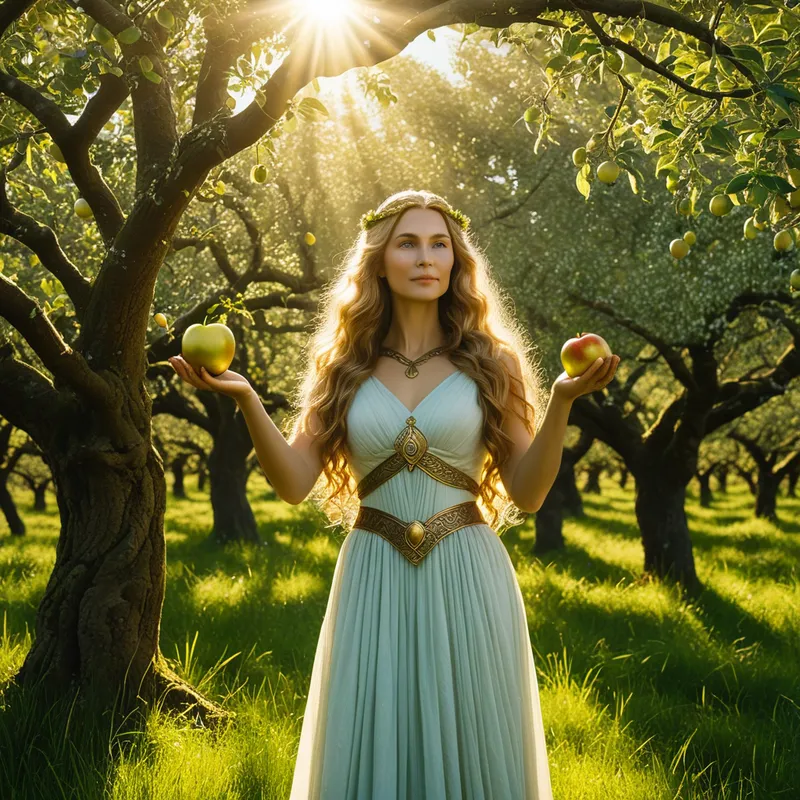
But in a secluded grove, where the light of the sun fell soft and dappled through leaves of perpetual green, the goddess Idunn kept her sacred trust. She moved with the grace of a spring breeze, her presence itself a balm. From a casket of finest ashwood, she would draw her treasure: apples of a gold so pure it seemed spun from sunlight itself. These were not fruits of mere sustenance, but of essence. When the gods gathered, weary and faded, Idunn would offer her gift. With a single bite, the grey receded, strength surged back into tired bones, eyes cleared, and laughter returned, fresh and vital. She was the silent, beating heart of Asgard’s eternity.
The peace was shattered by the silver tongue of Loki. Venturing beyond the safety of the gods' realm, he was captured by the giant Thjazi. To save his own skin, Loki wove a lie as cunning as a spider’s web. He spoke of Idunn and her apples, describing their power with such envy-inducing detail that Thjazi’s greed ignited like a forge-fire. Loki promised to deliver her.
Returning to Asgard, the trickster found Idunn in her grove. With feigned urgency, he told her of a tree beyond the walls that bore apples even more wondrous than her own, apples she must see to believe. Trusting, ever-innocent, Idunn took her casket and followed him beyond the gates. The moment they crossed into the wilds, the sky darkened. Thjazi, in the form of a monstrous eagle, swept down. His talons, like iron hooks, snatched Idunn and her casket, carrying her away to his barren, frost-rimed fortress of Þrymheimr.
In Asgard, the decay accelerated. Without Idunn’s apples, the gods aged with terrifying speed. Hair whitened, backs bent, voices grew thin and reedy. Desperation mounted. They turned their fading eyes to Loki, for his guilt was plain. Threats of brutal death finally loosened his tongue. He would bring her back, he swore, if the goddess Freyja would lend him her feather cloak.
Transformed into a falcon, Loki flew on a journey of terror and haste. He crossed frozen rivers and jagged peaks until he found Thjazi’s hall. Finding Idunn alone, he used his magic to transform her into a single, tiny nut. Clutching her tight in his talons, he beat his wings for home. But Thjazi returned, saw the theft, and in a rage of thunderous wings, gave chase.
The race shook the skies. Loki, straining every feather, shot toward Asgard with the giant eagle closing the gap, its shadow swallowing the land below. As the walls of the gods’ home came into view, the aged Æsir, seeing the pursuit, rushed to pile kindling against the ramparts. The moment Loki, the nut safe, streaked over the wall, they set the mountain of wood ablaze. Thjazi, unable to stop his furious dive, flew straight into the inferno. His feathers ignited, and he fell, burning, to be slain by the gods who had just regained their strength.
Idunn was restored. In her grove, she opened her casket. The golden light spilled out, and as the gods partook, youth and vigor flooded back into them. Laughter once more echoed in the halls. But the memory of the grey withering, the taste of mortality, lingered in their newfound strength—a silent, sobering guest at their eternal feast.

Cultural Origins & Context
This myth, like most of Norse mythology, survives primarily through the Poetic Edda and the later Prose Edda, compiled in 13th-century Iceland from far older oral traditions. It was not scripture, but living story, told by skalds (poets) in halls warmed by fire, a narrative woven into the fabric of a worldview defined by cycles and inevitable loss.
The societal function was profound. In a culture acutely aware of harsh winters, short lifespans, and the ever-present threat of entropy, Idunn’s myth addressed a deep existential anxiety. It explained not the fact of aging and death—that was the domain of the Norns—but the experience of vitality and its precariousness. The gods themselves were not immortal by nature; they required constant renewal. This mirrored the human condition: strength, health, and community spirit are not permanent possessions but states that must be actively maintained and protected from external threats (the giants, representing chaos and the destructive forces of nature) and internal betrayals (Loki’s deceit, representing folly and selfishness).
Symbolic Architecture
At its core, the myth of Idunn is a masterful depiction of the psyche’s regenerative principle. Idunn is not a warrior or a sovereign; she is the caregiver of the divine psyche itself. Her apples are the symbolic fruit of psychic energy—what we might call libido, vitality, or simply the will to live and engage creatively with the world.
The golden apple is not a reward for virtue, but the essential nutrient of consciousness. To lose it is not to be punished, but to be disconnected from the source of one's own animation.
Loki’s role is critical. As the trickster, he embodies the unconscious, amoral curiosity that can lead to both discovery and disaster. His betrayal is not merely evil; it is a necessary shadow. Without Loki’s intervention, the gods take Idunn for granted. Her gift becomes routine, its sacredness forgotten. The crisis—the theft, the aging—forces a heroic act of reclamation. The psyche must consciously recognize, pursue, and fight for its own source of vitality. Thjazi, the giant, represents the devouring aspect of the unconscious that seeks to hoard and isolate life-energy (vitality kept in a frozen fortress, useless to all).
The resolution is alchemical: Idunn is transformed (into a nut, a seed) for the journey home. The source of life must often be made small, portable, and protected to survive the journey back to consciousness. The fiery death of Thjazi at Asgard’s walls signifies the necessary destruction of the devouring complex—the selfish, hoarding impulse—to reintegrate the life-giving principle.
The Dreamer's Resonance
When this mythic pattern stirs in the modern dreamer, it speaks to a crisis of vitality. To dream of rotting fruit, a lost or stolen precious container, or a feeling of rapid, inexplicable aging points directly to the "Idunn complex."
Somatically, this may manifest as chronic fatigue, burnout, or a feeling of being "dried up" emotionally and creatively. Psychologically, it is the process of a vital aspect of the Self—the inner Idunn—being kidnapped. This often happens through a "Loki" moment: a betrayal (by self or other), a foolish bargain (prioritizing external validation over inner truth), or a naive wandering away from one’s protective grove (the boundaries of healthy self-care). The devouring giant may appear as a draining job, a toxic relationship, or a depressive complex that isolates one’s joy.
The dream is the falcon’s flight—the psyche’s urgent, desperate attempt to locate and reclaim what has been lost. It is a signal that the dreamer is in the midst of the chase, feeling pursued by their own consequences, yet on the cusp of a fiery reintegration.
Alchemical Translation
For the individual, the myth models the complete cycle of psychic transmutation, or individuation. The initial state is one of unconscious sustenance—taking one’s vitality for granted. The nigredo, or blackening, is the theft and the ensuing grey decay: depression, meaninglessness, the stiffening of one’s inner gods (the archetypal capacities for strength, wisdom, and connection).
The journey to Þrymheimr is a descent into the personal unconscious to confront what has been hoarded in shadow. The reclamation is not a return to a previous innocence, but a rebirth into conscious stewardship.
Loki, the shadow, must be compelled into service. This translates to confronting one’s own capacity for deceit, selfishness, and folly, and harnessing that same cunning energy for the sake of recovery. Transforming Idunn into a nut is the crucial act of distillation: identifying the core, seed-like essence of what gives you life—perhaps a childhood passion, a core value, a simple practice of joy—and making it portable enough to extract from the complex that holds it captive.
The final, fiery confrontation at the walls of Asgard is the rubedo, the reddening. It is the conscious, often painful, act of setting a boundary and destroying the pattern that devours your energy. You must light the fire at your own ramparts and let the devouring impulse burn itself out. Only then can the nut be cracked open, and the golden apple of renewed, conscious vitality be shared once more with all parts of your being. You are not just rejuvenated; you are now the guardian of your own grove, aware of its preciousness and its perpetual need for protection and honor.
Associated Symbols
Explore related symbols from the CaleaDream lexicon: