Idunn Myth Meaning & Symbolism
The myth of the goddess whose golden apples sustain the gods' youth, her abduction, and the perilous quest to restore the source of eternal vitality.
The Tale of Idunn
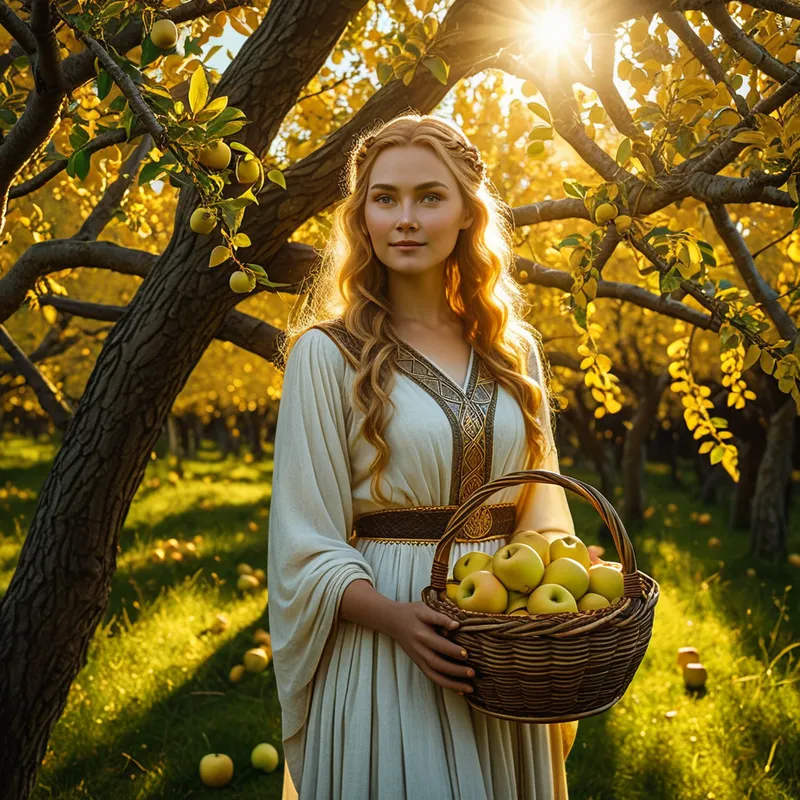
Listen, and hear the tale of the quiet pulse at the heart of Asgard. Where the great halls echo with boasts and the clang of training arms, there is a grove. In that grove stands Idunn, keeper of the secret. Her hands do not wield spear or hammer; they cradle a basket of apples, but not as any mortal knows them. These are apples of gold, and their flesh is not mere sustenance—it is time itself, distilled into sweetness.
The Æsir gods are mighty, but they are not immutable. Without Idunn’s gift, a creeping frost enters their bones, their hair thins to silver, and the weight of centuries bows their shoulders. In her quiet grove, she offers renewal. Each bite is a return to prime, a resetting of the inner sun. All depends on her, and on her golden hoard.
But a shadow fell upon this rhythm. It began with a journey, as so many troubles do. Loki, the shape-shifter, ever hungry for diversion, traveled with Thor and others to the edges of the world. Their journey was hard, and when they stopped to eat, a great eagle—larger than any natural bird—swooped down and stole their ox. Enraged, Loki seized a pole and struck the beast. The pole stuck fast, and Loki found himself dragged across sky and stone, his cries lost to the wind.
The eagle was no bird, but Thjazi the giant in disguise. He would free Loki only for a price: a vow to lure Idunn, and her apples, beyond the walls of Asgard. Bruised and fearful, Loki agreed.
Back in Asgard, Loki wore a mask of contrition. He went to Idunn, his voice a whisper of wonder. “Fair Idunn,” he said, “just beyond the walls, I have found apples of such marvel, their gold makes yours seem pale. Come, compare them for yourself.” Trusting, curious, Idunn took her basket and followed him to a place where the high walls cast long shadows. In a blast of wind and terror, Thjazi descended again, this time in his full, monstrous eagle-form. Talons like iron closed around Idunn. Her basket tumbled, apples scattering like fallen stars into the grass, as she was carried screaming into the bleak sky, toward the frozen fastness of Jotunheim.
In Asgard, the decay began. Not suddenly, but insidiously. A stiffness here, a grey hair there. A forgotten name. A dull ache in once-mighty limbs. The light in Odin’s eye dimmed. The gods gathered, their voices thin with a fear they had never known. They turned as one to Loki, for his guilt was plain upon him. “You brought this blight,” they thundered. “You will bring her back, or your suffering will make our aging seem a gentle sleep.”
Terrified of their wrath, Loki borrowed the feather-cloak of the goddess Freyja. He transformed into a falcon, a dart of desperation against the vast sky, and flew to Thjazi’s barren hall. He found Idunn alone, her apples gone, her spirit dimmed. In an instant, he changed her into a nut, clasped her in his claws, and beat his wings for home.
But Thjazi saw. With a roar that shook the mountains, he took his eagle-shape and gave chase. The race was a scar across the heavens. The gods, watching from the walls of Asgard, saw the falcon straining, the monstrous eagle closing the gap. They acted. On the ramparts, they piled the shavings of all the wood in Asgard. As Loki shot over the wall, they set the pyre ablaze. Thjazi, blinded by rage and momentum, could not turn. His vast wings caught fire, feathers becoming cinders. He fell, crashing to earth before the gates, where the waiting gods ended his life.
Idunn was restored to her grove. The golden apples were gathered. And one by one, the gods came to her. They took the fruit, and as they ate, the frost receded. Strength flowed back into their arms, clarity into their minds, light into their eyes. The quiet pulse of Asgard beat strong once more, sustained by the keeper who had been lost, and was found.

Cultural Origins & Context
The myth of Idunn is preserved primarily in the Poetic Edda, specifically in the poem Haustlöng, and is recounted more fully in the Prose Edda. These texts were compiled in 13th-century Iceland, a culture clinging to the myths of its pre-Christian past. The story would have been told by skalds (poets) and storytellers, not as a mere fable, but as an explanation of a fundamental cosmic principle.
In the harsh, cyclical world of the Norse—where winter threatened life, and age inevitably weakened the strongest—the concept of a renewable source of vitality was profoundly meaningful. Idunn’s myth served a societal function far beyond entertainment. It modeled a core existential truth: even the gods are subject to entropy and decay. Their power is not absolute but dependent on a sacred, cyclical source of renewal. The story reinforced the idea that vitality must be protected, that it can be stolen through treachery, and that its recovery requires cunning, collective action, and sacrifice. It is a myth about the maintenance of the cosmic order itself, where the caregiver’s role is as vital as the warrior’s.
Symbolic Architecture
Idunn is the archetypal guardian of the life-force. Her apples are not mere fruit but symbols of pyschic and somatic renewal. They represent that which prevents stagnation, rigidity, and spiritual death. The gods, for all their power, are incomplete without her; they are conscious structures in need of perpetual revitalization from an unconscious, nurturing source.
The golden apple is the secret fruit of the Self, the nourishment that allows the conscious ego to endure its encounters with the eternal without crumbling into dust.
Loki, the trickster, represents the chaotic, amoral aspect of the psyche that inevitably disrupts stable systems. His betrayal is not merely malice; it is the necessary shadow that forces a crisis. Without Loki’s treachery, the gods might take Idunn for granted. The abduction is the moment the psyche realizes it has lost touch with its own source of vitality. Thjazi, the giant, symbolizes the devouring aspect of the unconscious—the raw, archaic force that would hoard the life-energy for itself, freezing it in a state of sterile captivity.
The restoration is a classic heroic journey, but undertaken by the flawed trickster. Loki’s flight and retrieval symbolize the ego’s desperate, often clumsy attempt to reclaim what it has lost from the depths of the unconscious (Jotunheim). The final, collective act—the lighting of the pyre—shows that the reintegration of this life-force requires a sacrificial burning of the devouring complex (Thjazi). The old, possessive form must be destroyed for the renewal to be complete.
The Dreamer's Resonance
When this myth stirs in modern dreams, it speaks to a profound experience of enervation and recovery. To dream of losing a precious, glowing object, of a trusted figure leading you into danger, or of feeling a sudden, inexplicable aging, is to dream the Idunn pattern. Somatically, this may correlate with periods of burnout, chronic fatigue, depression, or a feeling of being “dried up” creatively or emotionally.
The psychological process is one of confronting the “theft” of one’s vitality. The dreamer is identifying what or who in their life plays the role of Loki—the charming distraction, the compulsive behavior, or the relationship that has led them away from their core source of nourishment. The bleak landscape of the dream (the frozen hall, the empty basket) maps directly onto the inner state of depletion. The dream’s resolution, if it comes, often involves a frantic search, a transformation (like being turned into a nut for safekeeping), and a fiery confrontation at a boundary (the walls of Asgard). This signals the psyche mobilizing its resources for a difficult but necessary act of reclamation and boundary-setting.
Alchemical Translation
The alchemical process mirrored in Idunn’s myth is the circulatio—the great circulation of spirit and matter that prevents the work from becoming fixed and dead. In the individuation journey, we all construct our personal Asgard: a complex identity, a set of achievements, a conscious personality. But this structure, without periodic renewal from the deeper Self, becomes a hollow fortress. We perform our roles, but the juice of life is gone.
Individuation is not a one-time achievement, but a cyclical feast. We must repeatedly descend from our fortified towers to receive nourishment from the orchard we so easily forget.
Loki’s role is crucial here. He is the inner provocateur who engineers the crisis of meaning, the midlife despair, the creative block. This “abduction” feels like a catastrophe, but it is the catalyst that forces the ego to stop taking its vitality for granted. The quest to retrieve Idunn is the soul’s work of shadow integration—facing the devouring giants of our own psyche (addiction, resentment, fear) that have captured our energy.
The triumphant return and feast are the coniunctio, the sacred marriage. The conscious mind (the gods) is reunited with the renewing feminine principle (Idunn). The golden apple is the lapis, the philosopher’s stone not as a static object, but as a recurring moment of synthesis. Each bite is a small, conscious integration of unconscious content, a taste of wholeness that rejuvenates the entire system. Thus, the myth teaches that our eternal task is not to avoid loss, but to master the art of return; to know the location of our inner orchard, and to have the courage to feast there, again and again.
Associated Symbols
Explore related symbols from the CaleaDream lexicon: