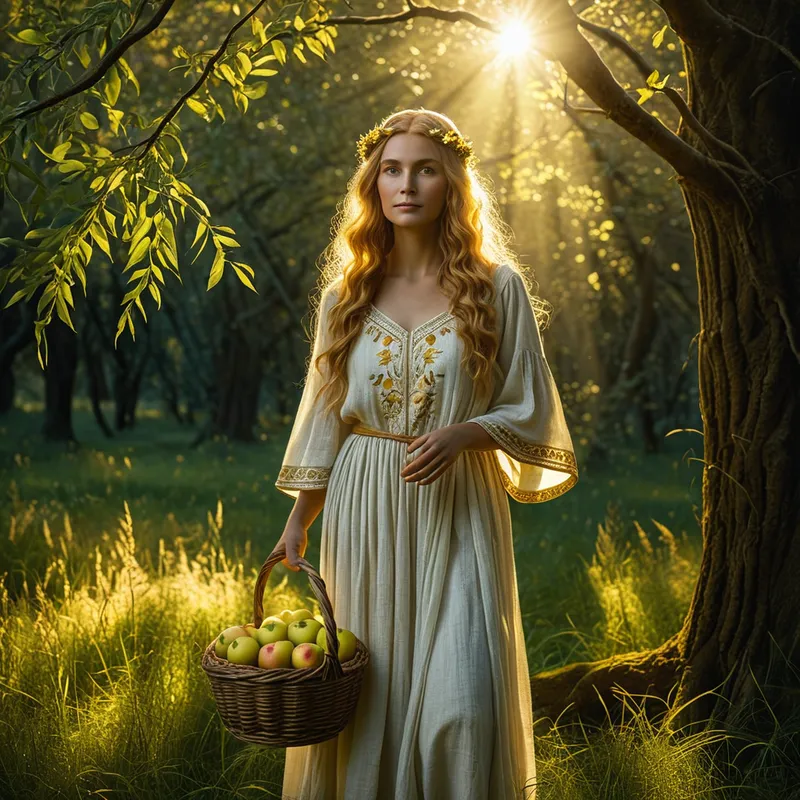
Idun Myth Meaning & Symbolism
The myth of Idun, keeper of the golden apples of youth, whose abduction plunges the gods into decay, revealing the fragility of vitality and the necessity of its recovery.
The Tale of Idun
Listen, and hear the tale of the gods’ most precious treasure. Not the spear of Odin, nor the hammer of Thor. Their true wealth was a sound, a scent, a feeling: the crisp, sweet crunch of a golden apple, and the warmth that followed, flowing through weary limbs like the first sun of spring after a long winter. This was the gift of Idun.
She moved through the halls of Asgard not with thunder, but with a quiet grace, a basket of these apples always at her side. Her presence was the promise of continuity. When the gods felt the weight of centuries, when Loki’s mischief left them bruised, or the strain of upholding the world against the giants wore them thin, they would seek her. With a smile, she would offer her fruit. The transformation was not a blaze of glory, but a deep, somatic sigh. Grey hair darkened, stiff joints loosened, and the spark of divine vitality was rekindled. She was the silent, beating heart of Asgard’s eternity.
But a heart can be stolen. On a journey beyond the safety of the gods’ walls, Loki, ever the provocateur, fell into the clutches of the giant Thjazi. To save his own skin, Loki made a bargain woven from lies. He swore an oath to lure Idun, and her apples, out of Asgard. “I have found apples in the forest,” he whispered to her later, his voice slick with false wonder, “golden like yours, but growing wild. Come, compare them.”
Trusting in the kinship of the gods, Idun followed him to a wooded grove at the edge of the world. The air grew cold. The light dimmed. With a rush of wind that smelled of ice and stone, Thjazi descended, not as a man, but as a monstrous eagle. His talons, sharp as glacier shards, closed around Idun. Her basket tumbled, apples scattering like fallen suns into the grass, as the giant bore her away to his barren fortress of Thrymheim.
Silence fell in Asgard. Then, a creeping chill. It was not the cold of winter, but the cold of time itself. Beards grew long and white, untouched by shears. Eyes, once sharp enough to see across the nine worlds, grew clouded. Hands that wielded cosmic weapons began to tremble. A profound lethargy settled upon the gods. They were fading, crumbling into antiquity before their time. The great hall echoed not with feasting and boastful tales, but with the dry cough of age and the whisper of despair. They were dying, not in battle, but in slow, ignoble decay.
They turned, as one, to the source of all their recent woes: Loki. Thor’s grip on his hammer was weak, but his rage was not. Faced with annihilation, Loki bargained again, this time for their salvation. Freyja lent him her falcon plumes. Transforming into a hawk, Loki flew on a desperate wind across the worlds, to the stark peaks of Thrymheim. He found Idun alone, her apples untouched by the giant, for their magic was hers to give. In an instant, he changed her into a single, perfect nut, clutched it in his talons, and shot skyward like an arrow.
But Thjazi saw. With a roar that shook the mountains, he took his eagle form and gave chase. The race shook the heavens. Loki, straining, burst through the walls of Asgard, the giant close behind. The waiting gods, prepared, lit a pyre that reached the clouds. Loki darted aside. Thjazi, his feathers vast and swift, could not turn. He flew into the heart of the divine fire, and was consumed. From his ashes, they say, new things were born. But the gods had eyes only for Idun, returned to her form, standing once more among them with her basket. One by one, they partook of the apple. Color returned to cheeks, strength to limbs, and the golden light of perpetual vitality was restored. The crisis had passed, but the memory of the chill, of the fragility of their youth, lingered forever in the halls of Asgard.

Cultural Origins & Context
The myth of Idun is preserved primarily in the Poetic Edda, specifically in the poem Haustlǫng, and is recounted in prose by Snorri Sturluson in his Prose Edda. These texts are our windows into a worldview where myth was not mere story, but a living framework for understanding reality. This tale would have been told in the long, dark winters of Scandinavia, a region intimately acquainted with cycles of life, death, and the desperate hope for renewal. The societal function was profound: it explained the necessity of cyclical renewal against entropy. The gods themselves were not immortal by nature, but by maintenance. Their need for Idun’s apples mirrored the human need for seasonal harvests, for the return of the sun, and for the rituals that ensured the continuity of the clan. It was a narrative that acknowledged a terrifying truth—that the foundations of order and vitality are perpetually vulnerable to theft, deceit, and the encroaching "frost" of chaos and stagnation.
Symbolic Architecture
Idun and her apples represent the principle of psychic and somatic renewal. She is not the creator of life, but its sustainer. Her apples are the symbolic nourishment required to integrate experience without becoming ossified by it.
The golden apple is not a fruit of immortality, but of rejuvenation—the sacred capacity to metabolize time without being consumed by it.
Loki, the agent of chaos, here performs a necessary, if traumatic, function. His betrayal forces a crisis that reveals a hidden dependency. The gods had taken their vitality for granted. Loki’s action exposes the mechanism, forcing it from the unconscious background into the conscious foreground. The theft is a symbolic "wounding" of the psyche's self-renewing function. Thjazi, the frost giant, represents the sterile, hoarding complex that would capture and isolate this life-giving energy for itself, freezing it into a static possession, which ultimately kills its essence. The recovery mission—Loki’s flight—symbolizes the perilous, focused effort required to reclaim a lost or repressed aspect of the self. The fiery destruction of Thjazi signifies the violent dissolution of the complex that held the life-force captive, allowing its energy to be liberated and returned to the whole.
The Dreamer's Resonance
To dream of this myth is to dream of depletion and the search for source. One might dream of a lost or stolen container—a jewelry box, a locket, a vial of medicine—that holds something essential for well-being. The dreamer may feel themselves aging rapidly in the dream, or moving through a world that is graying and desiccating. There is a somatic quality of fatigue that sleep does not cure. Alternatively, the dream may feature a treacherous guide (the Loki figure) leading one into a barren landscape. These dreams surface during life phases of burnout, creative stagnation, or emotional dryness, when an individual feels their vital energy has been "captured" by a draining situation, relationship, or internal complex (the Thjazi fortress). The psychological process is one of recognizing the theft. The dream does not solve the crisis, but it brilliantly diagnoses it: your vitality is not gone; it has been misplaced, and a part of you knows where it is held captive.

Alchemical Translation
The alchemical journey modeled here is the recovery of the prima materia of the soul. The individuation process requires not just acquiring new traits, but first reclaiming the basic, nourishing energy that makes growth possible.
The first and most sacred task is not to become something new, but to remember how to become yourself again and again.
The "god" in the modern psyche becomes identified with its roles, achievements, and burdens (the aging deities of Asgard). Loki, the trickster-shadow, engineers a crisis by luring our Idun-nature—our simple, renewing joy, our connection to the body, our creative play—out of its protected grove and into the clutches of a "giant": perhaps a relentless work ethic, a corrosive relationship, or a narrative of unworthiness. The ensuing psychic decay is a necessary dark night. It forces the ego to acknowledge its dependence on this deeper, sustaining function. The recovery is the heroic, hawk-like flight of consciousness (Loki, now in service to the whole) into the frozen stronghold of the complex to retrieve the essence. This often requires cunning (the shape-shifting), borrowed strength (Freyja’s cloak), and a willingness to face the pursuing fury of the complex (Thjazi). The final conflagration at the border of consciousness is the integration—the painful but liberating destruction of the old pattern that hoarded your energy. You bring the nut back into the heart of your being, crack it open, and taste again the apple of your own renewal. The myth teaches that vitality is not a permanent state, but a ritual. It must be sought, protected, and consciously consumed in a perpetual cycle of loss and return.
Associated Symbols
Explore related symbols from the CaleaDream lexicon: