Ibn Arabi's Mystical Visions Myth Meaning & Symbolism
A mystic's journey through celestial visions reveals the divine in all things, dissolving the self into the ocean of pure, unitive love.
The Tale of Ibn Arabi's Mystical Visions
Listen, and let the veil thin. In the deep, silent heart of al-Andalus, where the scent of orange blossoms mingled with desert dust, there lived a youth whose soul was a restless sea. His name was Muhyiddin, “Reviver of the Faith,” but the world would know him as Ibn Arabi. From his earliest days, the unseen world whispered to him. It was not a gentle call, but a torrent, a divine madness that pulled at the seams of ordinary reality.
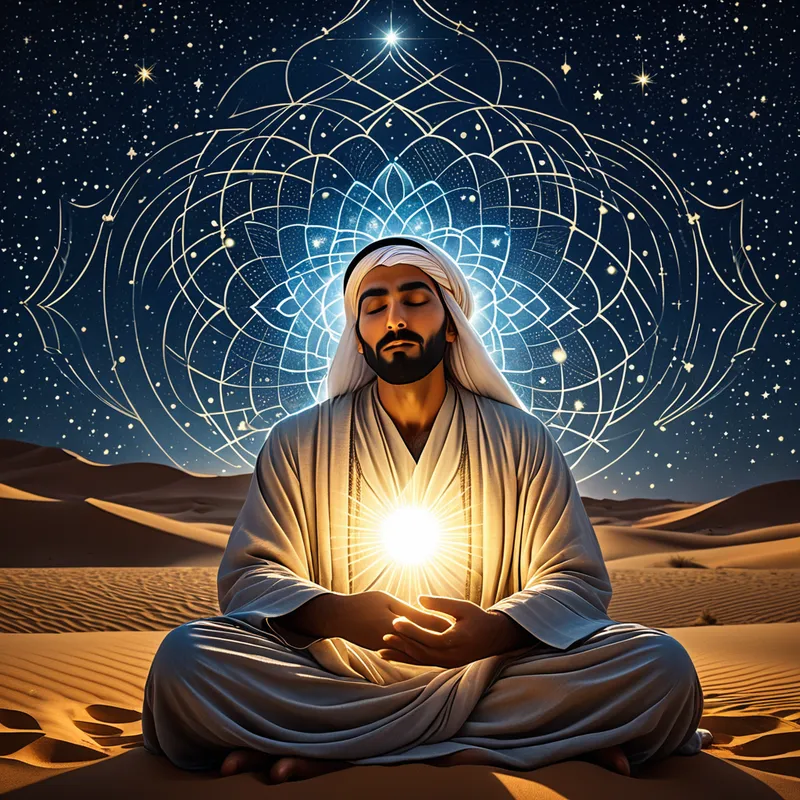
One evening, as the sun bled into the western hills, the young seeker walked the narrow streets of Seville, but he walked alone in a crowd of one. The chatter of the market, the call of the muezzin—all faded into a distant hum. A profound stillness descended upon him, a silence so vast it had a sound of its own. Then, a light. Not from the sky, but from within the very fabric of things. The walls of the city seemed to breathe, the stones to sing a silent hymn. Before him, the figure of a majestic youth appeared, radiant and terrible in his beauty. This was Khidr, the eternal guide, the green one who walks the path between worlds. Without a word, Khidr extended his hand. In it was not an object, but an entire cosmos—a swirling, living Mandal of light.
“Follow,” the vision seemed to say, not with sound, but by pulling the very core of Ibn Arabi’s being. The journey that began was not across land, but across the landscapes of the soul. He was taken to the `Alam al-Mithal, the World of Imagination, where thoughts have weight and prayers have color. He saw the divine as a boundless, shoreless ocean, and every created thing—every star, every blade of grass, every human heart—was a wave upon that ocean, distinct yet never separate. He witnessed the al-Insan al-Kamil, the Perfect Human, as a living mirror in which the entire universe was reflected.
The climax of his torment and ecstasy came in a vision of overwhelming love. A being of pure light appeared to him—a feminine manifestation of divine wisdom, whom he named Nizam. In her face, he saw the beauty of all creation; in her eyes, the compassion of the Creator. She spoke the doctrine that would become the fire in his heart: “Love is the essence. The lover, the beloved, and the love itself are one.” In that moment, the conflict of his seeking dissolved. The seeker vanished into the sought. The drop returned to the ocean, not by being annihilated, but by realizing it had never been apart. He awoke from this vision not to an end, but to a beginning—his life’s work, the writing of thousands of pages, was now just the feeble attempt to translate that unutterable song into human words.
Cultural Origins & Context
This is not a folk tale born around a campfire, but a living record of direct mystical experience, meticulously documented by Ibn Arabi (1165–1240 CE) himself in his monumental works like The Meccan Illuminations and The Bezels of Wisdom. Born in Murcia during the rich intellectual flowering of Muslim Spain, he was a product of a culture where philosophy, jurisprudence, and mystical yearning coexisted. His “myth” is the core narrative of Sufism, particularly its Akbarian school (named after him, al-Shaykh al-Akbar, the Greatest Master).
The visions were passed down not as oral folklore, but as sacred scripture within Sufi orders. Students would study his dense, poetic texts, and masters would use the narratives of his visions as maps for the inner journey. Its societal function was revolutionary: it provided a metaphysical framework that challenged rigid legalism. It asserted that the ultimate goal was not merely obedience, but a transformative knowing—a ma’rifa—that leads to the realization of unity (tawhid) in its most profound sense. It democratized the divine encounter, suggesting that the potential for such vision lay latent in every human heart.
Symbolic Architecture
The myth is a masterclass in the symbols of inner transformation. Ibn Arabi himself is the archetype of the Salik, the wayfarer. His journey is not to a physical Mecca alone, but to the Heart as the sacred center.
The world is a mirror, and every face you see is your own reflection in a different state.
The radiant youth, Khidr, represents the intuitive, direct knowledge that operates beyond formal religious law—the guide of the soul. The vision of the ocean and the waves symbolizes the doctrine of Wahdat al-Wujud, the fundamental unity of all existence. Nizam, the feminine divine, embodies the Feminine Principle often marginalized in exoteric theology, revealing that the divine is both transcendent and intimately knowable through beauty and love. The entire narrative models the dissolution of the ego-self (nafs)—the isolated wave—into the awareness of the True Self (al-Haqq)—the ocean.

The Dreamer's Resonance
When this myth pattern stirs in modern dreams, it signals a profound psychic reorganization. One might dream of merging with a landscape, of seeing their own face in the features of strangers, or of a guide (often an unexpected or luminous figure) offering a key or a map. The somatic experience can be one of overwhelming expansion—a feeling of the body dissolving into light or space, often accompanied by awe or holy fear.
Psychologically, this is the process of the conscious mind encountering the Self archetype. The dreamer is going through a crisis of identity, where old, rigid definitions of “who I am” are being flooded by a much vaster reality. It is the psyche’s innate movement toward wholeness, breaking down the dam of the personal ego to allow the waters of the transpersonal to flow in. This can feel like both a death and a birth.

Alchemical Translation
For the modern individual, Ibn Arabi’s visions model the alchemical Magnum Opus, the process of individuation. The initial nigredo (blackening) is his restless seeking and the dissolution of ordinary perception. The albedo (whitening) is the illuminating encounter with Khidr and the clarity of the imaginal world.
The goal of the path is not to become divine, but to cease pretending you are not.
The final rubedo (reddening) is the unitive vision of love with Nizam—the integration of opposites (masculine/feminine, lover/beloved, human/divine) into a golden, conscious whole. The struggle is the ego’s resistance to its own expansion; the triumph is its graceful surrender. We are invited to transmute our leaden sense of separation into the gold of connectedness. We perform this alchemy not in a laboratory, but in the crucible of our own awareness, learning to see the world not as a collection of dead objects, but as the living, breathing self-disclosure of the Real. The mystic’s vision becomes the psychologist’s integration: to behold the universe within and the Self without, and to know them as one.
Associated Symbols
Explore related symbols from the CaleaDream lexicon:
- Ocean — The central symbol of Ibn Arabi's vision of Wahdat al-Wujud; it represents the boundless, undifferentiated reality of the Divine Essence from which all individual beings arise as temporary waves.
- Mirror — Symbolizes the heart of the Perfect Human and all of creation, which reflects the attributes of the Divine; to know oneself is to polish this mirror.
- Light — Represents divine knowledge (ilham) and the illuminations (futuhat) that flood the seeker's consciousness, dissolving shadows of separation.
- Love — The essential force and ultimate goal of the mystical journey; in the myth, it is the realization that lover, beloved, and love are a single, unbroken reality.
- Journey — The suluk or spiritual path, which is an inward voyage through the stations of the heart and the realms of visionary experience, not a physical pilgrimage.
- Door — The threshold of perception, such as the moment of stillness before the vision begins; it represents the passage from the mundane world to the `Alam al-Mithal, the imaginal realm.
- Heart — The mystical organ of perception and the throne of the Divine; it is the battlefield where the ego-self is subdued and the site where unitive knowledge is revealed.
- Vision — The direct, unmediated experience of divine realities, which for Ibn Arabi was not metaphorical but a concrete perception in the "eye of the heart."
- Star — Often appears as the initial point of divine contact or guidance, symbolizing the spark of the transcendent that calls the soul from its slumber in the material world.
- Mystical Temple — Represents the inner, subtle body or the perfected human form (al-Insan al-Kamil), which is the true house of worship where all opposites are reconciled.