Hypnos and Oneiroi Myth Meaning & Symbolism
The myth of Hypnos, god of sleep, and his sons the Oneiroi, who shape our nightly visions from their cave beyond the sunset.
The Tale of Hypnos and Oneiroi
Beyond the western horizon, where the sun’s chariot plunges into the wine-dark sea, lies a realm untouched by its light. Here, at the world’s forgotten edge, a cavern yawns wide. No birdsong or rustling leaf breaks its silence, only the gentle, ceaseless murmur of the river Lethe, whose waters coil like a sleepy serpent at the cave’s mouth. This is the domain of Hypnos.
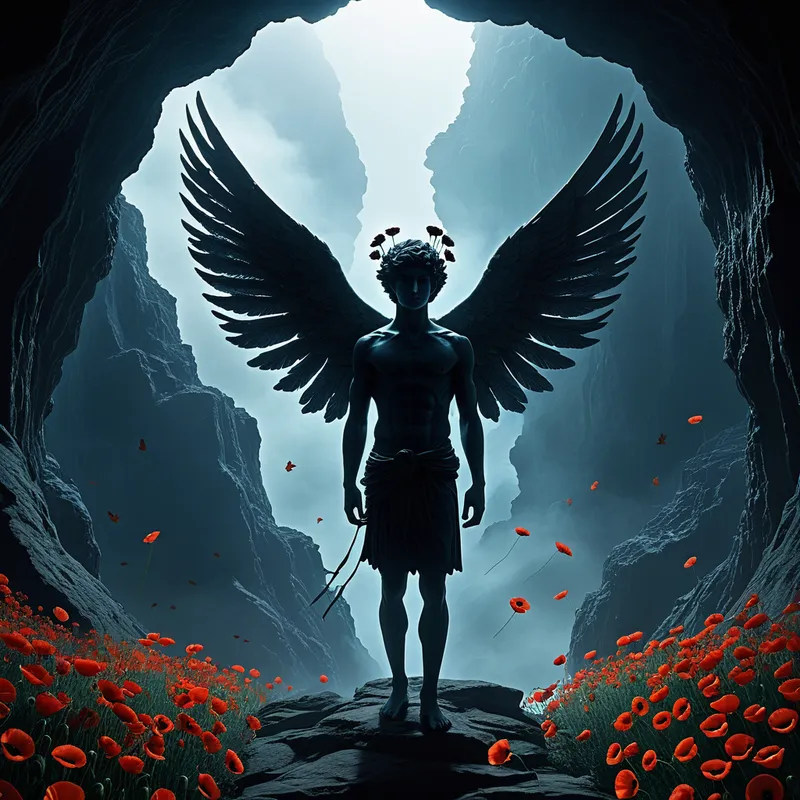
Within, on a couch draped in deepest indigo and sown with the silken petals of poppies, rests the god himself. He is youth eternal, beautiful and calm, with wings of darkest down sprouting from his temples or his shoulders, depending on the teller’s fancy. In his hand, he sometimes holds a horn from which he pours a slumber so potent it can still the heart of a god. Around him, the air is thick and sweet, heavy with the promise of oblivion.
From the shadows of this cavern, his children are born. They are the Oneiroi, a thousand shapes with a thousand names, but three who stand apart. They are winged daimons, spirits of the threshold between worlds. When the veil of day is drawn, Hypnos stirs, and from the cave’s depths, the Oneiroi take flight, passing through one of two gates.
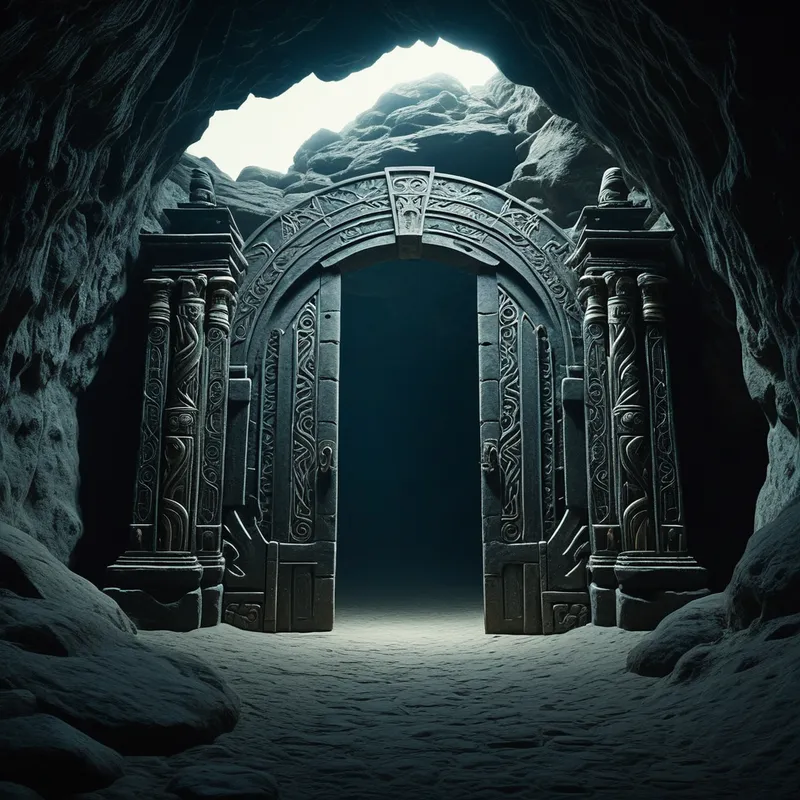
The first gate is fashioned of polished horn. Through this portal pass the dreams that are true, the visions that speak of what is or what will be. They are the messengers of the gods themselves, or the soul’s own deep knowing given form. The second gate, carved from dull, porous ivory, is the passage of falsehood. From it stream phantoms and fantasies, the mind’s idle chatter, the fears and desires woven into tantalizing, empty shows.
Chief among these dream-spirits are Morpheus, he of form; Phobetor, he of fear; and Phantasos, he of fantasy. Morpheus is the master shaper, the one who can mimic any human form, who appears in the sleeper’s mind as a beloved, a stranger, or a king, bearing true tidings. Phobetor takes the shape of beasts—serpents, lions, monsters—to embody our primal terrors. Phantasos crafts the inanimate illusions: the shifting earth, the crumbling rock, the flowing water of a dreamscape unmoored from logic.
They fly on silent wings over the sleeping world, entering not through the ears or eyes, but through the keyhole of the soul. To a king, Morpheus might come with a warning wrapped in a familiar face. To a shepherd, Phobetor might bring the shadow of the wolf. And to all, Phantasos spins his endless, bewildering tapestries from the day’s discarded threads. They are the weavers of the night, the silent playwrights of our most private theaters, serving the will of their serene father, Hypnos, who holds the sacred charge of granting respite—and revelation—to all beneath the stars.
Cultural Origins & Context
This vision of sleep and dreams as a divine, structured ecology emerges from the rich soil of ancient Greek thought, most famously preserved in Hesiod’s Theogony and given narrative life in Homer’s Odyssey. In Book 19 of the Odyssey, Penelope speaks of the two gates, establishing the core dichotomy that would resonate for centuries. For the Greeks, dreams were not random neurological events but meaningful communications, a legitimate mode of encountering the divine or the deeper layers of reality.
The myth functioned as a profound cosmology of the inner world. In a culture without our modern psychological frameworks, it provided a map for the bewildering nightly journey. It answered the urgent question: Is this dream a message to heed, or merely a phantom to dismiss? The myth was likely told in symposia, by hearths, and perhaps in healing sanctuaries like those of Asclepius, where “incubation”—ritual sleep for receiving curative or prophetic dreams—was practiced. It gave shape to the invisible, naming and personifying the forces that visited every person, from emperor to slave, in the universal democracy of the night.
Symbolic Architecture
The myth of Hypnos and the Oneiroi is a masterful symbolic architecture for the human psyche’s relationship with the unconscious. Hypnos himself represents not mere rest, but the necessary threshold state. He is the liminality required for the conscious mind to step aside, allowing other, older forms of intelligence to emerge.
Sleep is the lowered drawbridge over which the emissaries of the deep self may cross into the citadel of the waking mind.
The Cave symbolizes the womb of the unconscious itself—a hidden, fertile, and potentially chaotic place of origin. The two gates, of horn and ivory, represent the fundamental human dilemma of discernment. Horn (keras in Greek) was associated with truth because it is a translucent material; ivory (elephas) with falsehood, as it is opaque. This is not a simple judgment of “good vs. bad” dreams, but a categorization of origin and intent. True dreams (horn) emerge from a place of psychic integrity or transpersonal guidance; false dreams (ivory) from the personal complex, the day’s residue, the ego’s unfinished business.
The triad of Oneiroi—Morpheus, Phobetor, Phantasos—maps the primary languages of the unconscious: Personification (Morpheus), Instinct/Shadow (Phobetor), and Symbolic Landscape (Phantasos). Together, they are the full spectrum of dream content, the means by which the ineffable inner world communicates in forms the dreaming ego can perceive.
The Dreamer's Resonance
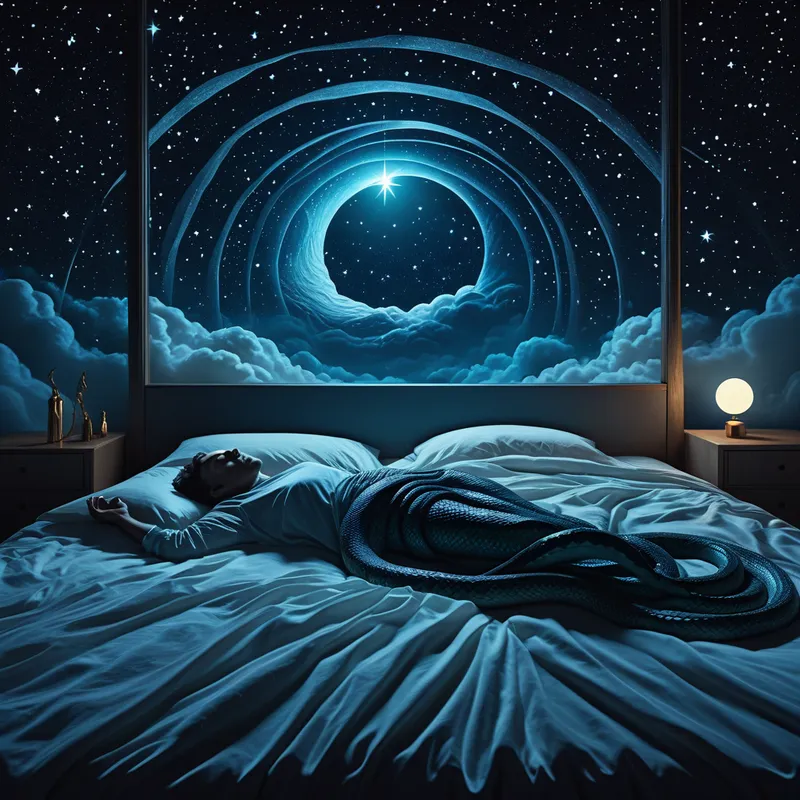
When a modern dreamer encounters the pattern of this myth—perhaps by dreaming of a profound, message-bearing figure (Morpheus), a terrifying chase by a beast (Phobetor), or a surreal, shifting environment (Phantasos)—they are participating in this ancient psychic process. The somatic experience is key: the paralysis of sleep, the rapid heartbeat of a nightmare, the awe of a numinous vision. These are the physiological signatures of the Oneiroi at work.
To dream of a guiding figure or a clear warning is to have approached the Gate of Horn. The psyche is attempting to integrate a truth, often one the waking self resists. To dream of monsters and chaos is to have Phobetor as a visitor from the Gate of Ivory; here, the somatic terror is the body processing unintegrated fear, trauma, or repressed instinct. The dream is not the problem but the process—the psyche’s attempt to metabolize what is too potent for daylight consciousness. The myth reminds us that every dream, true or false, is an act of psychic hygiene, a nightly council held in the cave of self.
Alchemical Translation
For the modern individual on the path of individuation—the alchemical process of becoming whole—this myth provides a precise model for psychic transmutation. The first step is the voluntary descent into the “cave,” the conscious engagement with the unconscious. This is the embrace of introversion, meditation, or active imagination—creating the “Hypnos state” of receptive quiescence.
The core alchemical work is the discernment at the gates. As dreams and unconscious content arise, we are tasked with the opus of differentiation. Is this image a true symbol emerging from the Self (horn), guiding toward greater wholeness? Or is it a complex-driven illusion (ivory), a symptom of wounding that needs to be made conscious and integrated? This is not intellectual analysis, but a feeling-into the dream’s numinosity and its connective tissue to waking life.
The alchemist’s furnace is the cave of sleep; their prima materia is the raw dream image. The gold they seek is the insight that transmutes leaden repetition into conscious choice.
Finally, engaging with the Oneiroi is engaging with the very fabric of the psyche. To dialogue with the Morpheus-figure is to integrate disowned parts of our personality. To befriend the Phobetor-beast is to reclaim our instinctual power and shadow. To navigate Phantasos’s landscape is to learn the symbolic language of our own soul. In doing so, we do not conquer sleep or dreams, but we become conscious collaborators with Hypnos. We honor the cave, learn the language of the gates, and in doing so, transform the nightly mystery from a passive occurrence into an active, sacred dialogue with the source of our own being.
Associated Symbols
Explore related symbols from the CaleaDream lexicon: