Hyldemoer Myth Meaning & Symbolism
A myth of the sacred elder tree spirit, embodying ancestral memory, the sanctity of the home, and the profound consequences of violating a sacred bond.
The Tale of Hyldemoer
Listen, and hear the whisper in the grain of the wood, the sigh in the rafters of the old house. This is not a tale of gods who shake the sky, but of a spirit who dwells in the hearth-smoke and the shadow under the bed. Her name is Hyldemoer, and she is the soul of the elder tree.
In the days when every grove had a voice and every stream a song, the elder was queen of the hedge-row. To cut her without cause was to invite a curse. To ask with respect, to explain your need, was to receive her blessing. For Hyldemoer was a guardian, a vættr of the threshold between the wild wood and the human dwelling. She watched over the home, especially the children who slept in cradles carved from her wood.
There was a man, a farmer with a new-born son. His heart was full of pride, but his mind was hollow of the old ways. Needing wood for a cradle, he went to the elder grove. He saw a tree, straight and strong, and raised his axe without a word of prayer, without a drop of offering. The first bite of iron into bark echoed like a gasp. The second struck deep, and from the wound, not sap, but a dark substance like blood welled forth.
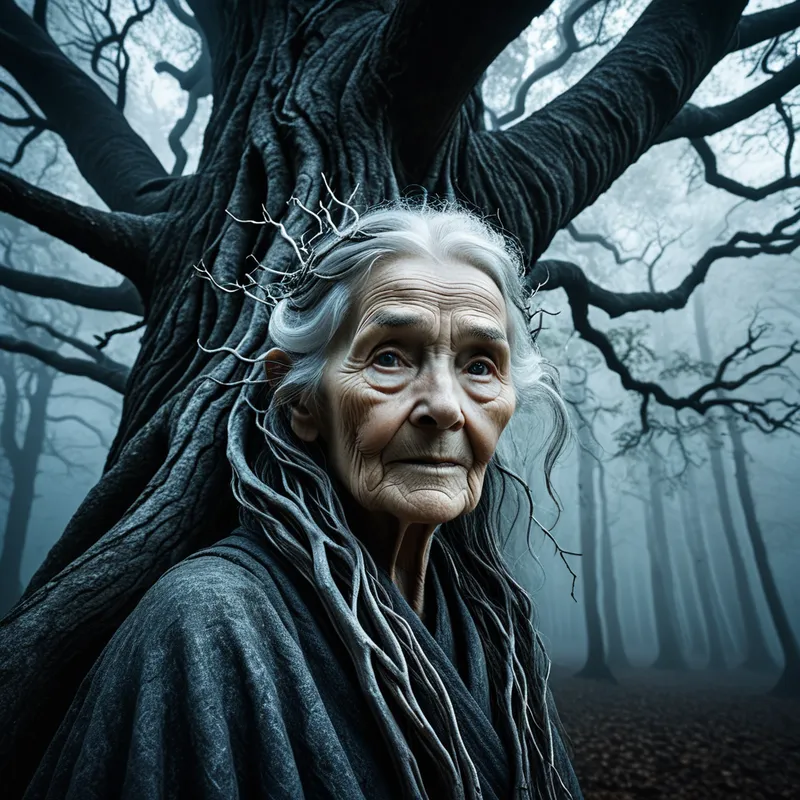
That night, in his house, the new cradle held his child. The fire in the hearth spat and crackled with unease. As the moon rose, a presence filled the room—not a shape, but a feeling of profound, sorrowful anger. From the very grain of the cradle, a form coalesced: the Hyldemoer, her face the texture of ancient bark, her eyes pools of deep, green shadow. She did not roar; her silence was more terrible. She reached for the child, not to harm, but to claim. For the cradle was now hers, born of violence and disrespect, and all within it fell under her law.
The child began to wail, a sound that chilled the parents’ blood. They awoke to see the spectral form bending over the cradle, a whisper of leaves and lamentation in the air. The father, realizing his trespass, fell to his knees. He poured out words of apology, of shame, promised offerings of milk and honey, swore to plant ten trees for the one he maimed. His words, born of true fear and recognition, hung in the air.
The spirit paused. Her gaze shifted from the child to the weeping man. The law was clear: a violation required recompense. But the law also knew the weight of a sincere oath. Slowly, the green light in her eyes softened. She laid a hand, which felt like cool moss, upon the child’s brow. The wailing ceased, replaced by peaceful sleep. Then, she faded, leaving behind the scent of damp earth and elderflower, and a warning that lingered in the very timbers of the house: Remember. All things have spirit. All bonds require honor.

Cultural Origins & Context
The myth of Hyldemoer springs not from the grand Poetic Edda, but from the living folk tradition of the Norse and wider Germanic world. This was the mythology of the hearth, not the hall of Odin. Passed down through generations by mothers, grandmothers, and farmers, it was a practical spirituality woven into daily life. The elder tree (Sambucus nigra) was a pharmacy and a protector; its berries and flowers were medicine, its wood was used for toys and tools, but always with strict ritual.
The telling of this tale served a vital societal function: it encoded ecological ethics and domestic law. It taught that resources were not merely taken, but negotiated with. It established the home, and particularly the children’s space, as a sacred precinct under the protection of local spirits. Violating this compact wasn’t just bad luck; it was a moral failure that invited direct, supernatural consequence. The myth acted as a social regulator, ensuring respect for the environment and reinforcing that safety was maintained through right relationship, not force.
Symbolic Architecture
At its core, Hyldemoer is the archetype of the Sacred Guardian of the Interior. She is not a wilderness spirit like a mountain jötunn; she is the spirit of the domesticated wild, the tree that consents to become part of the human home. Her myth maps a profound psychological truth: the structures that contain and nurture our most vulnerable selves (our "inner child") are sacred and must be built with consciousness.
The guardian spirit is invoked not by the act of building, but by the reverence offered during the gathering of materials. The psyche knows the difference between construction and creation.
The cradle is the perfect symbol—it holds nascent life, the future, in a vessel made of the past (the tree). To build it through violation poisons the container itself. Hyldemoer’s retribution—claiming the child—is not evil, but the natural law of the psyche asserting itself. When we build our inner security, our self-care, or our relationships on a foundation of disrespect (towards ourselves, others, or nature), that foundation will eventually assert its claim, often as anxiety, depression, or a profound sense of alienation. The spirit’s eventual mercy, upon hearing the sincere oath, symbolizes the psyche’s capacity for reconciliation when true acknowledgment and amendment are offered.

The Dreamer's Resonance
To dream of Hyldemoer is to encounter the deep, somatic intelligence of the ancestral and ecological unconscious. Modern manifestations may not feature a tree-woman, but the pattern is unmistakable.
You may dream of your house—your psyche’s dwelling—being invaded by slow, growing roots or vines. Furniture may be made of living, pulsing wood. A child in the dream (often your younger self) may be in a room that is becoming a forest. The somatic feeling is one of pressure, of a silent, patient, but immense presence demanding attention. This is the Hyldemoer complex activating: a part of your foundational self, perhaps a talent, a trauma, or a neglected inner child that you "built over" without respect, is now asserting its claim. It is the psychological equivalent of the violated tree bleeding. The dream is a summons to identify the original trespass—the ignored intuition, the dismissed need, the exploited relationship—and to begin the process of making right.

Alchemical Translation
The alchemical journey modeled by the Hyldemoer myth is the transmutation of neglect into sacred guardianship. It is a process of psychic housekeeping at the deepest level.
The initial state is nigredo, the blackening: the violent cut, the unconscious exploitation of one’s own resources or the world’s. This creates a poisoned vessel (the cradle), representing a life structure built on a fractured foundation. Hyldemoer’s appearance is the albedo, the whitening: the shocking, clarifying emergence of the consequence into conscious awareness. The spirit’s silent claim is the truth we have been avoiding, now made palpable.
The oath sworn by the father is not a bargain, but a surrender to a higher law. It is the ego yielding to the demands of the Self, agreeing to the labor of reconstruction.
This oath is the beginning of citrinitas, the yellowing, the hard work of amendment—the planting of new trees, the daily offerings. It is the conscious practice of respect, the therapy, the reparations, the changed lifestyle. Finally, the spirit’s touch of peace upon the child is the rubedo, the reddening. It signifies the integration of the neglected part. The violated tree and the vulnerable child are reconciled within a new, conscious whole. The home is no longer just a shelter, but a truly sacred space, because its guardian has been acknowledged and honored. The individual learns that true power and safety do not come from taking, but from the profound and reciprocal bond of care—for one’s own soul, for others, and for the living world that sustains it all.
Associated Symbols
Explore related symbols from the CaleaDream lexicon: