
Hygeia Myth Meaning & Symbolism
The myth of Hygeia, daughter of Asclepius, embodies the profound principle of health as a sacred, holistic state of being, not merely the absence of disease.
The Tale of Hygeia
Listen, and let the scent of crushed herbs and clean stone fill your mind. In the hush before dawn, where the mountain mist clings to the sacred groves of Asclepius, there walks a presence quieter than the fall of a leaf, yet more vital than the beating heart. Her name is Hygeia. She is not found in the clamor of battle, nor in the thunderous councils on Olympus. Her domain is the breath drawn deep into healthy lungs, the cool touch of a hand on a fevered brow, the strength in a limb that moves without pain.
She is the daughter of the great healer, but her work begins where his scalpel and poultice end. While Asclepius receives the wounded and the stricken at his asclepeia, Hygeia walks among the living. Her footsteps trace the paths of clean water sources. Her gaze blesses the stores of grain, ensuring they are free from blight. She is the spirit in the disciplined exercise of the body in the gymnasium, and the wisdom that chooses simple, nourishing food over gluttony. Her sacred animal, the serpent, drinks from her bowl not as a creature of poison, but as a symbol of the cyclical, renewing power of life itself.
The conflict she faces is not against a monstrous foe, but against the slow, creeping shadows of neglect, imbalance, and miasma—the spiritual pollution born of decay and disorder. Her rising action is the daily, unheralded practice: the sweeping of the hearth, the washing of the hands, the mindful preparation of a meal, the prayer for continued well-being. It is a silent war against chaos waged in the home, the city’s fountain, and the individual soul.
Her resolution is not a single, glorious victory, but a sustained state of grace. It is the city that does not fall to plague. It is the family that thrives through the seasons. It is the individual who awakens each day with a body and spirit in harmonious accord. Hygeia’s triumph is the quiet hum of a life lived in right relationship with itself and its world, a testament that the greatest power often resides not in curing the catastrophic break, but in nurturing the unbroken whole.
Cultural Origins & Context
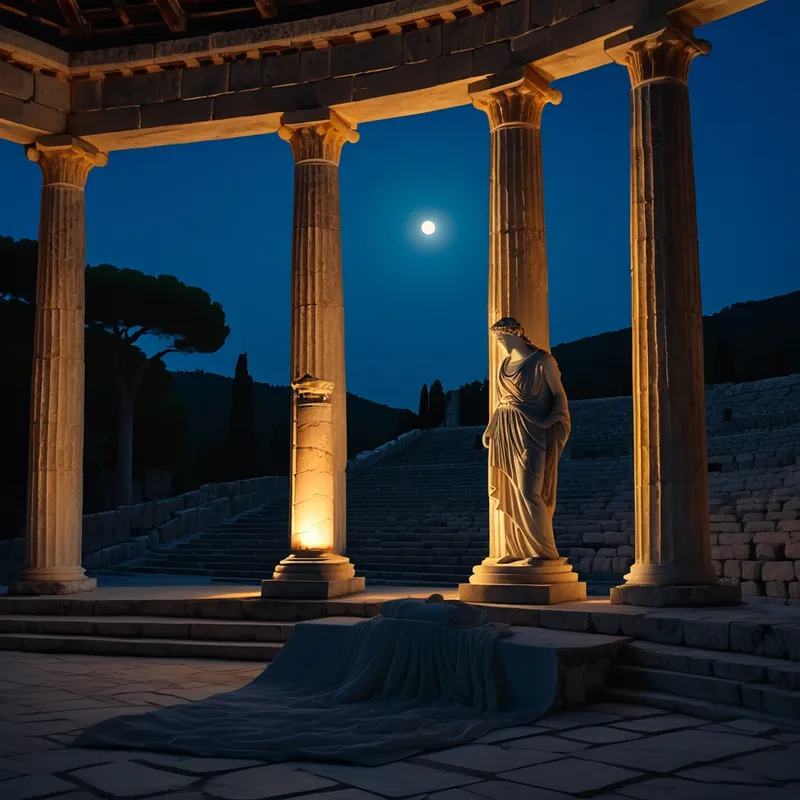
Hygeia’s worship was deeply woven into the practical and spiritual fabric of daily Greek life, emerging prominently around the 5th century BCE alongside the formalization of her father’s cult. While Asclepius presided over the dramatic temple medicine of the asclepeia—where the sick underwent incubation to receive dream-visions from the god—Hygeia represented the foundational, preventative principles that made such healing possible and sustainable.
She was a civic deity as much as a personal one. Her statues stood alongside Asclepius in his sanctuaries, like at the famous site of Epidaurus, but her influence extended to the agora and the home. City-states honored her to ensure public health, linking cleanliness and good order (eunomia) directly to divine favor. Her cult was less about episodic intervention and more about cultivating a permanent, sacred condition. She was invoked in oaths concerning health and was a symbol of the philosophical ideal of eudaimonia, which required physical well-being as a cornerstone of the good life. The myth was passed down not as a single epic narrative, but through hymns, votive offerings, and the daily practices she sanctified, making her a constant, subtle presence in the Greek worldview.
Symbolic Architecture
Hygeia is not the goddess of healing; she is the goddess of health. This is her profound symbolic core. She represents the precondition, the fertile ground from which life flourishes. Her symbolism is an architecture of wholeness, prevention, and sacred maintenance.
Health is not a trophy won after battle with disease, but the sacred, silent temple in which the soul resides.
Her primary symbol, the serpent drinking from a bowl, is a masterful encapsulation of this. The serpent, often associated with death and poison in other contexts, is here transformed. It represents the chthonic, instinctive, and renewing powers of life (via its shedding skin) being tempered, directed, and nourished by the vessel of culture, discipline, and conscious care (the bowl). The act is one of integration, not expulsion. Hygeia herself symbolizes the principle of holistic balance—the harmony of body, mind, and environment. She is the pharmakon not as drug, but as the right measure, the regimen. Psychologically, she represents the ego’s capacity for self-regulation, hygiene of thought, and the nurturing of psychic integrity that prevents the “outbreak” of neurosis or possession by unconscious contents.

The Dreamer's Resonance
When the archetype of Hygeia stirs in the modern unconscious, it rarely appears as a named goddess. Instead, it manifests as a profound somatic or environmental motif in dreams. To dream of Hygeia is to dream of the foundation.
You may dream of discovering a hidden, pristine spring in a neglected backyard, or of meticulously cleaning a long-abandoned, beautiful room. You might dream of feeding a wild but calm animal, or of a serpent coiling peacefully around your arm without fear. These dreams often carry a palpable feeling of relief, rightness, and calm vitality. Conversely, her absence or the violation of her principle appears as dreams of polluted water sources, rotting food in a supposedly full pantry, or a beautiful house with a cracked, unstable foundation.
Psychologically, these dreams signal a process of attending to the fundamentals. The dreamer is being called to examine the basic regimens of their life: sleep, diet, mental input, emotional hygiene, and the health of their immediate environment. It is a call for preventative “soul-care,” addressing small cracks before they become catastrophic breaks. The process is somatic—a deep, bodily knowing that a return to simple, nourishing order is the prerequisite for any more complex psychological or spiritual work.

Alchemical Translation
In the alchemical journey of individuation, Hygeia represents the crucial, often overlooked stage of ablutio—the washing and the albedo—the whitening. Before the soul can confront its shadow (the nigredo) or achieve transcendent union (the rubedo), its vessel must be clean, strong, and properly ordered.
The transmutation of the psyche begins not with grand quests, but with the sacred maintenance of the vessel that contains the work.
The modern individual, obsessed with dramatic breakthroughs and curative “fixes,” often bypasses this Hygeian stage at great cost. The alchemical translation of her myth is the practice of psychic hygiene. This is the daily, disciplined work of integrating the “serpent” of our instinctual, bodily, and unconscious energies (our libido, our appetites, our raw vitality) by offering it the “bowl” of conscious structure, ritual, and mindful care. It is creating a regimen for the soul: periods of digital silence, conscious consumption of media and information, regular communion with nature, and practices that ground spirit in body.
Her myth models that triumph is a sustained state, not a single event. The goal is not to slay the dragon of illness, but to cultivate a life where the dragon peacefully drinks from your hand, its power integrated into your wholeness. To honor Hygeia is to understand that the most profound alchemy is the slow, steady cultivation of a life so whole and balanced that it becomes, in itself, the ultimate healing and the greatest spiritual achievement.
Associated Symbols
Explore related symbols from the CaleaDream lexicon: