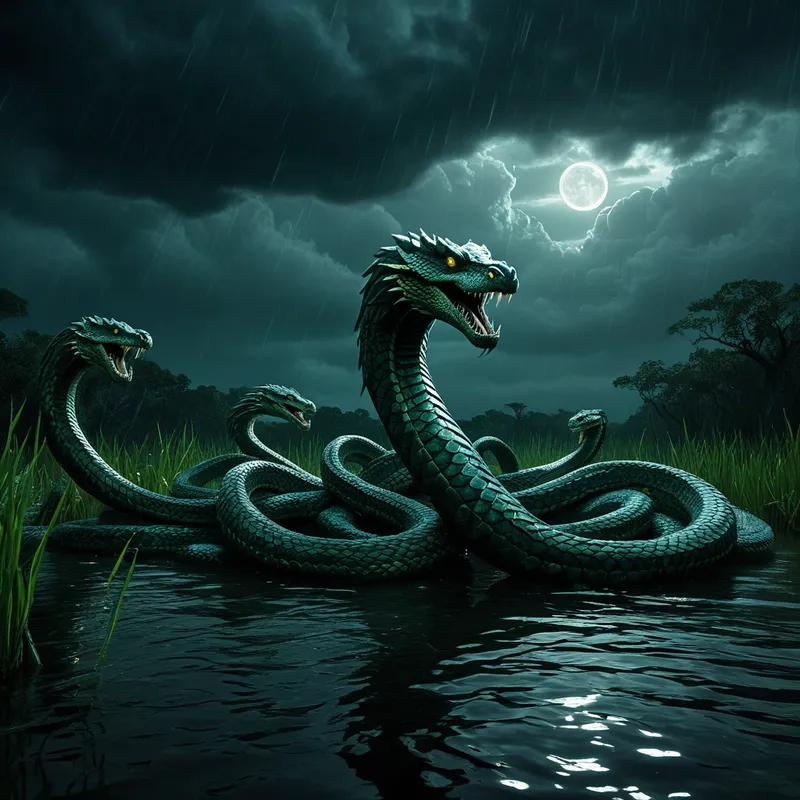
Hydra Myth Meaning & Symbolism
Heracles battles the Lernaean Hydra, a regenerating serpent, learning that to defeat a multiplying problem, one must cauterize its source.
The Tale of Hydra
Hear now of the second labor, a task born not of glory, but of penance. In the shadowed, miasmic swamps of Lerna, where the air hangs thick with the breath of decay and the waters of the spring Amymone run dark, a terror had taken root. It was the Hydra, child of monstrous Typhon and Echidna. Its form was a blasphemy against life itself: a serpentine body, thick as an ancient tree, and from its neck sprouted not one, but nine heads that writhed and hissed in dreadful unison. The center head was immortal, forged of a substance no mortal blade could mar, and its breath was a poison that could wither the land.
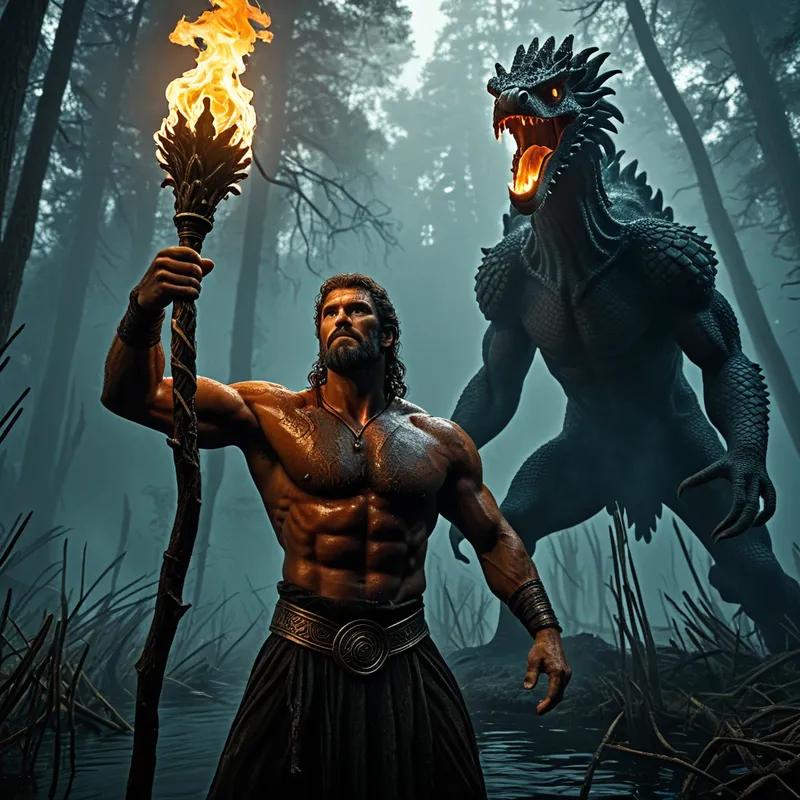
The hero Heracles, clad in the impenetrable skin of the Nemean Lion, approached the fetid bog. The stench of rot was a physical wall. With him came his young nephew, Iolaus, whose loyalty was a flickering torch in that place of despair. To draw the beast out, Heracles shot flaming arrows into its watery den. The Hydra emerged, a cascade of scaled horror, its multiple eyes fixing on the intruder with a single, ancient malice.
The battle was joined. Heracles, his club a blur, smashed one mighty head. But as the ichor spilled, a cold dread seized him. From the bleeding stump, two new heads sprouted, hydra-teeth sown in its own blood. He severed another, and two more grew. The monster multiplied with every blow, its forms becoming a forest of hissing, venom-dripping serpents that coiled around his limbs. The swamp itself seemed to aid the beast, a giant crab sent by Hera snapping at his heels. Desperation clawed at him. To fight in the old way was to be overwhelmed, to be buried beneath the very problem he sought to solve.
Then, a flash of insight, born of partnership. Heracles called to Iolaus. As the hero, with titanic effort, lopped off a head, the youth stepped forward with a burning brand. The fire kissed the raw, pulsing wound. The sizzle of seared flesh cut through the hissing, and the smell of burning venom filled the air. No new head grew. Stroke by cauterizing stroke, they worked, a gruesome dance of destruction and sealing. Finally, only the immortal head remained, twisting and undying. Heracles buried it deep beneath a colossal rock, a weight to hold eternity at bay. He dipped his arrows in the Hydra's venom, a final, terrible harvest from the beast, ensuring its poison would now serve his future quests.
Cultural Origins & Context
This myth was not a fireside fancy but a foundational strand in the cultural fabric of the ancient Greek world. It was canonized as the second of the Twelve Labors of Heracles, a cycle of stories that functioned as a national epic of endurance and civilization. The poet Hesiod gave it early form in his Theogony, placing the Hydra within the genealogy of primordial monsters. Later, it was elaborated by mythographers and dramatized in lost plays.
The setting of Lerna was significant; it was an ancient, pre-Greek site of mystery and chthonic power, a place of springs and a supposed entrance to the Underworld. To place the Hydra there was to locate the struggle at the very threshold of the unknown and the chaotic. The myth served a societal function as a parable of heroic arete (excellence), but also as a warning. It taught that some threats—like political strife, plague, or moral decay—do not yield to simple, brute force. They require strategy, innovation, and often, the crucial aid of a trusted companion. The labor was deemed "impure" by King Eurystheus because of Iolaus's help, underscoring the Greek tension between individual glory and the pragmatic necessity of collaboration.
Symbolic Architecture
The Hydra is the quintessential symbol of the problem that grows when attacked directly. It is the psychological pattern of repression, where pushing down one fear or anger only causes it to morph and resurface in new, often more virulent forms.
The Hydra does not represent a single trauma, but the process of trauma's regeneration. To fight it head-on is to feed it.
Each head can be seen as a distinct, yet connected, aspect of a complex neurosis: one head of rage, another of shame, a third of envy, all sprouting from the same core wound. The immortal head is the core complex itself—the foundational, often unconscious belief or memory that feels eternal and unkillable. The swamp is the murky, emotional substrate of the unconscious where such monsters breed. The crab, sent by Hera, represents the unexpected, sideways attacks from our own psyche or life circumstances when we are deeply engaged in a primary struggle—the ancillary anxieties that pinch at our focus.
Heracles’s initial method—the club—is the ego’s default: forceful suppression, willpower, direct confrontation. Its failure is the myth’s central lesson. The shift to sword and fire, with Iolaus’s aid, symbolizes the integration of a new psychic function: the sword is discernment (cutting through), and the fire is the transformative, purifying power of conscious awareness applied immediately to the wound. It is the act of witnessing a painful emotion without identification, thereby preventing it from taking new, disguised forms.
The Dreamer's Resonance
When the Hydra slithers into modern dreams, it signals a confrontation with a multiplying psychological challenge. The dreamer may be battling a situation at work that spawns new problems with every solution attempted, or navigating a relationship where one resolved argument immediately births two more.
Somatically, this dream often accompanies a feeling of being overwhelmed, of fighting a losing battle, a tightness in the chest and throat—the sensation of being choked by one’s own proliferating concerns. Psychologically, the dreamer is at the pivotal point where the ego’s standard strategies are failing. The dream is the psyche’s dramatic presentation of this deadlock. The appearance of a helper figure (an Iolaus) in the dream is crucial; it may represent an actual supportive person, a new skill, or an emerging aspect of the dreamer’s own psyche (like intuition or compassion) that must be enlisted. To dream of successfully cauterizing a stump is to experience, in symbol, the nascent possibility of a new and effective inner approach.

Alchemical Translation
The labor against the Hydra is a precise map for the alchemical stage of solutio (dissolution) and coagulatio (coagulation), the breaking down and reconstitution of the psyche. The initial, failed attacks represent the nigredo, the blackening—the despair and confusion when old ways shatter.
The immortal head is never destroyed, only buried. The goal of individuation is not the annihilation of our core complexes, but their conscious containment and integration.
Heracles’s journey is the individual’s path of individuation. He begins with brute strength (unconscious identification with the ego) and must learn a more sophisticated, conscious artistry. Iolaus represents the transcendent function—the mediating third that arises between the battling opposites of hero and monster, conscious and unconscious. The fire is the ignis of the alchemists, not destructive hellfire but the illuminating, transforming flame of sustained attention and insight.
For the modern individual, this translates to a fundamental shift in dealing with persistent inner or outer conflicts. When faced with a "hydra," the instruction is to pause the frantic cutting. Instead, one must first identify the "immortal head"—the root belief or fear. Then, with the "fire" of mindful awareness and often with the support of a "Iolaus" (a therapist, a practice, a community), one learns to meet each emerging "head"—each symptomatic thought or emotion—not with suppression, but with immediate, compassionate witnessing. This severs its connection to the regenerative power of the unconscious complex. The final act is to honor, not hate, the immortal core; to bury it under the "heavy rock" of conscious acknowledgment, where it becomes a source of depth rather than a multiplying terror. The poisoned arrows harvested afterward signify that our greatest wounds, once integrated, become the source of our most potent strengths and discernments in navigating the world.
Associated Symbols
Explore related symbols from the CaleaDream lexicon: