
Hyades Myth Meaning & Symbolism
Sisters transformed into stars for weeping over their brother, the Hyades embody the alchemy of grief into life-giving rain and cosmic order.
The Tale of Hyades
Hear now a story written not on parchment, but across the vault of the night sky. It begins not with a shout, but with a sob—a sound so deep it drew the attention of the earth and the heavens alike.
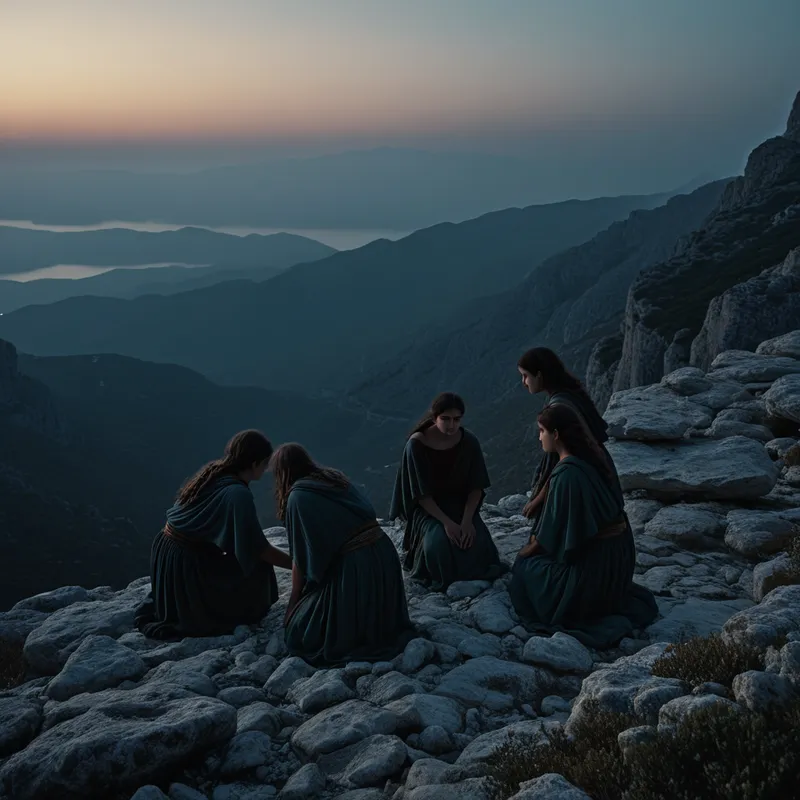
In the wild, thyme-scented hills of Boeotia, there lived five sisters, daughters of the mighty Atlas, who bears the weight of the cosmos on his shoulders, and Aethra, an ocean nymph whose blood was the deep blue of the abyss. Their names were Phaeo, Phaeote, Eudora, Koronis, and Kleis. But to the world, they were the Hyades, and they had a brother they cherished above all else: Orion, or in some tellings, the youth Hyas, a hunter of great skill and beauty.
The sisters’ days were woven from sunlight and laughter, tracking their brother through forests, sharing the spoils of his hunt. But the Fates cut threads with indifferent shears. Hyas, venturing too far in pursuit of a boar or a lion—the stories vary, but the outcome is tragically constant—met his end. His lifeblood seeped into the thirsty soil, and silence fell where his voice had been.
When the news reached the sisters, their world shattered. Their grief was not a quiet, private thing. It was a torrent. They wept until the hills echoed with their lament. They refused sustenance, refused solace. Their tears fell upon the cracked earth, and where they landed, the dust drank deeply. They wept for days that bled into weeks, their sorrow so vast and pure it became a force of nature. It rose from the ground like a mist, a palpable plea that reached the ears of Zeus himself.
The Thunderer, moved by this profound, unending devotion—or perhaps wary of the imbalance such unchecked mourning could cause on his earth—made a decision. He would not erase their pain, for even gods cannot undo love. Instead, he would transmute it. With a gesture that bent the fabric of the sky, he gathered the five weeping sisters. He did not silence them; he elevated their lament. Their bodies dissolved into points of brilliant light, their flowing hair becoming streams of celestial radiance. He set them in the forehead of the Taurus, where they shine as a distinctive, V-shaped cluster.
And still, they weep. But now, their tears are not of mere salt water. They are the tears of the sky itself. When their constellation rises with the sun in spring and sets in autumn, the heavens open. Their eternal, compassionate grief becomes the nurturing rains that break the winter’s hold and water the seeds in the soil, giving life in the name of the brother they lost.
Cultural Origins & Context
The myth of the Hyades is a foundational star-lore, a etiological myth deeply embedded in the agrarian rhythm of the ancient Greek world. Their name itself is poetically derived from the Greek verb hyein, “to rain.” This was not merely a pretty story for shepherds to tell; it was a functional, observational cosmology. Hesiod, in his Works and Days, uses their heliacal rising and setting as the farmer’s immutable calendar: “When the Hyades, strong Atlantides, begin to set… then avoid the sea and storms.”
The myth was passed down through oral epic poetry and later codified by mythographers like Pseudo-Apollodorus. Its primary societal function was twofold. First, it explained a visible, meteorological fact—the rainy seasons associated with the constellation’s movements. Second, and more profoundly, it provided a cultural container for the emotion of grief. It modeled a specific, sanctioned form of mourning: one so powerful it is recognized by the cosmos and ultimately recycled into a community-sustaining force. The sisters’ personal tragedy is absorbed into the celestial order, becoming essential for earthly survival.
Symbolic Architecture
At its heart, the Hyades myth is an alchemical map of grief. The sisters represent the raw, unmediated, and collective experience of loss. Their transformation is not an escape from sorrow, but its sacred integration into a larger system.
The most profound nurturance often springs from a well of personal sorrow. To give life, one must first acknowledge what has been lost.
The key symbols are potent. The tears are the initial, somatic expression of pain—fluid, dissolving, connecting the inner world to the outer. The constellation represents order imposed on chaos, meaning inscribed onto random suffering. It is the pattern that emerges from the storm of emotion, granting perspective and a permanent place in the cosmic story. The rain is the final, transmuted product: grief, through the divine intervention of consciousness (Zeus), becomes nourishment. It is the symbol of emotion recycled into empathy, personal loss transformed into communal sustenance.
Psychologically, the Hyades embody the archetype of the Anima in its nurturing, relational, and emotionally fluent aspect. Their story warns against the repression of deep feeling (which would leave the earth barren) and instead champions a process where emotion is fully felt, witnessed, and ultimately redirected into life-affirming channels.

The Dreamer's Resonance
When the pattern of the Hyades emerges in a modern dream, it seldom appears as literal stars. It manifests as the process the myth describes. The dreamer may find themselves in a state of profound, seemingly endless weeping that feels both personal and cosmic. They may dream of nurturing something—a plant, an animal, a child—with their own tears. The setting is often liminal: a shoreline where the sea meets the land, a window where the interior self meets the outer world, a field parched and waiting.
Somatically, this dream points to a deep psychological process of release and irrigation. The psyche is attempting to water a parched inner landscape—perhaps a neglected talent, a stifled emotion, or a memory held in drought. The grief being processed may not be for a literal person, but for a lost part of the self, a forsaken potential, or an old identity that has died. The dream is a signal that the unconscious is engaging in the necessary, messy, and ultimately fertile work of mourning to clear the way for new growth. It is the body-mind’s way of enacting the celestial alchemy within.

Alchemical Translation
For the modern individual on the path of individuation, the Hyades myth models the crucial stage of solutio—the alchemical dissolution. This is not destruction, but the breaking down of rigid, outworn structures (the isolated self in its fixed state of sorrow) into a fluid, receptive state.
The first step is the acknowledgment of the flood. The sisters do not moderate their grief; they surrender to it completely. In our terms, this is the courageous act of feeling one’s pain fully, without immediate analysis or spiritual bypass. It is the nigredo, the blackening.
Zeus’s intervention represents the arrival of a transcendent function—the Self—which introduces a new perspective. This is the ascent to witness. From the god’s-eye view, personal tragedy is seen as part of a vaster pattern. Psychologically, this is the moment we can step back from identification with our suffering and see it as an event within our story, not the totality of our identity.
The stars are fixed not to imprison, but to provide a constant, guiding pattern in the dark. Our deepest wounds, when constellated, become the maps by which we navigate.
Finally, the transmutation into rain is the act of creative sublimation. The raw material of grief is consciously worked with and offered to the world. The person who has suffered a great loss becomes a compassionate counselor; the pain of isolation fuels a drive for community; personal heartbreak is channeled into art that comforts others. The libido once bound to what is lost is freed to nourish life in new forms. The Hyades teach us that our most profound tears, when raised to the level of conscious, symbolic understanding, do not just water our own roots—they become part of the weather of the soul, essential for the ecology of the whole human experience.
Associated Symbols
Explore related symbols from the CaleaDream lexicon: