
Huītzilōpōchtli Myth Meaning & Symbolism
The hummingbird god's violent birth from the mountain goddess, his defense against cosmic enemies, and his ascent as the sun's warrior.
The Tale of Huītzilōpōchtli
Listen. The world was held in the grip of the Fifth Sun, and upon the sacred mountain, Coatepec, the great mother Coatlicue swept. She was the womb of the earth, her skirt of woven serpents whispering against the stone. As she labored, a single, miraculous ball of hummingbird feathers drifted from the sky, settling upon her breast. From that touch, a new life was conceived within her—a god, whole and complete.
But in the heavens, her other children, the four hundred Centzon Huitznahua, and their fierce sister Coyolxāuhqui, saw this conception not as a blessing, but as a profound dishonor. Their mother’s purity, they believed, was defiled. Fury, cold and bright as starlight, ignited in Coyolxāuhqui’s heart. She rallied her brothers, the legion of the southern stars. “We must cleanse this shame,” she declared, her voice the chill of the night wind. “We must destroy what grows within her.” They took up their weapons—obsidian blades and shields of eagle down—and began their terrible march from the sky to the slopes of Coatepec, an army of celestial vengeance descending upon the mountain of their birth.
Within the mountain, Coatlicue felt the tremors of their approach and the violent kicks of the child in her womb. Fear, a cold serpent, coiled in her belly alongside the god. She was trapped, the mountain both her sanctuary and her tomb.
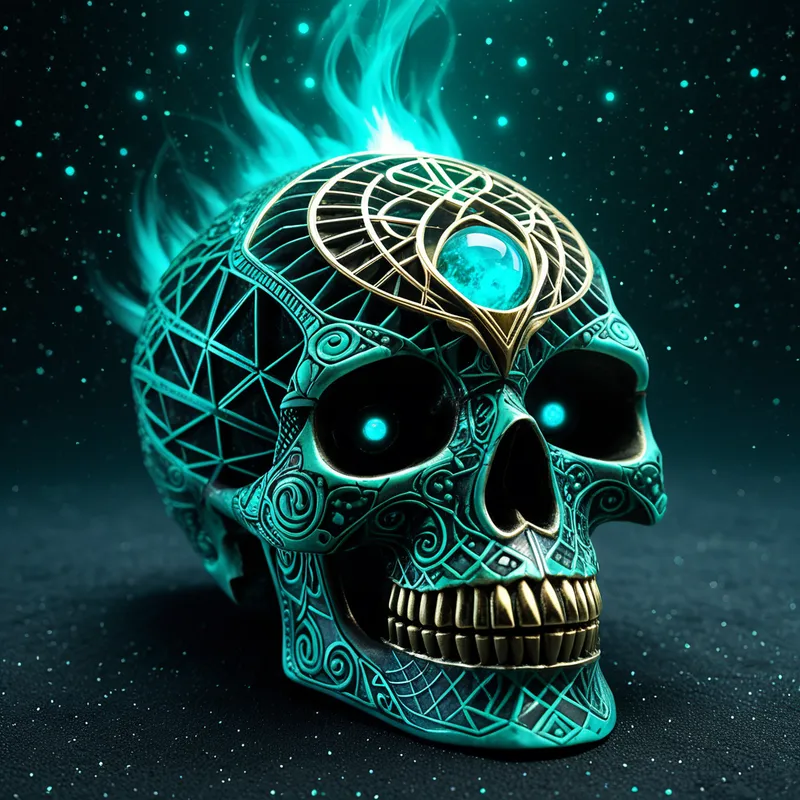
Then, a voice spoke from inside her. It was not the cry of an infant, but the clear, commanding tone of a warrior. “Do not fear, mother. I know what is to be done. I am here.” In that moment, the labor began—not a birth of flesh, but an eruption of will. Fully armed and radiant with the blue light of the noon sun, Huītzilōpōchtli burst forth from his mother’s womb. In one hand, he held the Xiuhcóatl, a serpent of turquoise flame. His body was painted for war, his left foot adorned with the feathers of the hummingbird, the tiny bird whose heart beats with the fury of the sun.
He saw his sister Coyolxāuhqui leading the charge up the mountainside, her beauty now a mask for murderous intent. Without a word, he raised the Xiuhcóatl. Its fire was not mere heat; it was the pure, disintegrating light of truth. He struck her down. Then, with a final, definitive blow, he severed her head. It rolled down the slopes of Coatepec, coming to rest in the dust. Her body, broken and lifeless, tumbled after it. Huītzilōpōchtli did not stop. He turned his wrath upon the four hundred brothers, the southern stars, and pursued them across the sky, scattering them into meaningless sparks. He chased them even into the underworld, ensuring no vengeance would remain.
Victorious, he took the head of his sister and flung it into the sky, where it became the moon, a cold, watchful, and defeated orb to forever chase his solar glory. He then gathered the weapons and regalia of the vanquished, the spoils of his first and most defining war. He had defended the cosmic order from chaos, born from a moment of grace to enact a necessary, terrible violence. The sun had its warrior. The world had its new, fierce heart.

Cultural Origins & Context
This myth was the central sacred narrative of the Mexica, the people often called the Aztecs. It was not merely a story but the foundational charter for their identity and imperial destiny. Recited by priests and elders, it was performed and re-enacted in the most dramatic way imaginable: at the heart of the Templo Mayor, a physical representation of Coatepec. Here, captives of war, embodying the defeated enemies of the god, met their end, their hearts offered to the sun to replay Huītzilōpōchtli’s eternal victory over the forces of darkness and decay.
The myth served multiple vital functions. It explained the daily cosmic battle—the sun’s triumph over the moon and stars at dawn. It justified the necessity of warfare and sacrifice (nextlaoalli, the sacred debt) as the fuel that kept the sun moving and the world from ending. Most personally for the Mexica, it mirrored their own journey: a humble, persecuted people (like the pregnant Coatlicue) who, guided by the voice of Huītzilōpōchtli, found their promised land and rose to dominance through fierce will and martial prowess, scattering their enemies (the Centzon Huitznahua) to become the “people of the sun.”
Symbolic Architecture
At its core, this is a myth of radical self-birth and the defense of a nascent, authentic identity against the collective’s murderous consensus.
The true self is often conceived in a moment of grace but must be born in a storm of conflict.
Coatlicue represents the fertile, receptive unconscious, the matrix from which new consciousness emerges. The hummingbird feather is the spark of inspiration, a divine impulse that arrives unexpectedly and impregnates the psyche with a new potential. Coyolxāuhqui and her brothers symbolize the entrenched psychic complexes—the “star children” of old habits, familial expectations, and internalized judgments. They perceive the emergence of this new, autonomous self as a threat to the established order and mobilize to destroy it.
Huītzilōpōchtli is the archetypal force of individuation itself. He is not born helpless but fully formed and armed, representing the idea that the capacity to defend one’s own being is inherent to its creation. His weapon, the Xiuhcóatl, is the incisive, purifying power of focused consciousness—the “light of truth” that cuts through deception and emotional manipulation. The decapitation of Coyolxāuhqui is not mere brutality; it is the necessary dethroning of a ruling complex (here, a lunar, perhaps matriarchal or sibling-based identity) to allow the solar, sovereign self to ascend.
The Dreamer's Resonance
When this myth stirs in the modern dreamer, it signals a profound psychic civil war. You may dream of being pregnant with something luminous yet feeling besieged by familiar faces—family, colleagues, or shadowy figures—who condemn your growth. You may dream of a hummingbird trapped in a dark room, or of a radiant, armed figure appearing within you during a crisis.
Somatically, this can feel like a tight, defensive coil in the solar plexus, a “knot” of unspeakable will fighting to be born. Psychologically, it is the process of confronting the internal “sibling rivalry”—those parts of you that feel jealous, scornful, or terrified of the new life you are cultivating. The dream is mapping the battlefield where your nascent authenticity (Huītzilōpōchtli) confronts the murderous outrage of your own conditioned past (the Centzon Huitznahua).

Alchemical Translation
The alchemy here is one of solarization: transforming base, scattered matter (the star-children) into a coherent, central light (the sovereign self). The modern individual’s journey is not about literal war, but about the internal struggle to claim one’s own authority and creative fire.
The first act of creation is often an act of destruction—the breaking of the old vessel to make way for the new.
The process begins with the receptio: receiving the hummingbird feather—the unexpected inspiration, the calling, the “why” that gives life new meaning. Then comes the mortificatio: the painful, isolating sense of being at odds with your former world, feeling betrayed or misunderstood. This is the army marching on your mountain. The crucial, active phase is the separatio: the fierce, internal decision to defend the new life at all costs. This is Huītzilōpōchtli’s birth. It requires wielding your own Xiuhcóatl—your discernment, your boundaries, your truthful “no.”
Finally, the coniunctio is achieved not with the enemy, but with your own purpose. You integrate the spoils—the strengths and insights gained from the conflict—and place the defeated complex (the moon) in its proper, subordinate orbit. You are no longer ruled by collective opinion or familial ghosts. You have performed the ultimate alchemy: turning a potential victimhood into a solar identity, ensuring your own psychic sun continues to rise.
Associated Symbols
Explore related symbols from the CaleaDream lexicon: