Hundun Myth Meaning & Symbolism
A myth of primordial chaos, well-intentioned violation, and the tragic cost of imposing form on the sacred, formless whole.
The Tale of Hundun
In the time before time, when the world was a broth of potential, there existed a sovereign of the center. His name was Hundun. He was not a king as we understand kings, for he had no court, no ministers, no decrees. He dwelt in the land of the center, a realm that was not a place but a state of being—a perfect, undifferentiated whole.
Hundun was formless. He had no eyes to see the distinctions between things, no ears to hear the cacophony of opinions, no mouth to taste bitterness or sweetness, no nose to smell decay or blossom. He had no seven apertures, the gates through which the world enters a being and a being pours out into the world. He was a seamless egg, a sphere of pure, humming potential. The winds of heaven and the waters of earth swirled within him in harmonious chaos.
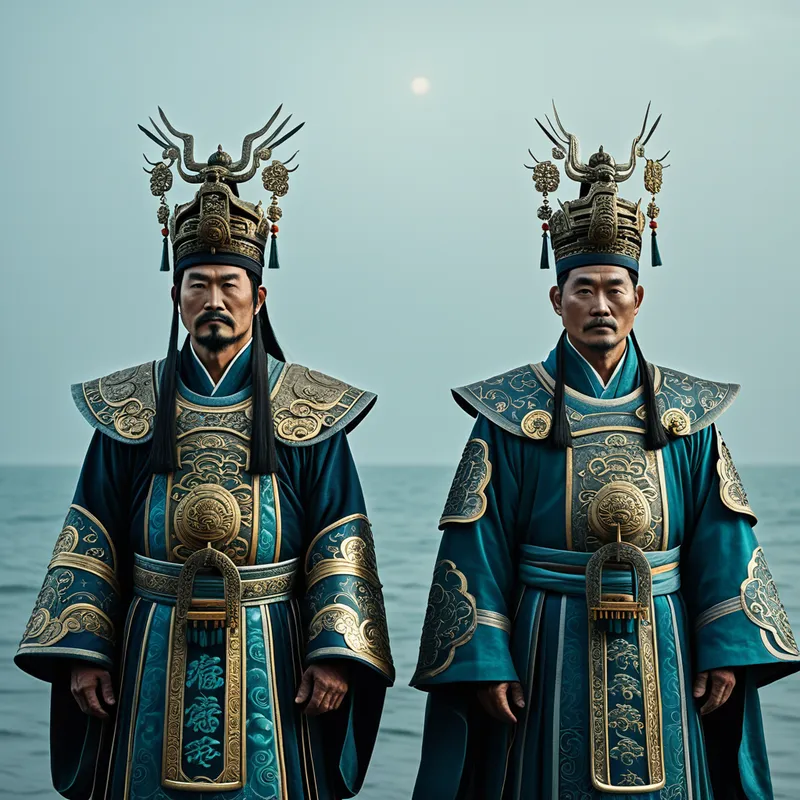
To the north and to the south, however, dwelt other sovereigns: the Emperor of the North Sea and the Emperor of the South Sea. They were beings of form, of perception, of culture. They visited Hundun often in his central realm, and he received them with a hospitality that was not an action but a state of welcoming presence. They were moved by him, but also perplexed. To them, his existence seemed a profound lack. "All men have seven apertures with which to see, hear, eat, and breathe," they said to one another. "This Hundun has none. It is a pity. He cannot experience the beauty of our world."
A resolve, born of compassion and a fundamental misunderstanding, grew within them. They decided to perform an act of charity, a surgical kindness. "Let us bore apertures for Hundun, one each day," they proposed. And so they returned to the land at the center, bearing not gifts of jade or silk, but tools of definition.
On the first day, with careful precision, they bored one aperture. Hundun, the primordial whole, did not cry out, for he had no mouth. He simply received the intervention. On the second day, another. And so it continued, day by day, as the sovereigns of form labored to give form to the formless. They carved eyes where there was only seamless perception, ears where there was only resonant unity, a mouth and nostrils where there was only the breath of the Tao itself.
On the seventh day, they bored the final aperture. The work was complete. Hundun now possessed the seven gates of human experience. And in that moment, the humming harmony within him shattered. The undifferentiated chaos, now given channels through which to escape, rushed out in a torrent of disjointed sensation and fragmented being. The perfect, contained egg cracked. And Hundun died.
The Emperors of the North and South stood in the sudden, silent stillness, their tools in hand, looking upon the lifeless form of the center. The hospitality of the whole had been extinguished by the kindness of the parts. Where there was once a sovereign of primordial unity, there was now only a memory, and the fragmented world we have inherited.
Cultural Origins & Context
The myth of Hundun is recorded in the Zhuangzi, specifically in the chapter titled "Ying Di Wang" (Responding to Emperors and Kings). It is not a state-sponsored myth of creation like the Pangu story, which emerged later. Instead, it is a philosophical parable, a story told by the Daoist sages to illustrate a core, paradoxical truth.
Its primary function was not to explain cosmogony but to critique a certain mode of consciousness. It was told in the context of the "Hundred Schools of Thought" period, where Confucianists, Legalists, and others were fervently proposing systems of governance, ritual, and social order (li). To the Daoist mind, these well-intentioned systems were akin to the boring of apertures—impositions of artificial form upon the natural, spontaneous, and perfectly self-so (ziran) order of the Tao. The myth served as a warning against the arrogance of conscious intervention, the tragic cost of forcing the unnamable into named categories, whether in governing a state or cultivating the self.
Symbolic Architecture
Hundun is the ultimate symbol of the primordial unity that precedes and underlies all duality. He is the unus mundus, the one world, the state of consciousness before the ego's birth. He represents the pleroma, the fullness where all opposites are contained in harmonious tension.
Hundun is not emptiness, but pregnant totality. It is the self before it is called "I."
The seven apertures symbolize the faculties of the differentiated ego-consciousness: perception, judgment, discrimination. They are the tools with which we navigate the world, but also the instruments of our exile from the garden of undifferentiated being. The Emperors of the North and South represent the conscious mind, the well-meaning but ultimately ignorant forces of culture, rationality, and order. They are the archetype of the "helpful ego," which believes wholeness is achieved by addition and definition, not by subtraction and surrender.
The death of Hundun is the central, devastating symbol. It is not a violent murder but a death by categorization. It represents the inevitable fragmentation that occurs when the sacred, unconscious wholeness is subjected to the analytical, dissecting gaze of consciousness. This is the original trauma of individuation—necessary, perhaps, but fundamentally a fall from grace. The myth suggests that our conscious, civilized world is built upon the corpse of a more fundamental, integrated reality.

The Dreamer's Resonance
When this myth stirs in the modern psyche, it often manifests in dreams of profound, sacred violation or unbearable wholeness. One might dream of a pristine, natural landscape—a silent forest or a untouched meadow—being surveyed by engineers with blueprints. Or of a cherished, simple object being taken apart by "experts" to be "improved," only to be rendered lifeless. The somatic sensation is often one of deep, wordless grief, a tightening in the chest, a feeling of something precious and intact being irreparably breached.
Psychologically, this dream pattern signals a process where the ego is attempting to force a nascent, unformed aspect of the Self into a pre-existing category. Perhaps the dreamer is analyzing a creative impulse to death, applying logic to an intuition, or trying to "fix" a state of melancholy or reverie that actually holds deep meaning. The dream is a warning from the unconscious: You are killing the thing you seek to understand. Cease your interventions. Allow it to be formless.
Alchemical Translation
The individuation process, as modeled by this myth, is not initially about adding structure, but about re-cognizing the original, structuredess structure of the Self—the Hundun within. The ego (the Emperors) must learn that its first task is not to act, but to witness; not to define, but to host.
The alchemical vessel is not for drilling holes, but for providing a space where the chaos can swirl without being named.
The modern struggle is to endure the tension of the unformed. In a life crisis, in the "dark night of the soul," we are returned to a Hundun-state. The old apertures of identity—job, relationship, status—seem to close. The ego panics and seeks to immediately bore new ones: a new passion, a new theory, a new label. The myth instructs us to stay in the formlessness. This is the nigredo, the blackening, where all distinctions dissolve. It is a sacred, if terrifying, return to the center.
The goal of psychic transmutation, then, is not to create a perfectly drilled and managed ego, but to allow the ego to become permeable to the Hundun-state. It is to develop a consciousness that can occasionally suspend its categorizing function and simply be the undifferentiated whole. This is the Daoist ideal of wu wei. We cannot resurrect the primordial Hundun—individuation is a one-way journey—but we can, through humility and non-interference, allow his essence, the memory of wholeness, to inform our fragmented existence. We live not in the center, but with a conscious nostalgia for it, which tempers our drilling and makes our hospitality to the unknown more profound.
Associated Symbols
Explore related symbols from the CaleaDream lexicon: