Huginn and Muninn Myth Meaning & Symbolism
Odin's two ravens, Thought and Memory, fly across the worlds each dawn, returning with whispers of all they have seen and heard.
The Tale of Huginn and Muninn
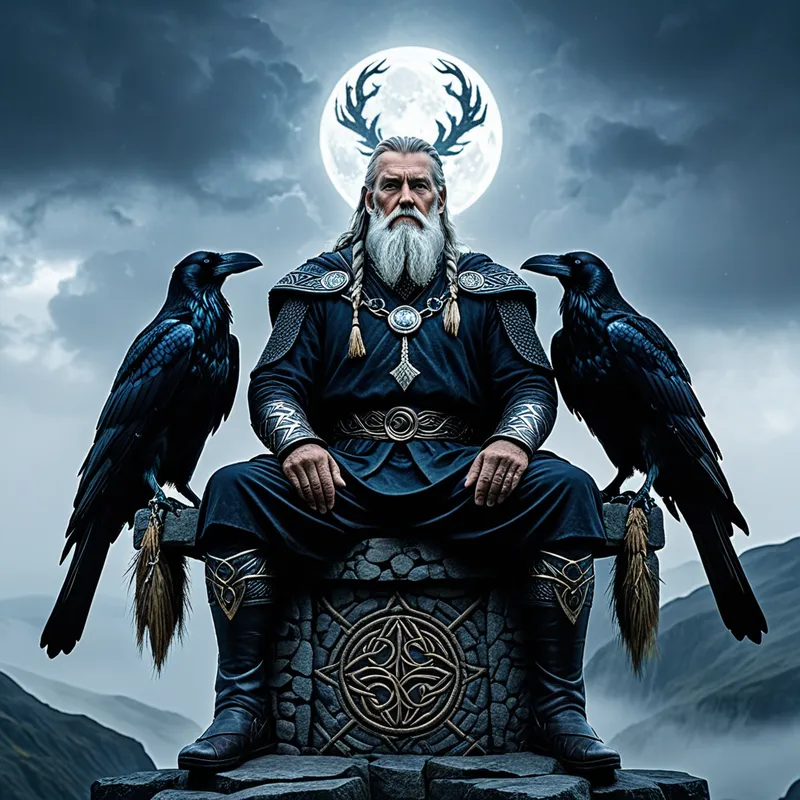
Before the sun’s first blade cuts the eastern sky, in the hall of Odin, a silence deeper than sleep holds sway. It is a silence of waiting, of a mind so vast it contains all the whispers of the worlds. Upon his throne, Hlidskjalf, the All-Father sits, his single eye a well of frozen starlight. His two wolves, Geri and Freki, lie motionless at his feet, dreaming of feasts. But upon his shoulders, restlessness stirs.
Two shapes, darker than the void between stars, shift their weight from foot to foot. They are Huginn and Muninn—Thought and Memory—his ravens. Their feathers are not merely black; they are the absorption of all light, all sound, all secret. They preen, their beaks sharp as broken promises. They feel the turning of the great Yggdrasil, the tremor in its roots from Jotunheim, the sigh from the golden leaves of Asgard, the distant clash of iron from the fields of Midgard.
Odin does not speak. He needs not to. With a thought as subtle as a spider placing its first thread, he grants them leave. A rustle, a whisper of air, and they are gone—two streaks of living shadow launched from the ramparts of Valhalla. They do not fly as ordinary birds. They unfold across the sky, becoming concepts given wings.
Down the great trunk of Yggdrasil they spiral, past the deer who nibble at its bark, past the coiled serpent Nidhogg in the murky depths of Hel. They break into the open air of Midgard. Here, Huginn—Thought—darts ahead, a lightning-quick probe. He flashes over a battlefield, absorbing the tactical fury, the desperate courage, the blinding fear. He skims a quiet homestead, catching the unspoken worry of a farmer, the secret love song a young man hums to his loom. He is the question, the spark, the branching path of "what if."
Muninn—Memory—follows a different flight path. He flies lower, slower. He settles on the gable of a longhouse, listening to an old woman tell a tale of the old gods, a story worn smooth by generations. He soaks in the scent of baking bread, the pattern of frost on a forgotten shield, the exact cadence of a lullaby a mother sings. He is the answer, the record, the deep soil where roots take hold.
All day they range, across all nine worlds. They witness treaties forged and broken in Alfheim, hear the clanging forges of the dvergar in their stone halls, and feel the primal, silent growth in the forests of Vanaheim. They are Odin’s senses, stretched across the cosmos.
As the long northern twilight bleeds into dusk, a pull, stronger than gravity, calls them home. Weary but saturated, they beat their way back up the axis of the world. Through the gathering dark they fly, each carrying a universe of fragments.
They find him still upon Hlidskjalf, a statue of patient hunger. Without ceremony, they alight, their claws gentle on the worn rings of his cloak. They lean in, their beaks close to the shell of his ear, and they begin to murmur. They do not speak in sentences, but in a cascade of images, sounds, emotions, and truths—a raw, unedited stream of being from every corner of creation. Odin listens. His eye closes. He receives it all—the glorious and the grim, the noble and the petty. This is his feast. This is how he staves off the coming twilight of the gods. Not with mead, but with meaning. And as the last whisper fades, he knows he will send them out again at dawn, for his thirst is eternal, and the world is ever-speaking.

Cultural Origins & Context
This vivid imagery of Odin’s ravens is preserved primarily in the Old Norse poetic tradition, most notably in the Eddic poem Grímnismál (The Sayings of Grímnir) and referenced in the Prose Edda. These texts are our windows into a worldview where the boundaries between the internal mind and the external world were fluid and permeable. The myth was not a children’s fable but a sophisticated metaphysical model recited by skalds (poets) and understood by a culture for whom wisdom was the ultimate currency and survival often depended on foresight.
In the harsh, dynamic landscape of the Viking Age, information was power. The ravens, as scouts and messengers, reflect a very practical reality: chieftains and explorers relied on outriders and intelligence. On a deeper level, they embody the Norse esteem for <abbr title="Often translated as 'fate' or 'destiny', but deeper as the inherent order and becoming of the universe'>ørlög—the woven fate of all things. To know more of the world was to better understand one’s place in its vast tapestry. Odin’s daily ritual symbolizes the ceaseless human (and divine) endeavor to comprehend the complex web of cause and effect, past and future, that constitutes reality. The myth functioned as a reminder that wisdom requires active, daily pursuit and the courage to confront whatever truths that pursuit may reveal.
Symbolic Architecture
Huginn and Muninn represent the fundamental binary of conscious awareness. They are not separate from Odin; they are extensions of his own being, psychic organs he deploys into the cosmos.
Thought (Huginn) is the active, discriminating faculty. It analyzes, plans, questions, and projects into the future. It is the spear Gungnir cast into the unknown, seeking a target. It is inherently risky, flying furthest and fastest, potentially getting lost in abstraction or anxiety.
Memory (Muninn) is the receptive, integrative faculty. It stores, patterns, grounds, and provides context. It is the well of Mímisbrunnr from which Odin drank, containing the past’s bitter and sweet waters. Its danger is stagnation, becoming a tomb of nostalgia or unresolved trauma.
The profound tension—and necessity—lies in their partnership. Thought without Memory is rootless and manic. Memory without Thought is inert and dead. Odin’s genius, and the myth’s core teaching, is his ability to send them both out and to call them back, to synthesize their reports into a wisdom that is greater than the sum of its parts. He is the still point at the center of the dualistic storm of cognition.
Furthermore, their daily return speaks to the cyclical nature of consciousness. Each day, the mind ventures out, engages with the world (the other eight realms), and must return to the Self (Odin on his throne) to integrate those experiences. Failure to return—where Thought or Memory goes astray and does not report back—represents a fragmentation of the psyche, a loss of self-awareness.

The Dreamer's Resonance
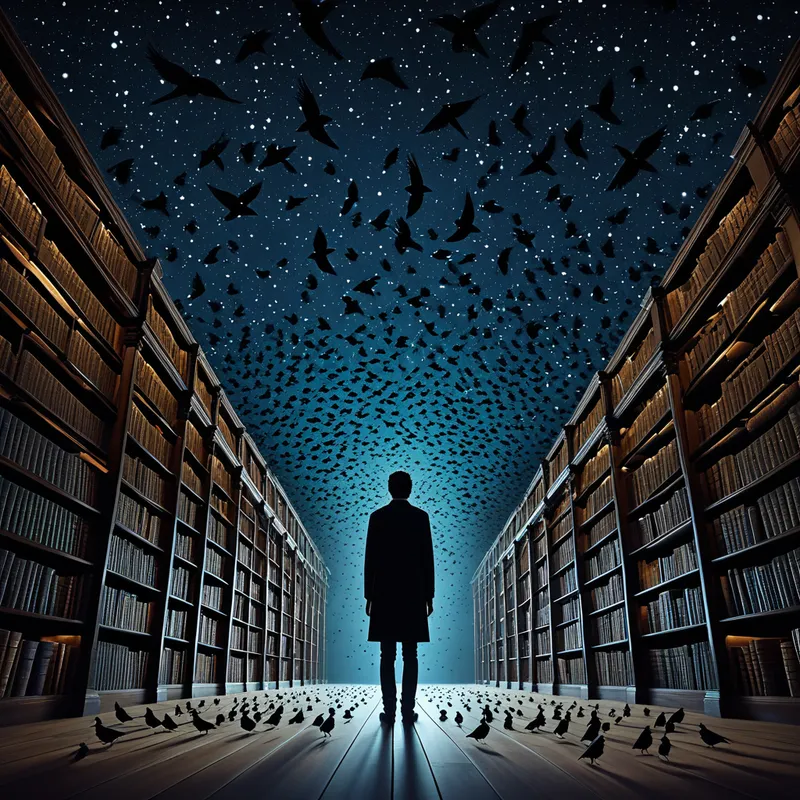
When this mythic pattern stirs in the modern dreamer, it often manifests as dreams of being observed by birds, particularly dark birds like crows or ravens, or of being such a bird in flight. One might dream of two identical birds, or a bird that splits in two. The somatic feeling is one of surveillance, but also of immense, panoramic perspective.
Psychologically, this signals a process of intense information gathering by the unconscious. The psyche is sending out its own "ravens" to scout territories the conscious ego has neglected or feared. Dreaming of a raven returning and whispering may indicate a crucial insight or forgotten memory pushing toward consciousness. If the ravens seem lost or do not return, it may reflect a feeling of being mentally scattered, unable to integrate experiences, or suffering from dissociation—a Self (the dreamer’s inner Odin) that has lost connection to its own faculties of Thought and Memory. The dream is an image of the psyche attempting to re-establish its central command and reconnaissance functions.
Alchemical Translation
The individuation process, the journey toward psychic wholeness, is mirrored perfectly in Odin’s daily ritual. We all have our Huginn and Muninn—our racing thoughts and our buried memories. The modern individual is often identified with only one, lost in frantic thinking (Huginn) or trapped in repetitive memory loops (Muninn). The alchemical work is to become the sovereign who can command both.
First, one must build the Hlidskjalf—the seat of inner observation. This is the cultivated practice of mindfulness or self-reflection, the "single eye" that can witness without immediate judgment. From this seat, we consciously send out our attention (Thought) to engage with the world and our inner world, and we deliberately engage our recollection (Memory) to understand our patterns and history.
The alchemical gold is forged in the return and the whispering. It is the moment of synthesis where raw experience (the ravens’ report) is metabolized into personal insight and wisdom. This is the sacred feast.
Odin’s fear, expressed in Grímnismál, that one day Huginn or Muninn might not return, is the shadow of this work: the risk of psychic disintegration. The individuated Self must therefore hold a sacred anxiety, a loving concern for its own faculties. It must create a "home" within—a Valhalla of the soul—compelling enough, secure enough, and receptive enough for all parts of the psyche to want to return and share their findings. In doing so, we no longer just have thoughts and memories; we relate to them. We become, like the All-Father, not a slave to our mind’s contents, but the wise ruler who listens, integrates, and uses that knowledge to navigate the impending dawns and twilights of our own existence.
Associated Symbols
Explore related symbols from the CaleaDream lexicon:
- Falcon Dive
- Hawk Vision
- Haunting Crow
- Sending Messages
- Orbiting Satellite
- Illuminated Satellite
- Sunset Tern
- Guardian Hawk
- Courageous Falcon
- Visionary Oracle Bird
- Alarming Parakeet
- Flock of Crows
- Sleek Kestrel
- Foreboding Corvid
- Witty Raven
- Squawking Partridge
- Feathered Friend
- Eagle's Wing Feathers
- Crows Taking Flight
- Eagle Vision
- Raven Messenger
- Sotdae Pole
- Satellite