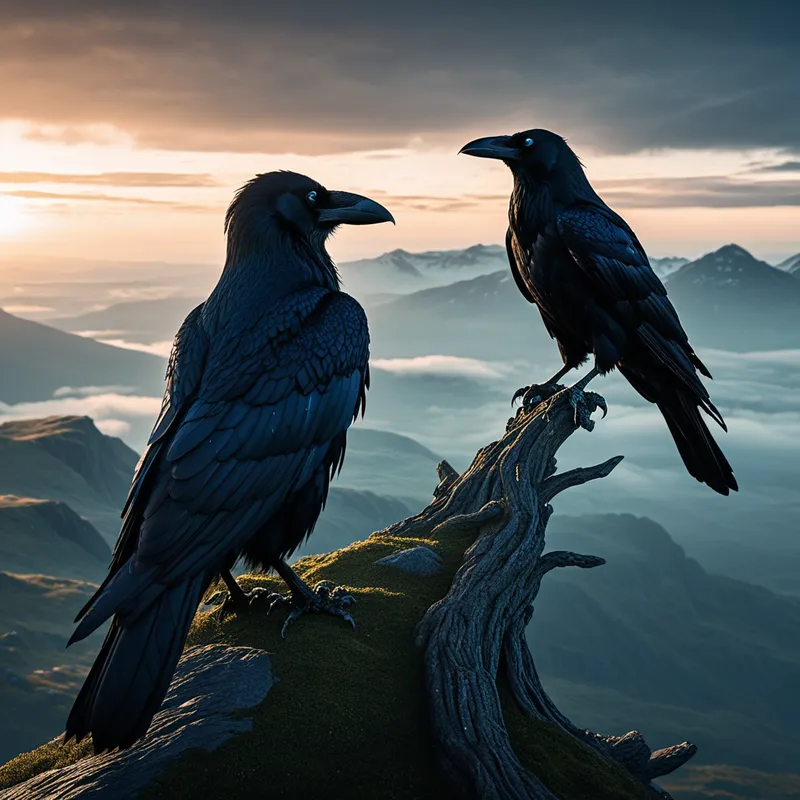
Hugin and Munin Myth Meaning & Symbolism
Two ravens, Thought and Memory, fly daily from Odin's shoulders to gather the world's knowledge, embodying the mind's ceaseless, hungry quest for awareness.
The Tale of Hugin and Munin
Before the sun’s first pale finger touches the peak of Yggdrasil, he is awake. In the hall of Valhalla, where the rafters are spears and the roof is shields, a single figure sits in silence. It is Odin, the Hooded One, the High One. His face is etched with the wisdom of ages, and in the socket where one eye should be, there is only a depth—a well into which he sacrificed sight for sight of a different kind.
Upon his broad shoulders, two shapes are perched, darker than the deepest shadow. They are Hugin and Munin, Thought and Memory. Not mere birds, but extensions of the god’s own vast mind. Their feathers are not simply black; they are the black of a starless night between worlds, the black of a raven’s eye that sees everything and gives nothing back.
As the first grey light bleeds into the sky, they stir. No command is spoken, but a silent tension thrums through the air. Hugin shifts, his claws tightening, a mind itching to unravel a mystery. Munin tilts his head, the keeper of all that has been, the silent witness. Then, with a rustle like a cloak of shadows falling, they are gone. Two streaks of darkness, parting the morning mist, flying out from the golden realm of Asgard.
Their wings beat a rhythm older than the gods themselves. Down the great trunk of Yggdrasil they spiral, past the four stags who nibble at its leaves, past the eagle who screams from the highest branch, past the serpent Nidhogg who gnaws at the roots in the dark. They fly over Vanaheim, where magic grows like moss on stone. They skim the frozen wastes of Jotunheim, where ancient giants plot in rumbling voices. They dive into the smoky forges of Svartalfheim, and drift over the green fields of Midgard, where men wake, love, fight, and die, unaware of the dark witnesses above.
They see it all. The secret whispered in a giant’s hall. The tear shed on a mortal deathbed. The new rune carved on a standing stone. The hidden path through a tangled forest. Hugin seeks the new—the spark, the idea, the unfolding event. Munin gathers the old—the consequence, the pattern, the echo of what was done. They are the silent surveyors of fate, drinking in the world’s breath.
All day they fly, until their wings grow heavy with the weight of the world. And as the sun bleeds out in the west, painting Bifrost in hues of fire and gold, they return. Through the high windows of Odin’s hall they sweep, to settle once more upon the shoulders of the waiting god. They lean in, close to his ears, and in voices only he can hear—a rustle of leaves, a crackle of embers—they tell him everything. They whisper all they have seen and heard. And the god, who gave an eye to drink from the well of Mimir, listens. He feeds on their reports. For in their flight is his sight. In their return is his power. And in the silent moment after their whispering ceases, a dread sometimes fills him. A fear voiced in the grim poetry of the Hávamál: “Hugin and Munin fly each day over the wide world. I fear for Hugin, that he may not return, yet I fear more for Munin.”
Cultural Origins & Context
This powerful image of the All-Father and his ravens is not the product of a single author, but a crystallized expression of a worldview. It is recorded primarily in the Poetic Edda, specifically in the Grímnismál, where Odin, disguised as Grímnir, reveals his many names and attributes. The myth also appears in the later Prose Edda of Snorri Sturluson.
In the Norse world, knowledge was not abstract; it was a form of power, a currency, and a weapon. Odin is the quintessential seeker of wisdom, a god who undergoes ordeals (hanging on Yggdrasil, sacrificing his eye) to obtain it. The ravens, then, are the perfect vehicles for this quest. Ravens were not seen as mere scavengers but as incredibly intelligent, observant birds, common on battlefields—places where fate was decided and stories ended. They were liminal creatures, connecting the living world with the aftermath of death.
The myth was likely told in halls by skalds (poets) and elders, serving multiple functions. It explained Odin’s omniscience, a necessary trait for the ruler of gods facing an inevitable, prophesied doom in Ragnarok. It also modeled an ideal: the active, relentless pursuit of awareness. In a harsh, unpredictable world, the one who gathered the most intelligence—who used both thought (Hugin) and memory (Munin)—had the best chance of survival and mastery.
Symbolic Architecture
At its core, the myth of Hugin and Munin is a profound map of consciousness itself. They are not two separate birds but two inseparable functions of a single perceiving mind.
Hugin, Thought, represents the active, outward-moving, discriminative faculty of the mind. It is analysis, curiosity, projection into the future, and the quest for new data. It is the question asked, the problem solved, the path not yet taken.
Munin, Memory, is the receptive, inward-gathering, integrative faculty. It is experience, pattern recognition, the wisdom of the past, and the substrate of identity. It is the lesson learned, the wound remembered, the story that shapes us.
Odin, the self who sits at the center, is the consciousness that employs these twin forces. His fear—that Hugin (Thought) might not return—is the anxiety of distraction, of a mind scattered to the winds, lost in endless possibility without grounding. His greater fear—for Munin (Memory)—is the ultimate psychological terror: the loss of self. Without memory, there is no continuity, no identity, no meaning derived from experience. We become a blank slate, adrift in a meaningless present.
The daily flight and return is the essential psychic process of integration. Raw perception (the flight over the worlds) must be brought back to the center (the self) and processed (whispered in the ear) to become true knowledge. The myth warns that consciousness is not a static possession but a dynamic, cyclical activity that must be continually performed, lest the self unravel.
The Dreamer's Resonance
When this myth stirs in the modern unconscious, it often manifests in dreams of being observed by dark birds, or of sending out a part of oneself that must return. To dream of a raven or crow perched nearby, watching silently, can signal that a deep, integrative process is underway. The psyche is in a state of gathering intelligence about itself.
Somatically, this might feel like a buzzing in the head, a pressure behind the eyes, or a sense of being “full” of unprocessed thoughts and impressions. Psychologically, the dreamer is often at a crossroads, faced with a decision that requires both careful analysis (Hugin) and consultation of past experience (Munin). The dream birds are emissaries of the Self, urging a broader, more panoramic view. A dream where the bird does not return, or is injured, may point to a fear of mental overload, dissociation, or a traumatic memory (Munin) that feels too dangerous to integrate.
Alchemical Translation
The alchemical work modeled here is the circulatio—the circular distillation of the mind. The modern individual, besieged by information (Hugin’s endless flight) and burdened by personal and collective history (Munin’s heavy weight), must learn to become their own Odin.
The first step is to create the inner Hlidskjalf—the high seat of reflection. This is a disciplined practice of stepping back from identification with every passing thought and memory. It is the cultivation of the observing self.
The second step is to consciously send out and recall these faculties. We send Hugin out when we study, explore, and question. We send Munin out when we reflect, journal, and consciously revisit our past. The critical alchemical act is the return and the whispering: the dedicated synthesis of what has been gathered. This is meditation, therapy, creative expression, or deep conversation—the process where raw data is transformed into personal wisdom.
The ultimate goal is not to avoid Odin’s fear, but to understand it. The individuated Self does not possess Thought and Memory; it is in a constant, living relationship with them. The fear for their return is the sacred anxiety that keeps the process alive, that prevents consciousness from stagnating. In embracing this cyclical hunger—the daily flight, the fearful wait, the grateful integration—we perform the myth. We no longer just have a mind; we tend the sacred ravens of our own awareness, feeding them on the world and, in turn, being nourished by their dark, wise whispers.
Associated Symbols
Explore related symbols from the CaleaDream lexicon: