Hraf-haf Myth Meaning & Symbolism
The deceased must answer the surly ferryman Hraf-haf to cross the lake of fire, a test of composure and respect on the journey to the afterlife.
The Tale of Hraf-haf
The silence here is not empty. It is a presence, a weight of millennia pressing upon the soul. You have traversed the Duat, passed gates guarded by demons whose names are curses, proven your heart lighter than the Feather of Ma'at. You believe the great ordeal is over.
You are wrong.
Before you lies a expanse that steals the breath—a lake, but not of water. Its surface glimmers with a cold, blue-silver radiance, like liquid moonlight set aflame. This is the Lake of Fire, and its waves whisper with the echoes of forgotten prayers. On the far shore, a light pulses, soft and golden: the Field of Reeds. Peace. Rest. Eternity.
But between you and that peace is the ferryman.
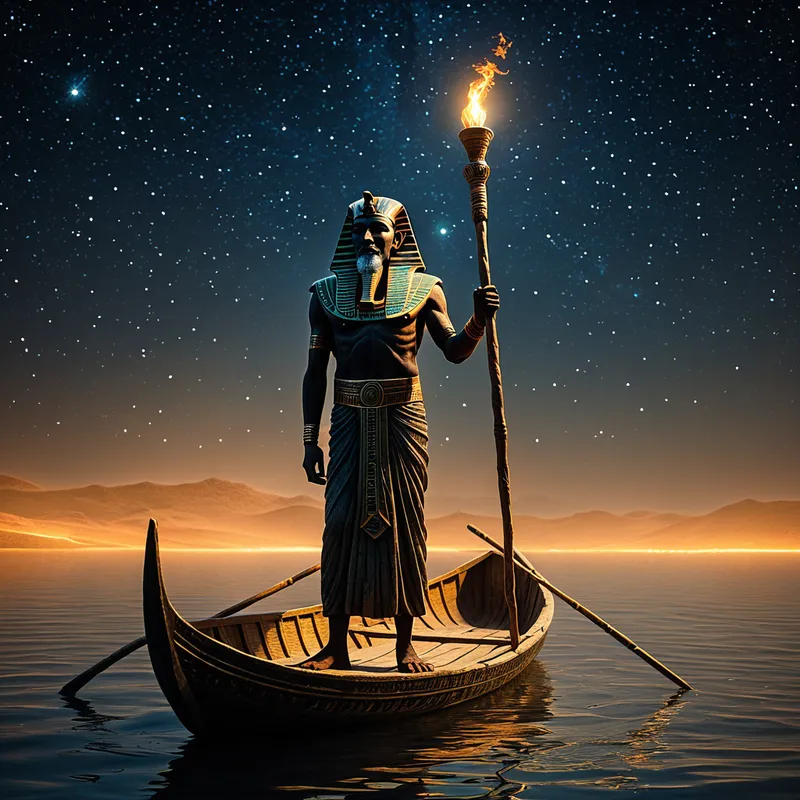
His skiff is of ancient, blackened papyrus, tied with reeds that seem to have grown from the lake itself. He stands at the stern, not rowing, merely waiting. He is Hraf-haf. His body is powerful, shoulders broad from an eternity of poling through celestial currents. His face is not cruel, but it is carved from the bedrock of indifference. His eyes hold the patience of the desert and the sharpness of a flint knife. He does not speak. He only watches.
Your instructions, whispered by the gods of the dead, ring in your memory. You must call to him. You must ask for passage. And you must do so with perfect, unwavering respect.
You gather the remnants of your courage, your ba-spirit trembling. "Ho! Ferryman!" you call, your voice a ghost of sound over the luminous waves. "Bring me this skiff!"
Hraf-haf does not move. The silence stretches, colder than the lake's fire. Then, he turns his head, just slightly. His voice, when it comes, is like stone grinding on stone. "For whom do you bring this skiff?"
You remember the formula. "It is for the transfigured one who is with you."
A flicker in his stony gaze. It is not enough. "What have you brought for me?" he demands, his tone laced with a boredom that is more terrifying than rage. This is the test. Not a test of strength, but of composure. Of knowing your place in the order of things. You are a supplicant. He holds the key.
You offer the words prescribed, the bread and beer of politeness, the acknowledgement of his toil. "I have brought you a measure of bread from the Eye of Ra, and a jar of beer from the Ished-Tree."
He considers this. The fiery lake laps at his boat. The moment hangs, eternal. Then, with a motion so slight it is almost imperceptible, he nudges the skiff toward the shore. "Welcome, transfigured one," he says, and the words are not warm, but they are correct. They are the words of passage. You step onto the unstable papyrus, feeling the strange, cool heat of the lake beneath you. Hraf-haf poles away from the shore, his back to you, his gaze fixed on the golden fields ahead. He does not speak again. The only sound is the gentle splash of the pole in the fiery water, carrying you from the ordeal of judgment to the peace of eternity.
Cultural Origins & Context
The encounter with Hraf-haf is not a standalone myth but a critical, nerve-wracking episode embedded within the sprawling textual and spiritual landscape of the Book of the Dead (known to the Egyptians as the Book of Coming Forth by Day). These texts, inscribed on papyrus and placed in tombs from the New Kingdom onward, were a practical guidebook for the deceased. They were not mere literature but operational manuals for navigating the perils of the Duat.
The spell to pacify Hraf-haf (often Spell 99 or its variants) was a vital piece of this equipment. It provided the exact words, the "correct speech," needed to pass this final, mundane-yet-critical hurdle. This reflects a core Egyptian principle: the afterlife was a bureaucratic as well as a spiritual journey. Knowing the names of gods, the passwords at the gates, and the proper etiquette for divine functionaries like Hraf-haf was essential for a successful transition. The myth was passed down through scribal and priestly traditions, its recitation a form of magical insurance for the soul, ensuring no surly boatman could bar the way to paradise due to a lapse in manners.
Symbolic Architecture
Hraf-haf is not a villain, but a threshold guardian of the most potent kind. He represents the final, practical obstacle before attainment. After the soul has faced cosmic judgments and monstrous demons, it meets a figure embodying petty authority, boredom, and the demand for social niceties. He is the ultimate test of integrity after the climax.
The greatest trials are often not the dramatic battles, but the mundane negotiations that come after, when the soul is weary and believes itself entitled to rest.
Psychologically, Hraf-haf symbolizes the internalized critical authority—the inner critic, the societal super-ego, the voice that says, "Yes, but are you sure you deserve this?" He is the gatekeeper of our own self-worth. His name, "He Who Looks Behind Him," suggests a figure concerned with the past, with what one brings, with the account of one's life. The Lake of Fire he crosses is not merely punishment but a final purification, a burning away of the last dross of the ego that might believe the journey is complete. The correct speech is not groveling, but the calm, centered assertion of one who has been tested and knows their own truth. It is the humility of the sage, not the fear of the slave.
The Dreamer's Resonance
When this mythic pattern stirs in the modern unconscious, it rarely appears as an Egyptian ferryman. The dreamer may find themselves before a stern bureaucrat at a final desk, a dismissive gatekeeper at an exclusive club, or a tired parent figure withholding approval. The setting is always a liminal space—an empty airport at dawn, a deserted dock, a waiting room.
The somatic feeling is one of frustrated anticipation. The heart of the ordeal has passed (a major project, a relationship ending, a health crisis), and a longed-for resolution seems inches away. Yet a trivial, maddening obstacle remains. The dreamer feels a rising, impotent anger ("After all I've been through, this?") mixed with anxiety that this petty figure holds ultimate power. This dream signals the psyche working through the final stage of a major life transition: integrating the experience and claiming the earned peace without arrogance or residual guilt. It is the ego's last stand before surrendering to a new, more authentic state of being.

Alchemical Translation
The alchemical journey of individuation is not complete with the Magnum Opus itself, but with its integration into the world and the self. Hraf-haf models this final, crucial phase of psychic transmutation.
The hero has secured the golden treasure (self-knowledge), but must now pay the ferryman to return home. This "payment" is the abandonment of spiritual pride. The triumphant ego, inflated by its victory over the shadow, must now offer "bread and beer"—the simple, nourishing substances of humility and respect for the structures of reality. To answer Hraf-haf correctly is to perform the alchemical Fixatio: stabilizing the newfound gold of the Self in the vessel of daily life.
The final secret is that the ferryman and the traveler are aspects of the same psyche. To pay him respect is to honor the part of oneself that maintains order, that asks for accountability, that ensures the treasure is not squandered.
For the modern individual, this translates to the phase after a breakthrough. You have had the insight, survived the crisis, earned the promotion. Now comes the unglamorous work of living it—dealing with the paperwork, managing the new responsibilities, accepting the quiet daily routine that follows the epiphany, without resentment. You must politely, firmly, answer your own inner Hraf-haf, who questions whether you are truly ready for the peace you have earned. In doing so, you pole yourself across the last fiery barrier of doubt, arriving not as a conquering hero, but as a composed and worthy inhabitant of your own hard-won Field of Reeds.
Associated Symbols
Explore related symbols from the CaleaDream lexicon: